

Each Hawai’ian island has its own vibe. The Big Island, Hawai’i, is my favorite. It is the biggest and ecologically most diverse, with 11 of the planet’s 13 climate zones represented on the island. (Yes, you can even ski on Mauna Kea.) Also thanks to its size, it is the one island that doesn’t feel totally overrun by tourists, even during high season.
The Kona Country Club, located six miles from downtown Kona in Keauhou, harkens back to an even less touristy time. The 6,657-yard course was designed by William Bell in 1966, at a time when prime ocean-front land was still abundant. Thankfully, despite rampant development, this Big Island gem retains its charm and ocean vistas today.

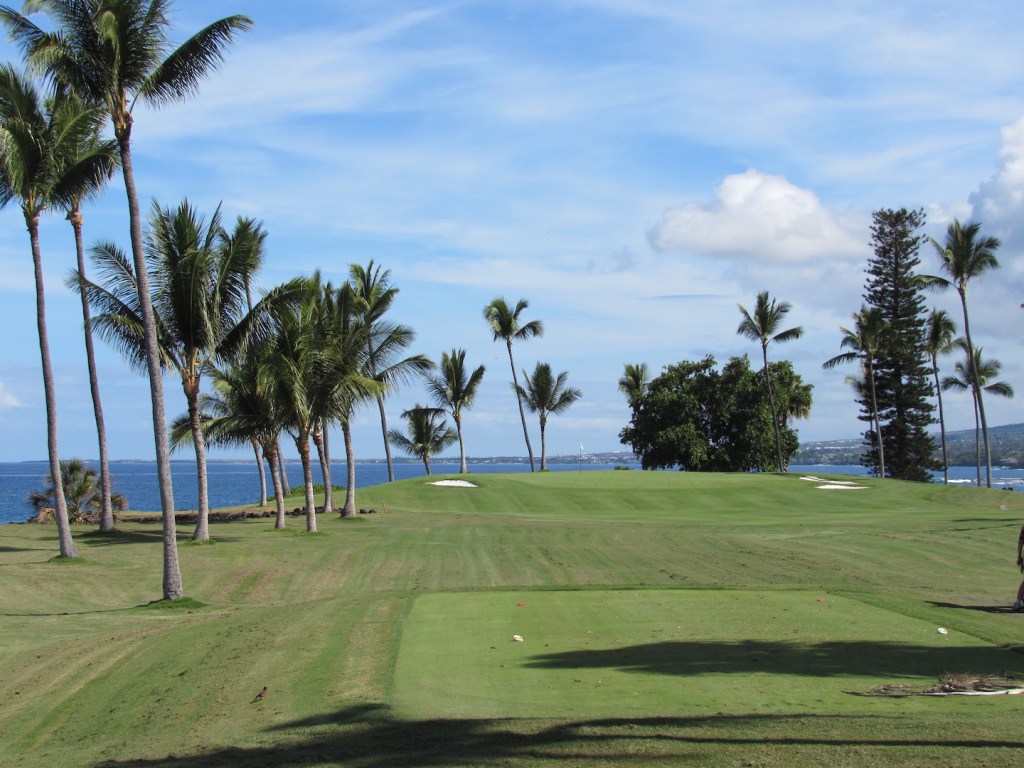
Several holes of the Kona Country Club run directly along the ocean, which proshop staff refer to as “the biggest water hazard in the world,” and just about every hole offers some view of the crystalline blue Hawai’ian waters. Lava outcroppings line the shore and run through sections of the course, forming blowholes (“puka”) when the waves are high. From November through March, players are also likely to spot humpback whales breaching just offshore. Onshore, there are views of Mt. Hualālai, as well as the most curiously shaped palm tree you’re likely to find anywhere.

Sure, you expect natural beauty in Hawai’i. But is it a good course? The LPGA played a tournament here for a couple of years, so the layout is championship quality. Impressively, it is also an excellent resort course, which is convenient, since it is surrounded by condos and resorts, including the Kona Coast Resort, which boarders the course (whose guests receive a $24 discount on green fees). It is the type of layout that allows first-timers to enjoy the round and play well even without any local knowledge.
Playing the Kona Country Club
When William Bell laid out the course in 1966, there was little development between it and the ocean. Amazingly, despite rampant building all around, nearly every hole boasts at least a glimpse of the sea. Straight out from the first tee, players gaze down on Keauhou Bay and marina, where dozens of snorkeling and sightseeing tours set sail throughout the day.

Four sets of tees allow players of all skill levels to not only enjoy the memorable views, but also the superb golf. For many, the 6,263-yard blue tees will feel comfortable. The downhill 1st hole is a nice, gentle opener that doesn’t require driver. A solid hybrid or fairway metal will trundle down into a large gathering area where the fairway turns 90-degrees to the left, back up toward the green.
The collection of par 3s is outstanding, but choosing the correct set of tees for your round will make all the difference. On the front 9, both par 3s are over 200 yards from the tips but drop down to about 140 yards from the forward tees. The one-shotters on the back are shorter, with the 17 maxing out at just 149 from the championship tees. The first of these great short holes is the 3rd, which plays 195 from the blues with the ocean all along the right-hand side.


The fairways are quite generous, but several holes are lined by houses built very close to the edge of the course. Worse yet, many have terrifyingly large windows, raising the stress level on the tees. Rather incredibly, though, lucky bounces do occur – on the par-4 8th, one of the worst drives I hit all day caromed off a roof and back into the fairway. (Whew!)
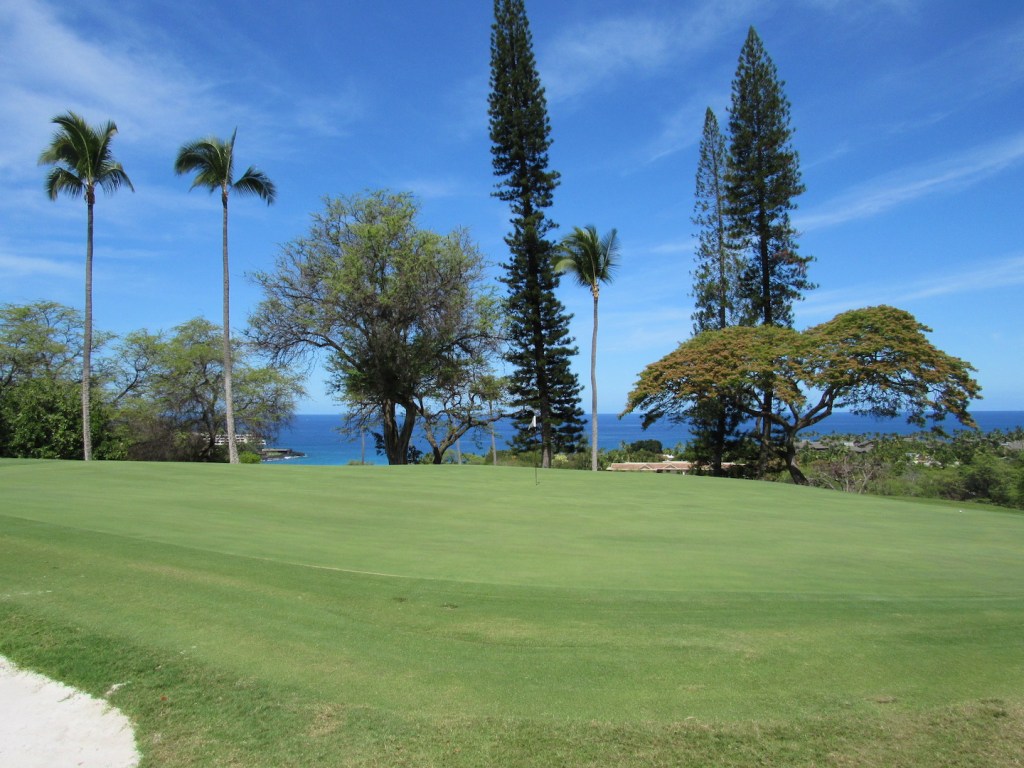
The real Big Island magic starts on the 405-yard par-4 9th, which plays uphill to a green situated at one of the highest points on the property. Even if you’re putting out for a double-bogey, take a moment and soak in the endless expanse of the Pacific.


The stretch from 12 to 15 presents one postcard-worthy shot after another. The 12th is a mid-length par-3 with lava rocks and the ocean tight on the left. The 13th is a longish par-4 where, if the surf is up, you might get sprayed by one of the aforementioned blowholes. Between the 13th green and 14th tee you’ll find the famed “corkscrew palm,” which looks like some child’s crazy drawing came to life.


The single weak hole on the course is the steeply uphill, left-to-right par-4 16th, where the only job is to hit the ball straight off the tee, as houses are definitely in play in the elbow of the dogleg (be wary of trying to cut the corner). “Everybody hates this hole,” said the regular I played with. After struggling to make a rather miraculous bogey putt, I understood why.
The short par-3 17th is nevertheless somewhat intimidating as your tee shot has to carry an ancient lava flow and a deep ravine to find the steeply canted green. And finally, the uphill par-5 18th taunts you with a row of condos on the left just FULL of big windows. Avoid having to file an insurance claim, though, and you’re treated to one last lovely view from a severely back-to-front tilted green that can ruin your round if you end up above the hole.
The Kona Country Club: The verdict
The Kona Country Club is a Golden Age classic that, despite surrounding development, has maintained its hang-loose vibe and dozens of memorable ocean vistas. The visitor rack rate of $189 is perhaps a bit steep, but guests at surrounding resorts are discounted to $165, and the “twilight” rate of $125 begins after 1pm, which is both pretty early for a twilight rate and pretty reasonable for authentic Hawai’ian golf. Quality rental clubs are available.
After your round, enjoy a cold beverage at The View Restaurant in the clubhouse. It’s not just a clever name – the view is fantastic. Just as impressively, the prices for the excellent sandwiches and full entrees are some of the best you’ll find in the Keauhou area. Seriously, the restaurant is as much of a gem as the beautifully maintained course.
The Big Island is the final Hawai’ian frontier. It’s still possible to find spots that feel “local” and “real.” The Kona Country Club is definitely one of them.
Sightseeing Tip
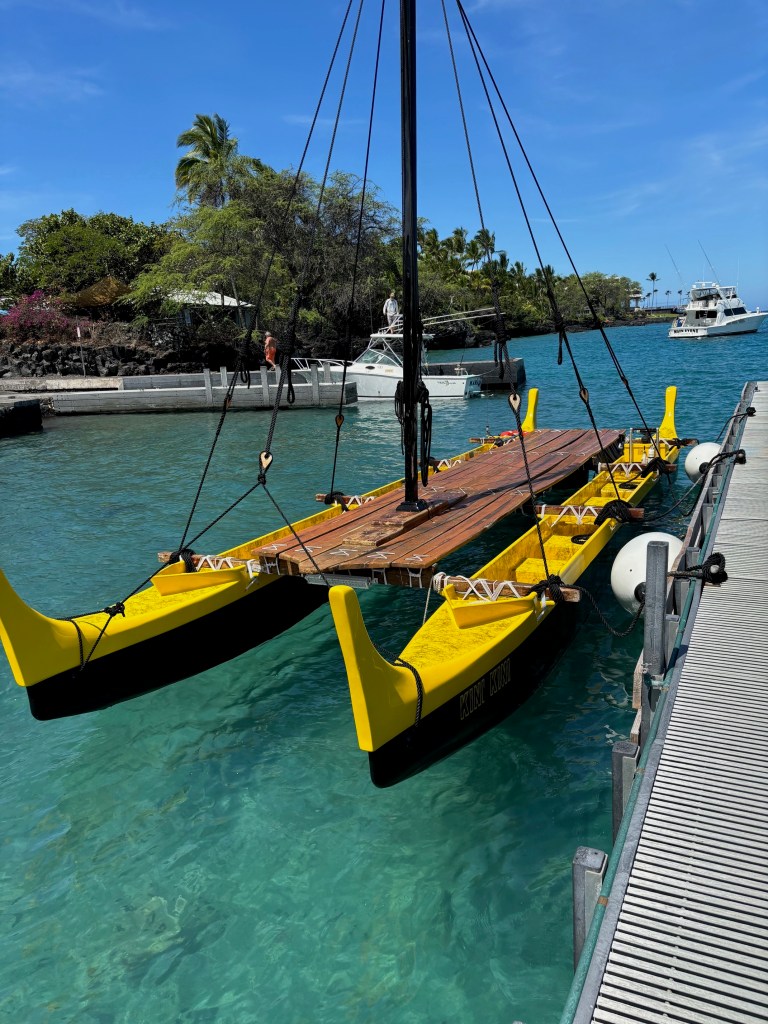
There’s lots of unforgettable adventures on the Big Island, from helicopter flights over active volcanoes to whale-watching to cliff-diving off the southernmost tip of the United States, but according to many locals, the coolest is taking a night snorkel with manta rays. These prehistoric behemoths are up to 23 feet across their wingspans, weighing up to 6,600 lbs. Night snorkels put you in the water with them, and as they scoop up the plankton drawn by the lighted board that divers hang onto, they come within inches of you – like graceful, slightly terrifying aquatic archangels. The tour I’d recommend is run by Eka Canoe, which donates a portion of their profits to teach local Hawai’ian kids sailing and ocean stewardship.
It’s an amazing rush!
 Midwestern Golf