
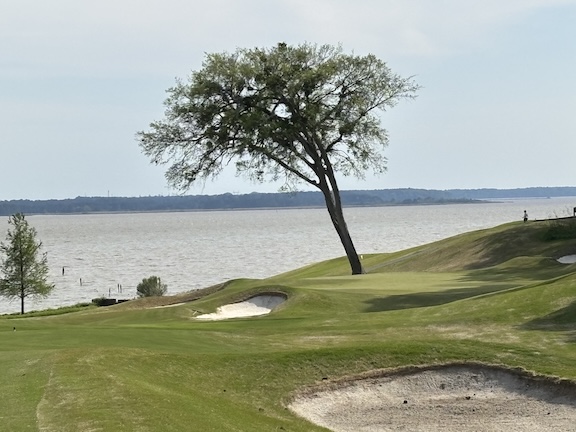
The final two holes on The River Course at Kingsmill Resort, outside of Williamsburg, Virgina, feature several historical markers. One of these describes how the first English settlers in North America landed near the escarpment above the wide James River that is now the elevated tee box of the par-3 17th hole. Those settlers moved upriver a bit further, to Jamestown, where ships could anchor closer to shore. There, those settlers faced starvation, disease, and conflicts with the Native Americans, and by 1610, 80%-90% of the settlers had died. Evidence suggests that some had to resort to cannibalism to survive.

Personally, I would have stayed on the 17th green overlooking the water, but that’s just me.
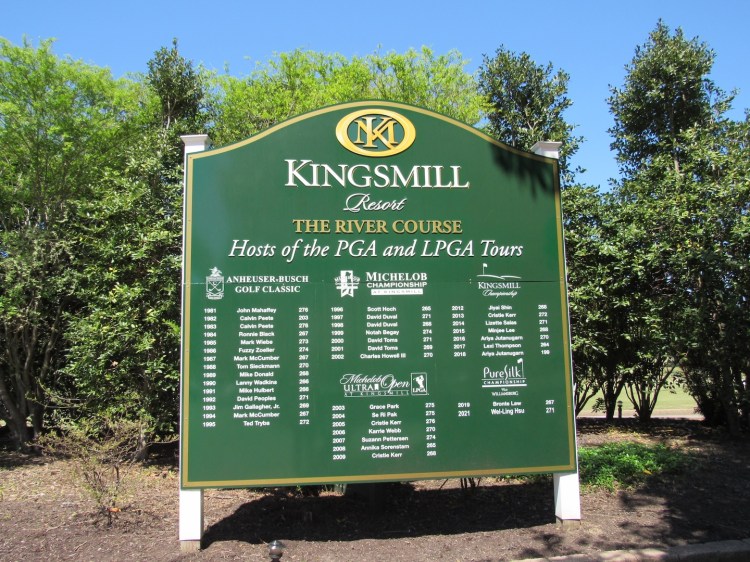
Another historical record greets you as you walk towards the front of the clubhouse – a large sign listing all the names of the winners of the multiple professional tour tournaments competed on the Kingsmill River Course over the decades: Anheuser-Busch Golf Classic, Michelob Championship at Kingsmill, Michelob Ultra Open at Kingsmill , Kingsmill Championship, and PureSilk Championship of Williamsburg. One of these tournaments ran close to annually from 1961 to 2021. When asked why the tours stopped coming to Kingsmill, one of the staff said, “They hit the ball too far these days. There’s no room to expand the course.”
Happily, 99% of recreational golfers do not hit the ball as far as Tour players. And those that might occasionally come close don’t hit it nearly as straight. So for recreational golfers looking to play some historic courses on some historic property, the 1975 Pete Dye-designed River Course and the 1986 Arnold Palmer-designed Plantation Course provide plenty of challenge and fun.
Kingsmill Resort
Kingsmill Resort is a sprawling, mixed-use property located on the outskirts of historic Williamsburg, just outside the front gates of the Busch Gardens amusement park. There are part-time and full-time residents (and members), there are timeshare condos, there are resort units. There are also myriad indoor and outdoor recreational facilities, a marina, and restaurants and bars. The sunset views from the patio of the marina restaurant really should not be missed.
Because of the sheer size of the Kingsmill Resort, guests really benefit from having a car on property. Although some of the rooms and facilities could use a bit of updating, the overall vibe is one of old-money, Mid-Atlantic rustic comfort. The two golf courses add considerably to this vibe, and they clearly serve as the crown jewels of the resort.
The Golf Courses
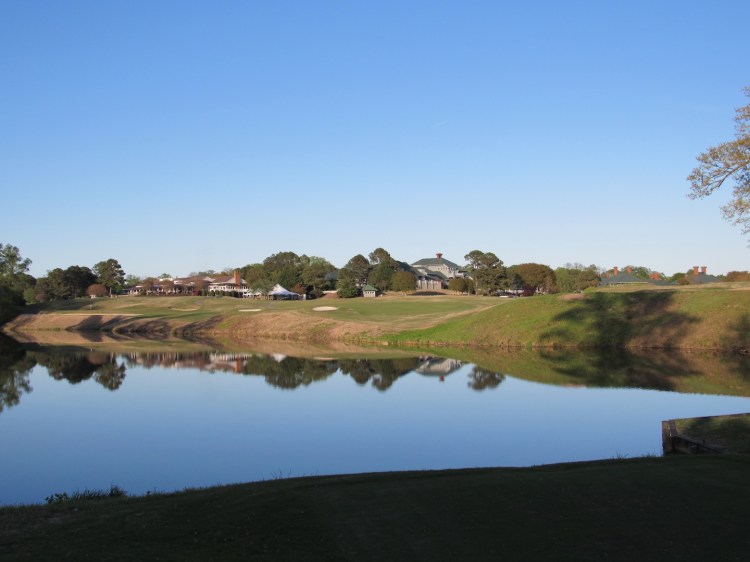
In the well-staffed, well-stocked proshop, there was a vigorous debate amongst the staff when I asked which course, River or Plantation, is the hardest. A slight majority appeared to vote for the River Course – a 1975 Pete Dye layout that stretches to 6,831 yards from the back tees. This view was mostly due to its length and, perhaps, to a sort of recency bias related to the two courses’ respective 18th holes. The River Course ends with a bang: a 450-yard par-4 cape hole that requires an intimidating carry over a lake from all but the forward tees. The Plantation Course ends with a thud: a 333-yard, possibly drivable par 4 with no real trouble in any direction.
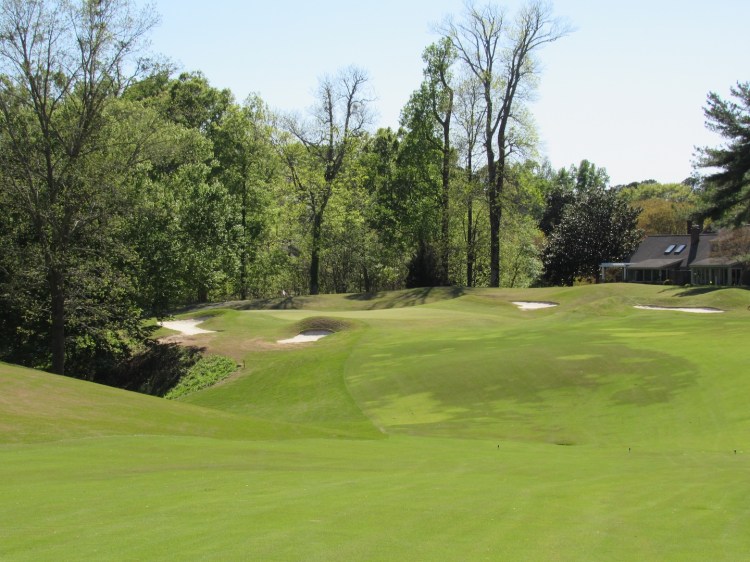
On the other hand, those voting for the Plantation as the more difficult 18 pointed to the narrower fairways, some requirement to play “target-golf” on certain holes, multiple blind hazards (and no GPS on the carts), a few long carries off the tee, and greens that often cantilevered – sloped downward from the middle of the putting surface toward both front and back. To be honest, I do think these devilish greens made the overall experience on the Plantation for first-time players more vexing. Both courses had their own charms and demons, however.
The River Course
In 1975, Pete Dye was coming into his own as a golf course architect. He was entering the stage of his career – and an age of golf – when course difficulty was considered a paramount virtue (from the tips, Course Rating: 73.2; Course Slope: 136). The rolling topography along the James River lent itself perfectly into Dye’s penchant for visual deception: when players can’t see the ground between themselves and their targets because of swales or valleys, yardages are much harder to estimate. And in the 1970s, laser rangefinders weren’t a thing yet. Today, even with modern yardage-measuring devices, recreational golfers have trouble overcoming doubts – many carries over hazards and up to predominantly elevated greens look much longer (and occasionally even shorter) than the laser says. (Buy a Player’s Book in the proshop – very useful!)
The rollercoaster topography – featured on both courses – lends itself to plenty of blind or semi-blind shots, especially off the tee. Then, on approaches to the River Course greens, you notice that nearly every one has a certain table-top quality, with sharp and penal drop-offs to one, two, or all sides. Players who miss greens here will have their short games tested. Then, once on the putting surfaces, the grainy Bermuda turf will make both speed and line difficult to judge. I think I three-putted more on the front 9 of my first round on the River Course than I had in a half-dozen previous rounds.
There are several memorable holes on the River Course, led by the aforementioned 18th – really a stunning closer that makes you pick a line and hit it to stay dry. Even a bomb can get you in trouble, though, as the fairway is not overly wide, and the right rough is no picnic to play from.
On the front side, the par-3 5th, which can play 70+ yards longer or shorter, depending on tees and pin position, is a real beauty. Here club choice is key if you’re going to hit the deep, narrow green and avoid the bunker and wetlands right and steep bank on the left.

The pretty 525-yard, par-5 7th is another gem. Here, like on the rest of the layout, the second shot is key. Driving the ball is not really the issue for the most part on the River Course, as long as you keep it relatively straight. But the second shots and/or approaches? Whoa. Here, the green is offset to the left of the end of the fairway. There is a dramatic drop-off to the left of the green into brush and wetlands.
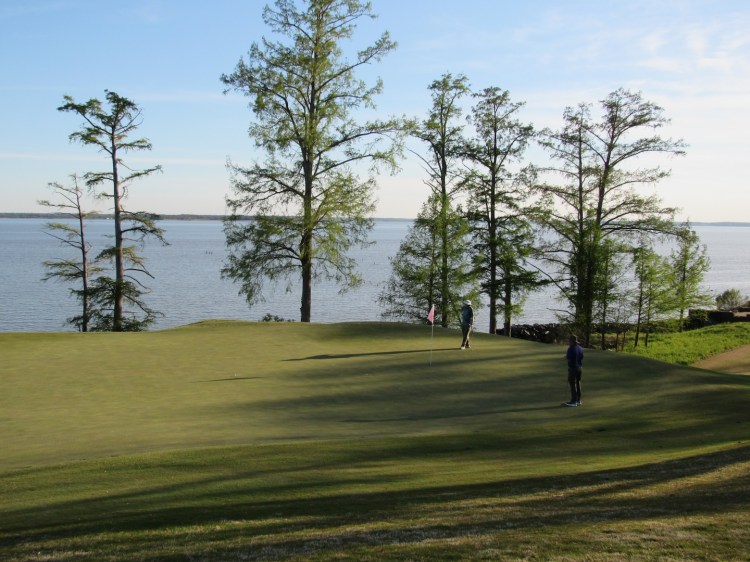
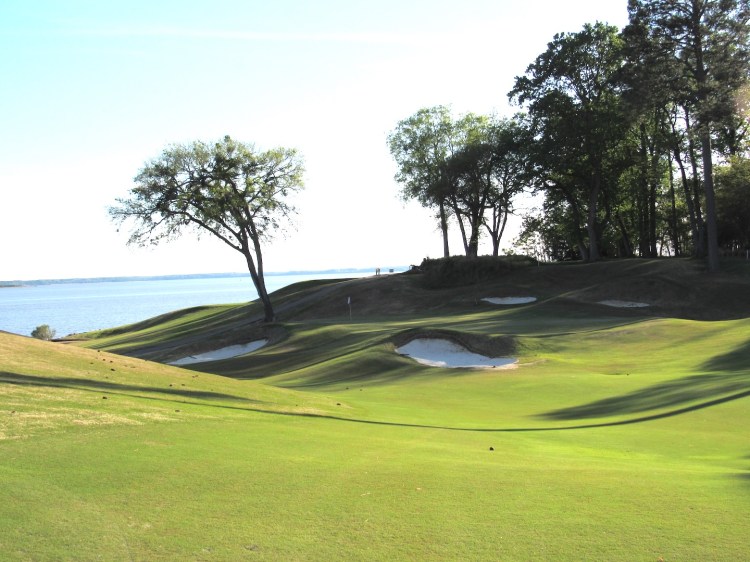
The closing three holes are really the stars of the River Course, though, as they play down to and along the James River. The fairway of the 458-yard 16th has OB both left and right, if you get a little wild. Then the hole turns right and snakes down toward a smallish peninsular green backdropped by the river. If the wind is coming off the water, as it usually is, club choice and angles are everything. The 177-yard, par-3 17th has an elevated tee box and equally elevated green, separated by a 30-foot valley. I don’t know if it was the wind or the weight of history (there are numerous historical markers near the tee box and green), but just about every tee shot I saw (and hit myself) came up a bit short. The unlucky ones rolled down to the bottom of the valley.
The Plantation Course
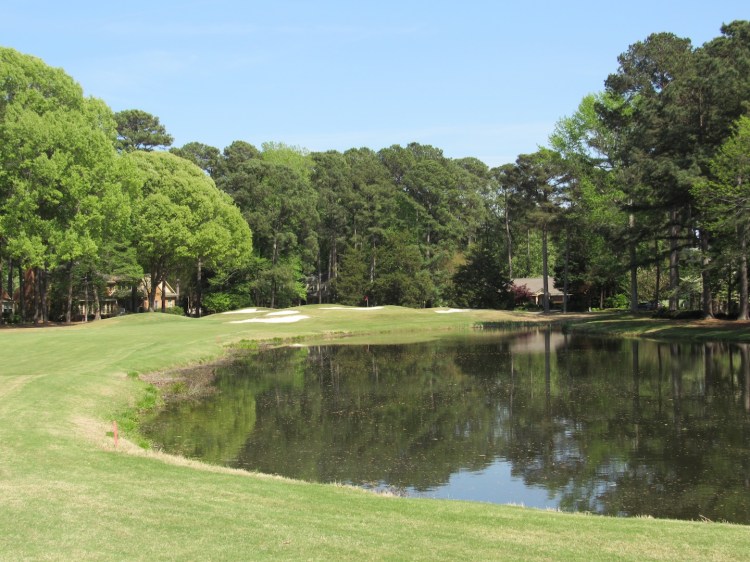
At just 6,437 from the back tees (Rating: 71.4, Slope: 132), the Arnold Palmer design with the historically problematical name should play easier on paper…but as noted above, might not on grass. Of special note is the back 9, which kicks off with a string of three 400+ yard par 4s. Numerous holes – notably 1, 10, 12, and 13 – have blind water hazards off the tees. Finally, as previously mentioned, the cantilevered greens require precise distance control or else balls will roll off the backs of the greens (or come back off the fronts) into areas that are very hard to get up and down from. As some of the proshop staff warned, the Plantation Course is more about position and avoiding hazards than power.
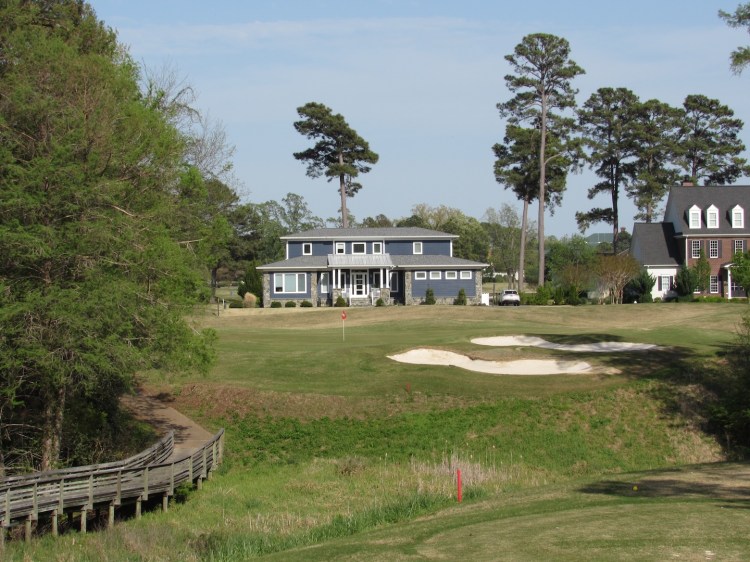
Perhaps because the junior layout was sort of shoe-horned into land surrounding its big sister, there are fewer visually arresting holes, though many of the same characteristics are shared between the two courses: elevated tees and/or greens, lots of swales and valleys, stands of hardwood trees, deep bunkers, and plenty of water. From the start, players are faced with what might be intimidating carries off the tee on the 365-yard 1st and 519-yard 2nd holes. Then, on the 177-yard, par-3 17th – arguably the most memorable hole – there’s a long carry over a ravine that is called, I believe, Snake Valley because of, well, snakes. There should really be a drop zone on the other side (it was unclear that there was, so a sign on the tee would be useful) – at least to keep players away from the snakes.
The only sour experience on the Plantation Course was the customer service (which, to be honest, was occasionally spotty throughout the resort). One of my group actually carded a hole-in-one on the 14th. When that foursome finished and wanted to wait for my foursome to come in, they called the bar and asked if someone could drive beers out to the 18th to celebrate (neither the 9th nor the 18th of the Plantation is located near the clubhouse). They were refused. Later, one staff member drove a non-golfing member of our group out with beers, but apparently just delivering beers alone was too much to ask at the former home of multiple Anheuser-Busch-sponsored tournaments.
The Verdict on Kingsmill Resort
When I think of Mid-Atlantic golf, I basically think of Kingsmill Resort as the template: great golf, beautiful scenery, excellent food, homey accommodations. Could the Jamestown settlers of 1607 have even imagined how idyllic this land would become in 400 years? Our only real privation was that the drink cart stopped service at 1:30pm all three days we played (so, right at our tee times), and there was no other water anywhere on courses (drinking fountains were shut off). Although this lack of service on the very warm days we played actually was somewhat dangerous (a few of our members were pretty dehydrated the first day), we were thankfully not forced to resort to cannibalism to survive.
Altogether then, Kingsmill Resort remains one of the Mid-Atlantic’s premier golf vacation destinations. It is always a treat to play the same courses as the pros played, and the added benefit of treading the same soil as some of the founders of this great nation is definitely an added bonus.
 Midwestern Golf