
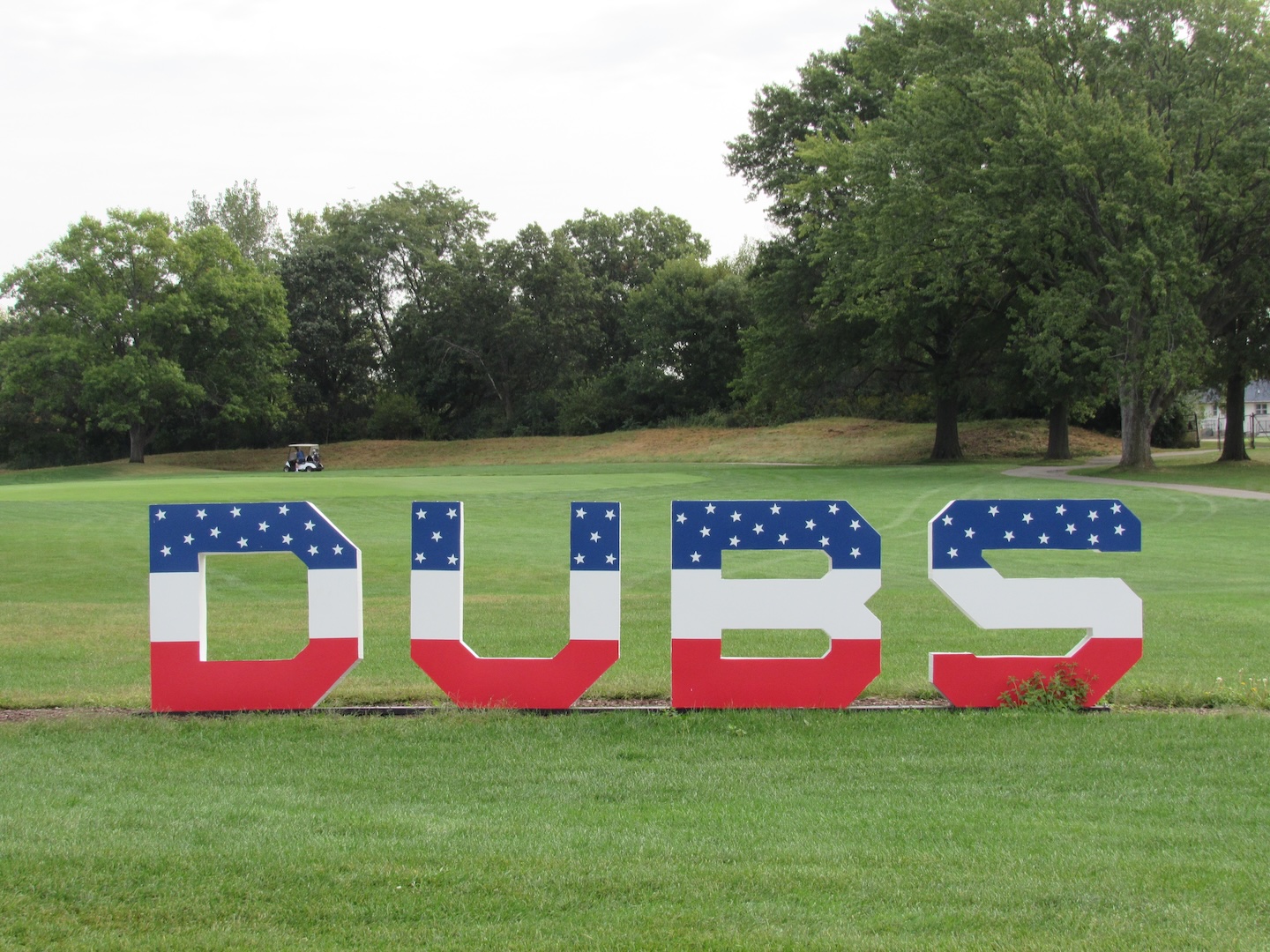
Since the mid-1990s, golf has witnessed the widespread development of far-flung golf resorts constructed according to a “build it and they will come” philosophy. The idea is that dedicated golfers will travel to the ends of the earth to play great layouts. Today’s golfing public sometimes forgets, however, that the best courses are often within easy reach of major population centers, allowing even players of modest means to hop in a car or bus or train and access world-class golf. This latter philosophy was held by Joe Jemsek, the “Patriarch of Chicago Public Golf” when he purchased the two existing courses at Cog Hill in Palos Park, Illinois, and embarked on a lifetime mission to turn the facility into the pinnacle of Midwestern public golf.
The first course at Cog Hill was opened in 1927 by the three Coghill brothers, John, Martin, and Bert. The original David McIntosh design was joined in 1929 by a second course, also by McIntosh (with Bert Coghill). In 1951, Joe Jemsek purchased Cog Hill, and he hired famed golf architect Dick Wilson to renovated Cog Hill #1 in 1963. Cog Hill #2 received a facelift in 1995 from Joe Lee and Rocky Roquemore. Also in 1963, Jemsek contracted Dick Wilson to construct Cog Hill #3, often called “The Ravines” in recognition of the numerous forced carries. Despite the burgeoning success of these three courses, Jemsek dreamt of a public-access layout to rival the famed private clubs in golf-rich Chicagoland. This dream came to fruition in 1964, with the opening of Cog Hill #4, nicknamed Dubsdread. The Dick Wilson and Joe Lee design soon became host of multiple prestigious amateur and professional tournaments. In 2008, Rees Jones thoroughly renovated “Dubs,” and it hosted the BMW Championship on the PGA Tour several years thereafter, cementing Cog Hill’s legacy as a Tour-quality public-access facility, with Dubsdread perennially ranked as the top public course in Illinois and one of the best public courses in the entire nation.
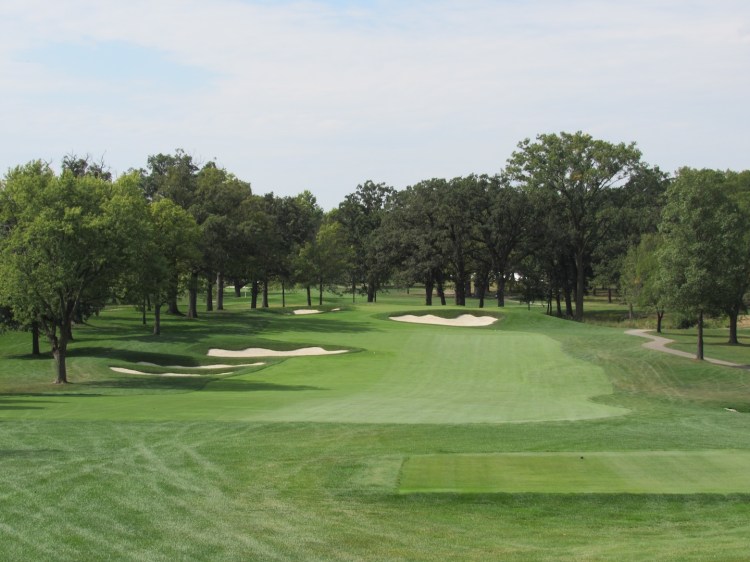
Playing Dubsdread
Chicago’s blue-collar bona fides were perhaps most succinctly captured by poet Carl Sandberg, who called the city “Toolmaker, Stacker of Wheat…City of the Big Shoulders.” Pulling into the parking lot at Cog Hill, this working-class ethos was visceral – a dozen high school busses crowded the lot, as a day-long boys’ and girls’ golf meet was underway on Courses #1 and #3. Despite Cog Hill being one of the most storied and respected public golf facilities in the nation, the place is distinctly unpretentious. Although the facility boasts an august, historical clubhouse, heated year-round practice bays with Top-Tracer technology, and the top-ranked courses, no one puts on airs. The staff were unfailingly friendly, patient, helpful, and down to earth. Even the prices for apparel and gear in the well-stocked proshop in the “2-4 building” (there is a separate proshop for courses #1 and #3) were reasonable.
The moniker of Cog Hill #4, “Dubsdread,” stands as a warning to “dubs” – players with limited skills (a.k.a. duffers) – that they might be in for a long day. This is 100% true if players don’t choose the appropriate tees for their skillset. From the champaionship Black tees, “Dubs” stretches to 7,554 yards with a rating of 78.0 and a slope rating of 153. I frankly don’t think I’ve ever played a course with ratings this severe. Fortunately, the yardages of the remaining 6 sets of tees (including a Blue-White Combo of 6,564 yards) shrinks down to 5,422 at the forward-most tees.
We played the Combo set, which was perfect for my own 9-handicap and my buddy’s 2-handicap. What became immediate apparent is that Dubs is very much a “second-shot course.” For me, keeping the ball in play off the tee usually leads to low-scoring rounds. Remarkably, I didn’t lose a single ball off the tee on Dubs. Yet I did not score terribly well, as most of my approach shots failed to find the greens, or, when they did, they left massive putts over dramatic undulations.
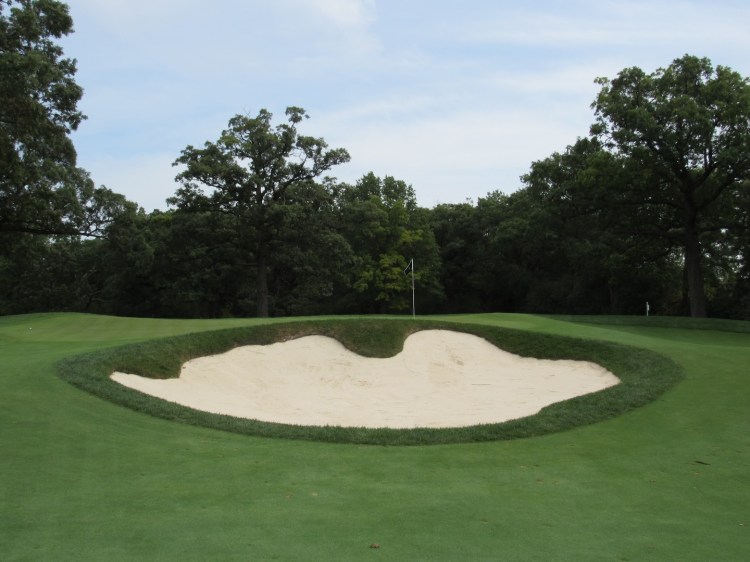
There are 89 bunkers on Dubs, all of which have recently been rebuilt and filled with snowy-white sand from Ohio (where the best bunker sand in the world is found). According to Troy Newport, General Manager of Cog Hill, the granular structure of this sand is such that it sort of locks together and doesn’t wash down the faces of the bunkers, even during midwestern gutter-washers. I can attest to the bunkering’s impeccable grooming, given that I found myself in greenside bunkers on at least half of the holes. The bunker design throughout is epitomized by the one fronting the 5th green – steep faced craters that usually leave you with little to no view of the putting surface.
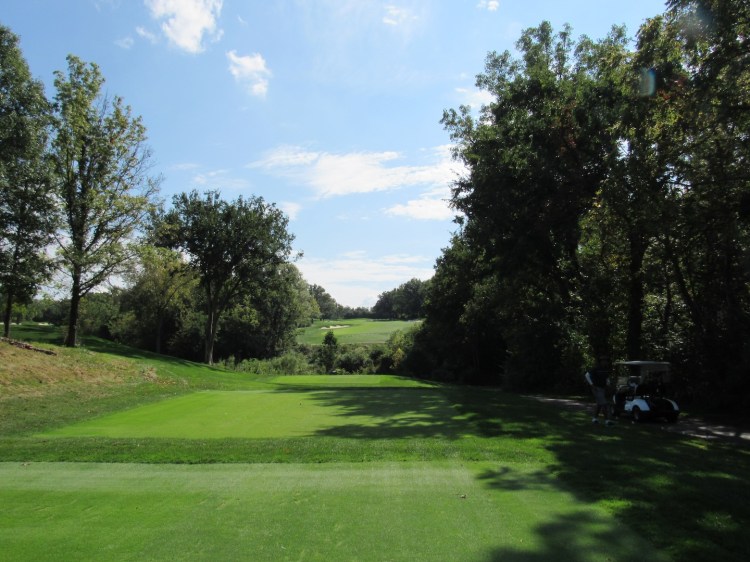
One of the striking features of Dubsdread is the brutish collection of par 3s. From the Black tees, these measure 224, 240, 216, and 215 yards. From the Combo tees, they are a much more reasonable 161, 173, 178, and 174 – still, none are pushovers.
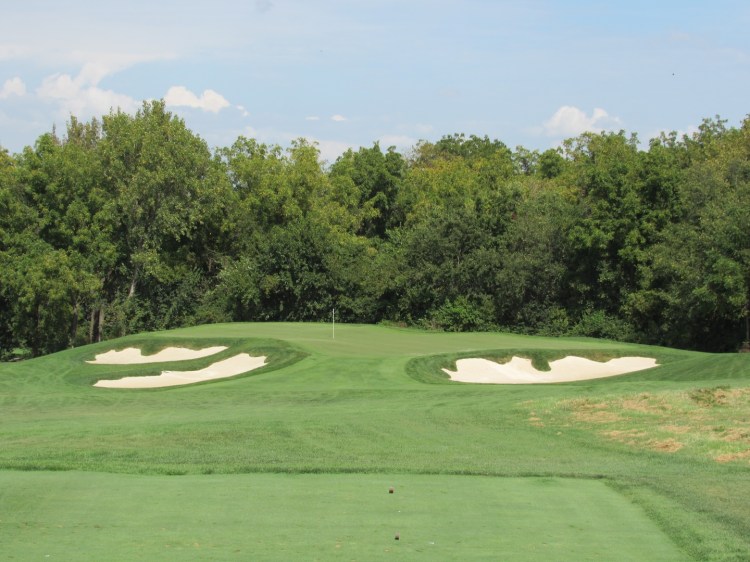
Another memorable feature are the greens, with their amorphous shaping and vexing contouring. Consider the par-4 7th, where deep bunkers nestle into the “crooks” of the cruciform putting surface. We played on a Monday, yet it seemed nearly every pin was in a “Sunday” position, tucked behind traps and set into slopes. Two lessons were learned, though not as quickly as they should have been: Keep the ball below the hole and ALWAYS take an extra club to make sure you clear the sand.
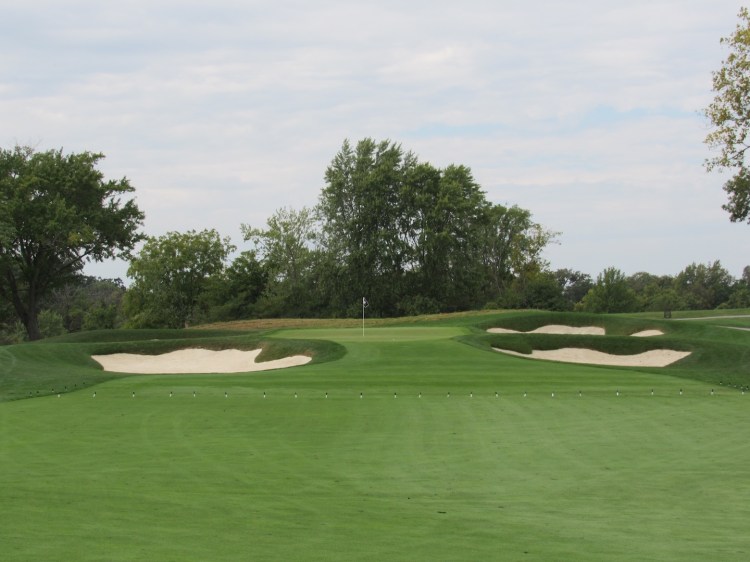
If there is one hole on Dubsdread that symbolizes the idyllic nature of Cog Hill, despite its location on the outskirts of America’s third-largest city, it is the par-5 11th. From the back tees, this 607-yard monster is a test for even the best players in the world. No matter which tees you start from, though, everyone ends at the remarkable green, which is perched high above the surrounding county, presenting an endless vista across the brilliant green tops of hardwood trees. The atmosphere is diametrically opposite the gritty Chicago that Sandberg described.

Dubsdread: The Verdict
Dubsdread is the unrivaled king of Chicagoland public golf, and Cog Hill is the archetype for multi-course facilities in major metropolitan areas. When asked whether there are plans to bring more Tour events to Cog Hill #4, GM Newport says management is open to it. But the planning would need to take into account the Jemsek family’s dedication to providing the highest-caliber public golf in the state for the residents of the Chicago area.
Green fees range widely across the four courses, with Dubsdread running between $149-$204 in 2025. The other courses, however, are more budget-friendly. The Ravines (#3) maxes out at $92, and the other two range between $40 and $80.
If Cog Hill were a remote boutique destination, these rates would all be considerably higher. As it is, their accessibility and laid-back atmosphere invite players of all levels to step out of Carl Sandberg’s “stormy, husky, brawling” city, roll up their sleeves, and flex their broad shoulders to play a round in a literal urban golfing paradise.


 Midwestern Golf