
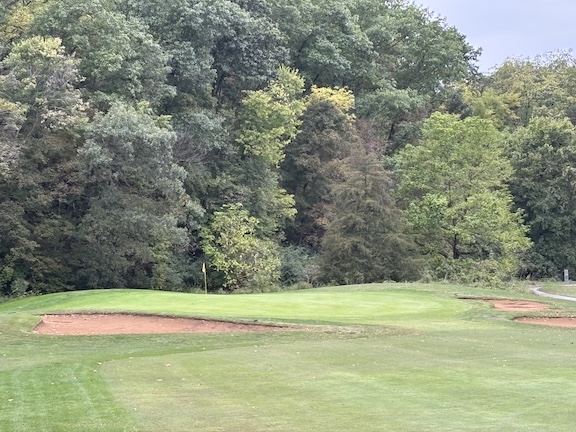
Columbia, Missouri, is known as the location of the state’s flagship public university. And to its faithful fans and alumni, The University of Missouri is known as MIZZOU. During the Tigers’ sold-out SEC football games at Faurot Field at Memorial Stadium, you can hear half the avid fans cheering “M-I-Z” and answered by the other half responding “Z-O-U!” one-third of a mile away at the A. L. Gustin, Jr. Golf Course. Despite its proximity to the stadium, and to the heart of campus itself, the course is surprising to many, even to many university community members.
Gustin Golf Course occupies 127 acres just off Stadium Boulevard. The land was donated by A. L. Gustin, Jr. in 1959 and specifically earmarked for a golf course. Golf course architect Floyd Farley laid out a 6,508-yard, par-70 course that relies on blind landing areas and narrow driving corridors to challenge players of all levels. A number of sharp doglegs, hidden hazards, and dense woods take driver out of the hands of most of today’s long-hitters, placing a premium on accuracy and local knowledge. In short, Gustin reveals surprises at every turn – and there are a LOT of turns.
The development of Gustin Golf Course into an SEC-worthy university course has been, shall we say, deliberate. Although the course opened in 1959, the clubhouse dates only from 1997. According to Aaron Wier, Director of Golf Operations, much of the irrigation system still dates from the 1970s-80s. Wier also notes that many students who play often don’t realize the course, with its well-conditioned Bermuda grass tees, fairways, and greens, is in their backyard. “I’ve proposed that students be granted access to the course as part of their recreation facility fees,” says Wier. “I’d love it if students could come play for free with just their IDs.”
When he heard that my son and his buddy, both seniors and avid golfers, were visiting for the first time, he shook his head and said, “See? Many students don’t know we’re right here. Better late than never, though!”
Playing A. L. Gustin Golf Course
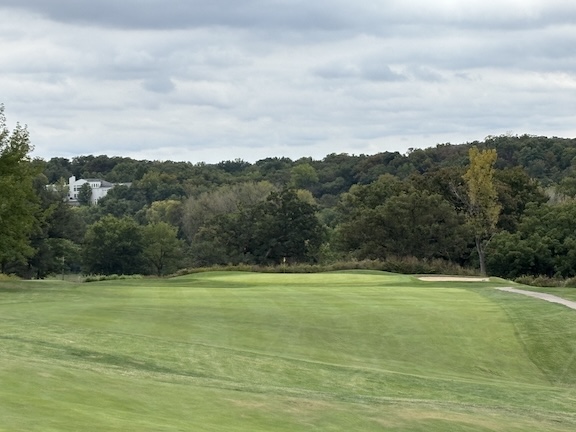
Given the course’s modest 6,508-yard length from the back tees (rating 71.4, slope 125), Gustin doesn’t overwhelm with length. There are just two par 5s, and only one of those is barely over 500 yards. There are, however, four 400+ yard par 4s if you play from the tips, which first-time visitors absolutely should not do. Why? Well, even from the 6,024 gold tees, players unfamiliar with the course will find themselves asking over and over, “What’s the line from here? Where’s the green?” In fact, the first non-par-3 green players can see from the tees comes on the 18th hole, where the blessedly open tee shot still has to contend with the thickest rough on the entire layout.
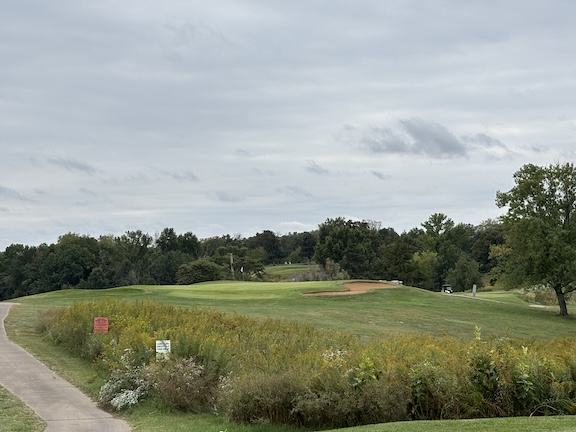
There is a 500+ yard gap between the back tees and the next-most forward (gold) tees, which results in a half-dozen par-4s of about 350 yards or less from the gold tees. One might think, then, that long-hitters would be launching their drivers like howitzers. But all these shortish par 4s feature sharp doglegs, sloping fairways, and blind hazards, making shorter clubs the wiser choice for nearly everyone.
The layout opens with one of the two par 5s, which tumbles down from an elevated tee and then climbs gently back uphill to a table-top green. This putting surface, like most of the others, does not break as much as it appears it should. The fairways, on the other hand, break plenty. The 400+ yard par-4 3rd Hole is the first introduction to the devilish fairway contouring. This is the #1 handicap hole because of the convex fairway that bends right and drops severely off into the underbrush to the right. Tee shots should hang left, but even these tend to wander into the rough if too far left. This was the first of many holes where one or more of our foursome thought we had hit perfect drives, only to crest a hill or round a bend and discover that our balls had ricocheted into trouble.
There are a few unique holes – quirky, even – on the front and on the back. On the front side, the par-3 5th Hole actually has two greens, which can be put into play on alternating days to lend a radically different angle and feel to the tee shot. Rather unintuitively, the farther green makes for the easier shot, as the pond right of the shorter green is taken mostly out of play.

The short par-4 7th Hole is perhaps the quirkiest on the course. Here, the black and gold tee boxes are located back in the woods, raised above the fairway on a wooden platform. That’s right, players drive out of a narrow chute through the trees off of mats. To the uninitiated, this feels rather claustrophobic.

The highlight of the back nine is the “Tiger’s Den” – holes 14-17, which a sign on the course touts as “arguably the hardest 4-hole stretch in Missouri.” Whether or not that description is accurate, it is noteworthy that only one of these (the 15th Hole is 467 yards from the tips) is considered “long” by today’s standards. The 14th and 16th holes are both quite “short” for longer hitters, but, as we found out, they are still plenty hard.
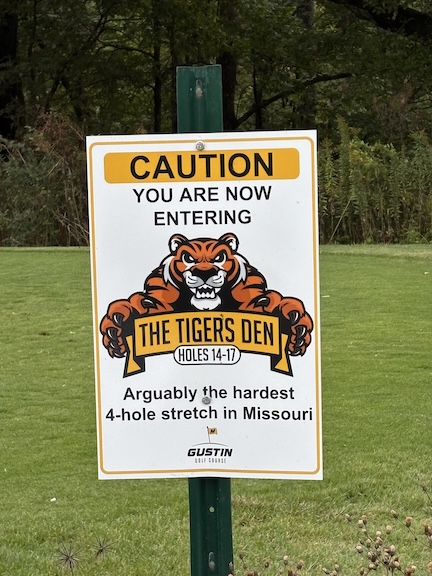
The difficulty comes from the old-school design philosophy. The 14th Hole is a dogleg left, but the fairway cants steeply to the right, which makes it hard to hold the fairway and also makes the second shot to the elevated green tougher than expected. At the longer 15th Hole, the tee shot is up and over a hill to a completely blind landing area that is much farther left than is apparent from the tee. Three “solid” drives in our group were found to have scampered into the woods on the right. At the short 16th Hole, with its sharp dogleg right, the green lies less than 300 yards away as the crow flies. But big hitters who want to go for it must first elevate their drive quickly to carry massive trees and then not hit it too far, as balls that go through the fairway may be lost.
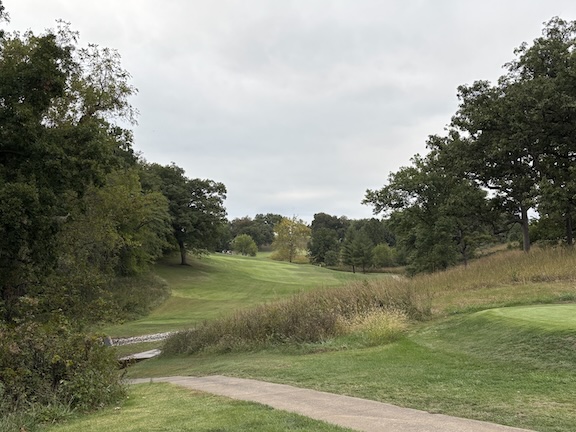
Finally, the par-4 17th Hole punishes with one last totally blind tee shot. There is even a defunct periscope at the tee that was once used to check whether the group ahead was still in the landing zone. After a round of blind shots like this—and escaping the Tiger’s Den—it is a relief to get to the 18th and finally be able to see where you need to hit it.
A.L. Gustin Golf Course: The Verdict
Mizzou’s Gustin Golf Course presents players with plenty of surprises. From Stadium Boulevard, you can hardly tell it’s a golf course. The 127 acres are far more than just a place to play golf, too. Gustin was the first collegiate golf course in the nation to be named an Audubon International Cooperative Sanctuary in 1997. Director of Golf Wier reports that the rolling, pristine prairieland is the birthplace of some 3,700 fledgling bluebirds annually. There are also nine pollinator plots (the course is a member of Monarchs Forever) and four bee hives on the land (with plans for more). At times, it feels like you’re playing golf through a nature preserve just on the edge of campus.
With public weekend green fees topping out at around $35, rates are extremely affordable, even for many students (who receive a discount). Carts are $20, but walking is allowed. (The numerous hills, though, would make for a challenging walk!) The course does just over 25,000 rounds a year, but if you play on a football game day, when most of the city is at the game or watching it at the numerous college bars, you might have the links mostly to yourself – and you will be able to hear the cheers from the fans drifting through the trees: “M-I-Z…!”
 Midwestern Golf