
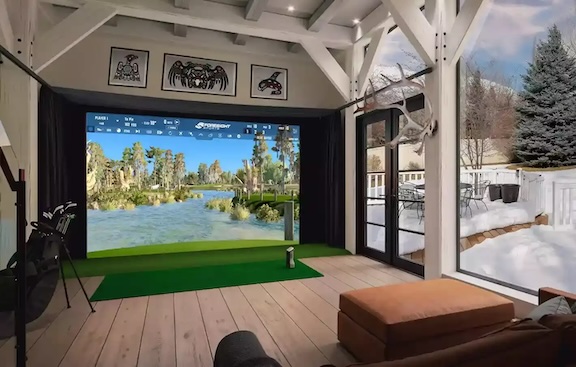
I grew up on a horse-boarding farm in Minnesota. Winters could be brutal – back in the day (yeah, I’m old), -20F was typical even without windchill. And always so much snow! But to be honest, aside from the physical discomfort, there were plusses. First of all, horse manure doesn’t smell when it’s frozen. Second, winter means no baling hay, no planting, weeding, and picking vegetables, etc. The “off season” on a northern farm is sort of restful.
Now that I do not live on a farm, winter means exclusively one thing to me: No golf. And life without my weekly rounds is more brutal than -20F.
Thank goodness for golf simulators. About 12 years ago, my local muni invested in their first golf simulator and started a winter indoor golf league. To be honest, the original technology wasn’t overwhelming, and the hitting bay felt claustrophobic. (A tall buddy of mine once caught an overhead light with his driver follow-through, dramatically shattering the light bulb.)
Like all technology, though, golf simulators have improved, and my home course stuck with the indoor golf league. Now they have two Foresight simulators in the facility’s high-ceilinged event space. And us regulars lean heavily on weekly league play as we limp through the winter, waiting for the fairways to green.
Foresight Golf
Foresight Sports, headquartered in San Diego, CA, introduced their first golf launch monitor in 2010. Within six years, it was the best-selling professional-grade launch monitor in the U.S. In 2017, Foresight introduced their GCQuad monitor, and the technology has been improved every subsequent year. Today, Foresight is the industry leader in golf monitors and simulators, with over 15,000 units installed around the country.
At Lake of the Woods Golf Course in Mahomet, IL – my home course – there are two Foresight simulators with GC3 launch monitors ($6,999). General Manager Chris Edmondson says, “We moved to Foresight (from TruGolf) in 2022. This allowed us to switch from a sensor and light-based simulator (TruGolf) to launch monitors.” The course uses the Foresight Simulator-in-a-Box (starting at $16,000) with the Birdie Package, which includes 28 courses (such as Pebble Beach and The Old Course at St. Andrews).
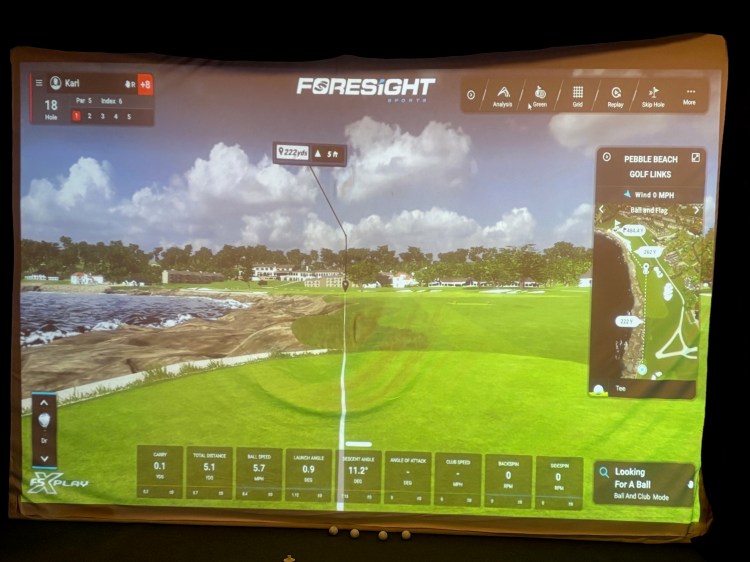
According to Edmondson, the reason for the change in simulator provider was performance. “With the [previous] sensor-based systems, we had constant issues with light bulbs burning out or not functioning, sensors not reading or reading incorrectly, and often the sensor board would just stop functioning,” he recalls. “We were constantly working through issues just to keep two simulators running.” (I remember the previous system badly misreading some of my shots several times a round.)
Now with Foresight, he says, “There is the very rare misread that will be software related.” Although I must admit that the system occasionally fails to read one of my putters with a matte-black finish. I had to hit one putt 11 times before it registered (though I did make that 11th putt).
One real perk of Foresight is its precision. The resident clubfitter uses the system for clubfitting, too, and the teaching pros use it all winter long for lessons. Other great features are the putting alignment and green-reading aids built into the software. With a few clicks on the keyboard, you can line up your putt, and, if you hit it straight with the right pace, the system projects the correct break. Also, because the software is cloud-based, you can play against people around the world.
Playing Foresight
Of the three or four simulator systems I’ve played during winter golf league, Foresight provides the most life-like experience. Granted, without the 3D visual cues that exist in “the real world,” distance judgement can be challenging, especially with short shots. In “real life,” I don’t need to know my yardage from 100 yards and in – I just feel it. It’s hard to “see” shots on a 2D screen.
Sometimes yardages can be a puzzle, too. Sometimes it feels like you crush a drive, and it barely goes 200 yards. Next hole, you hit what feels like a knock-down 9-iron, and it goes 20 yards longer than a full 9 normally would. This seems quite idiosyncratic, but part of the issue is that any slight contact with the mat before hitting the ball can dramatically change the ball flight and yardage. The trick to enjoying simulator golf, and scoring well, is to think of it as a different game – like playing beach volleyball rather than volleyball in a gym. They’re just different games.
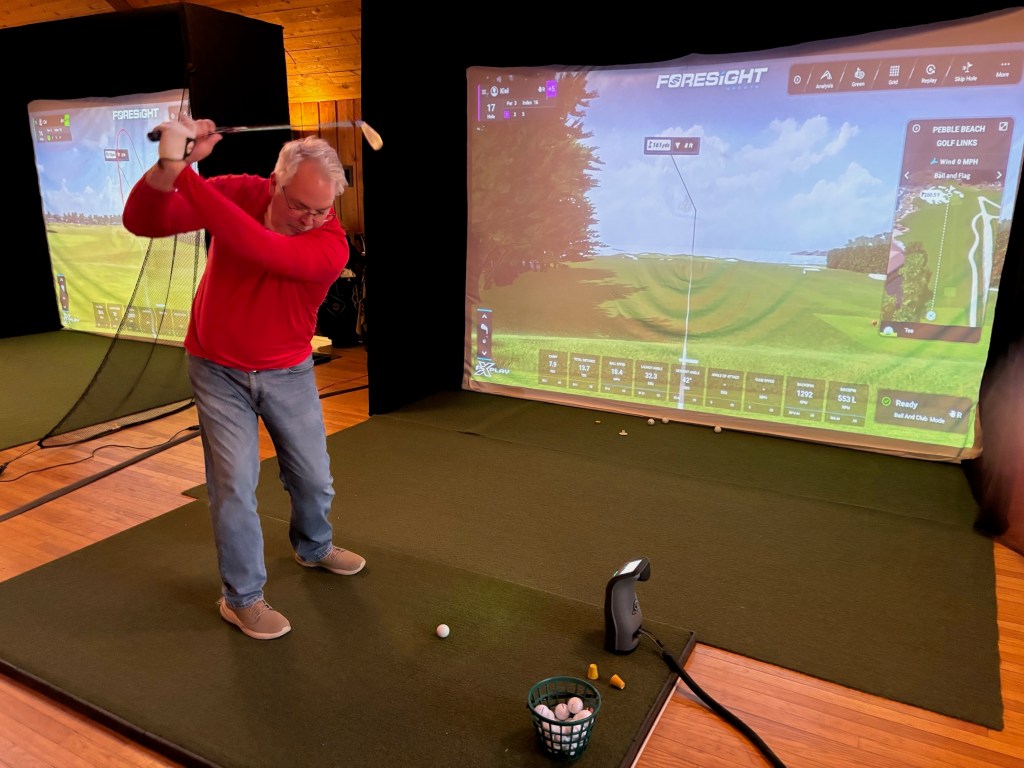
Nit-picking aside, Foresight does provide numerous “real life” features, like sand bunkers that simulate play from actual sand more realistically than previous systems. And trees, bushes, and tall grass really play more “solid” than other systems. I’m counting this as a plus, rather than a minus – which feels sort of masochistic.
But hey, no matter how you score, or how far your driver goes, as my simulator-league partner Karl says, “We’re playing golf in February in Illinois.” In this way, the simulator offers some real-life perspective, after all.
 Midwestern Golf
One thought on “Foresight Sports: Winter “Blahs” Alleviated by Simulator “Aahs””