Depending on which statistics one looks at, the percentage of golfers who never break 100 is somewhere around 50%. Of course, this estimate also depends on how you define “golfer.” Is someone who plays once or twice a year a golfer? We could argue about this all day.
Irrespective of these statistics, though, everyone who plays golf at all can agree that it is a frustratingly difficult sport. Recent calls to “roll back” the ball or limit the power of drivers for Tour professionals would not – and should not – apply to recreational players because we recreational players, us regular folk, need all the help we can get.
Let’s face it, golf IS more fun when you hit the ball farther. Heck, I know people who’ve toyed with the idea of playing. Then they go to a practice range and fail to get even a single ball into the air and simply quit before they ever even play an actual hole. A lot of factors work against “growing the game” – cost, time, exclusionary culture. But frankly, the single factor that keeps golf from being more popular is golf itself. Golf is HARD.
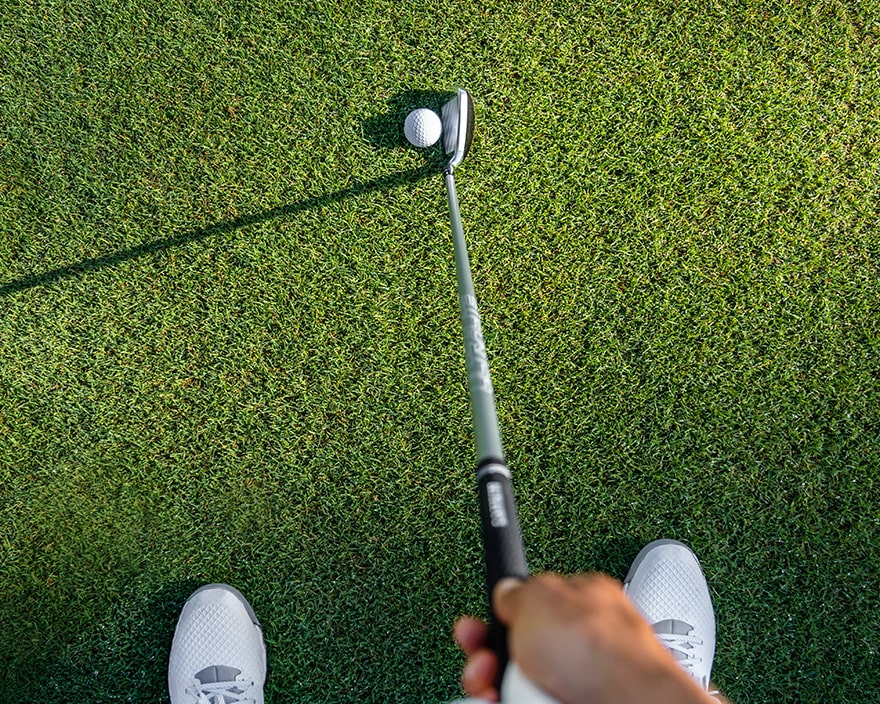
Fortunately, more and more equipment companies are developing lines of clubs to help regular folks have more fun playing golf. The latest entry into the “Max Game Improvement Iron” category are the Cobra T-Rail Irons ($999, PW-4 hybrid). If you’re trying to entice friends or family into playing golf with the thrill of hitting high, long shots, these are the clubs you will want to have them try.
Playing the Cobra T-Rail Irons
Let’s be honest: if you’re looking for sleek irons with a thin topline, these are not for you. Every iron in the T-Rail set has a hollow, hybrid-like design. However, the black carbon back does go some way towards camouflaging the bulbous profile.
But forget about the set-up aesthetics. These irons, which come stock with Cobra Ultralite 50 (55g) graphite shafts, are light but beautifully balanced. You can ramp up swing speed without losing the feel for the position of the clubhead. The oversized head remains stable on off-center strikes, and the patented namesake T-Rails on the sole provide consistent contact with the turf.
I tested the T-Rails at my local driving range and during a 9-hole round on my local course. Naturally, the range session consisted of one nearly flawless strike after another, with the ratty old range balls sailing easily 10-20 yards father than with my normal irons. And the ball fight was so incredibly high that I thought I’d popped up the first couple of shots until I realized how far they had traveled.
On the course, nothing ever goes as well as on the range. Nevertheless, when I wasn’t trying to over-swing, the T-Rails delivered effortless power. I had to club down on several shots in order to not go over the green. With some practice, I was even able to work the ball both right and left with the T-Rails (an accomplishment that, as with any of my clubs, was less consistently achieved on the course).
The verdict on Cobra T-Rail Irons
Iron sets that are basically full-set hybrids are not for every golfer. But if we’re being brutally honest, about 50% of golfers could probably benefit from playing them. For me, the T-Rail 4-hybrid (20 degrees, 39.75 inches) is the club I’ve been looking for for years. I’ve been having trouble with my fairway woods for nearly a decade, and the 4-hybrid T-Rail is an ideal replacement for my 19-degree 5-wood. The shorter shaft and more compact head give me the feeling of more control, and Cobra’s brilliant engineering gives me more height, more control, AND more distance despite the shorter shaft. And in my semi-psychotic golfer brain, I can tell myself “It’s just an iron” and take a normal swing. This is a vast improvement over my fairway wood swing thought, which is something like, “Oh, gawd – I hate fairway woods! What’s going to happen this time?”
Come to think of it, it really is a miracle that I ever broke 100.
Your putter is the only club you use on every hole. This intense familiarity tends to breed a manic relationship between golfers and their flatsticks. One type of player largely ignores their putters – they’ve played the same one for 20 years, and the grip is glassy smooth, the head is dented, the shaft might not even be straight anymore. The other type of player is obsessed – haunting the putter section of every pro shop and big box sports store they enter, these players squirrel away part of their lunch money every week to save up for the latest $700 wand by Cameron or Bettinardi because it will definitely, this time, save strokes.
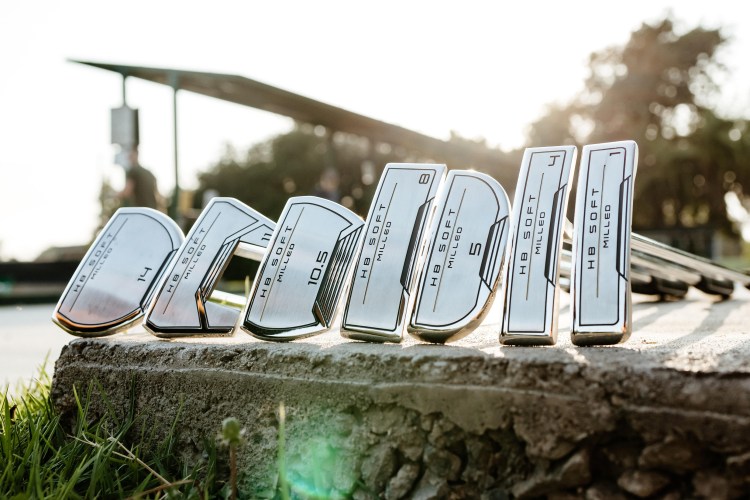
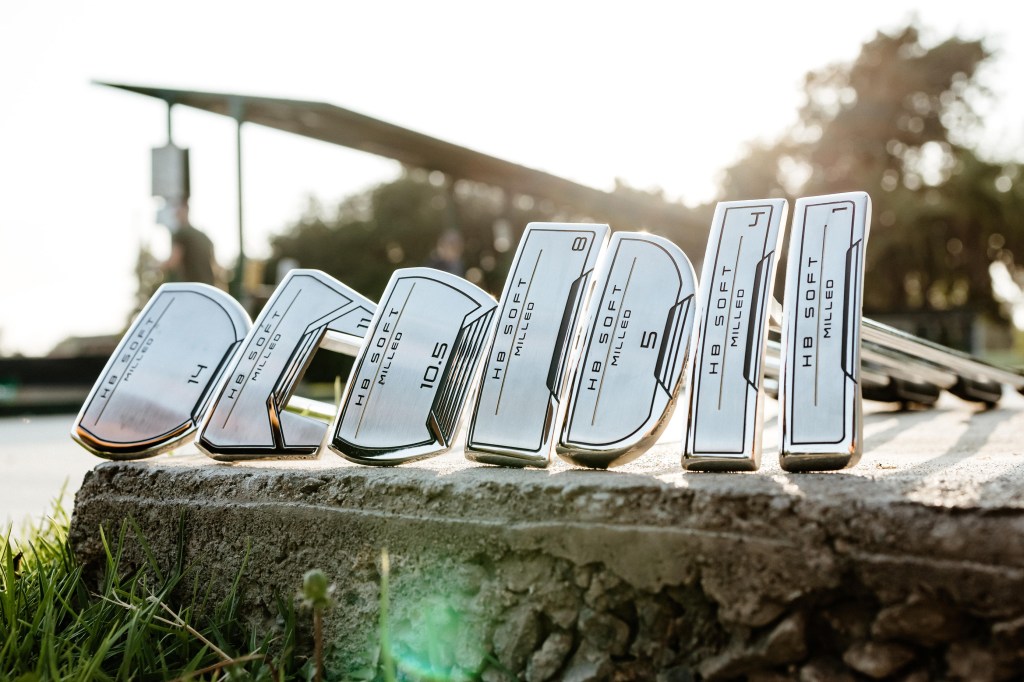
I’m here to tell you that there is a middle ground, a calm eye of sanity in the psychological hurricane that is putting. Cleveland Golf consistently produces putters that represent the best combination of performance and affordability on the market. In November, 2022, Cleveland introduced the Huntington Beach (HB) SOFT Milled Putter Line ($200), which consists of seven models designed to fit the full range of putting strokes.
Playing the Cleveland HB SOFT Milled Putter
Putting strokes basically fall into two styles: straight-back-straight-through and closed-open-closed, often termed “straight” and “arc” (or “gate”), respectively. Great PGA Tour pros have played both, so one’s not any better than the other. The key is to find a putter whose weighting and grip fit your stroke. With seven models—and their respective grip shapes—the HB SOFT line offers a match for every golfer.
For arc putters, Cleveland recommends the Golf Pride PRO ONLY Red Star grip, with a pistol shape that promotes the opening and closing of the putter face. For straight putters, there is the Golf Pride PRO ONLY Green Star grip has a more rounded, oval-back shape that helps the hands stay still through the stroke.
Once you settle on a grip, the next decision is the putterhead shape. What looks best to your eye? Now, arc putters often prefer Anser-style or flanged blade shaped heads, whereas straight putters often prefer some flavor of mallet. But this generality is not absolute. Toe-hang is another reliable indicator: face-balanced putters tend to work best for straight putters; some degree of toe-hang tends to work best for arc putters. The HB SOFT models are 1, 4, 5, 8, 10.5, 11, and 14. Smaller numbers are smaller heads, ranging up through mid-mallets to full mallets, and every model offers variations with different face- and toe-balancing.
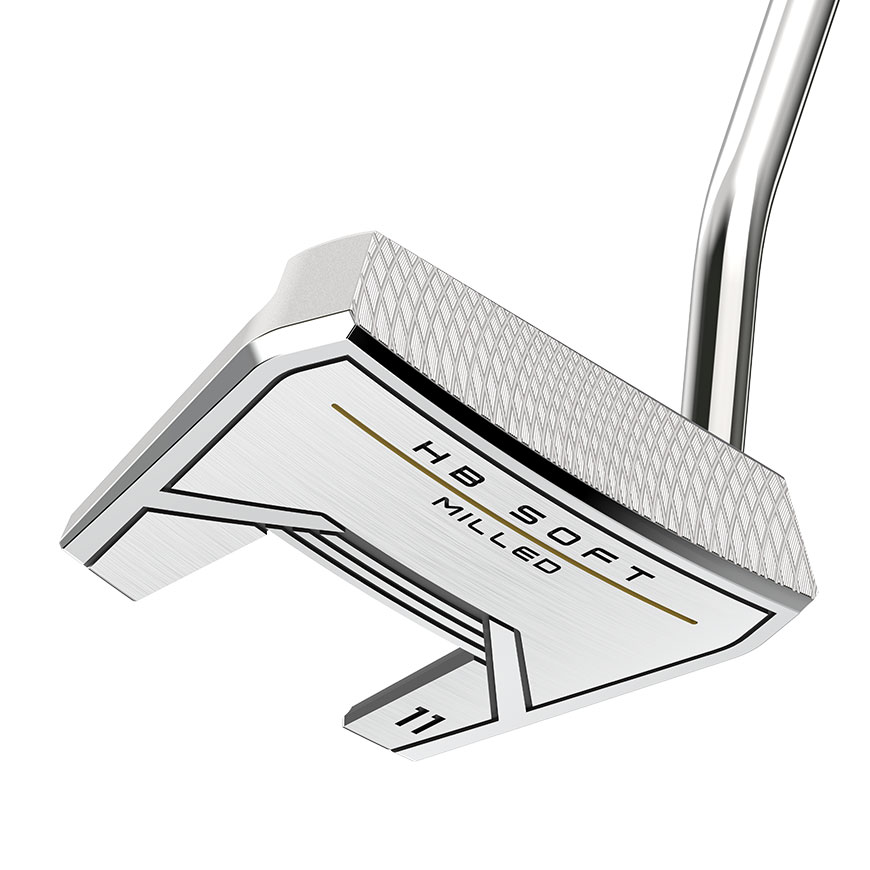
I chose the 11: 370g, single-bend neck, 3-deg loft, face-balanced, 35”. The 11S is for arc putters; the 11 is for straight putters, which I am (when I’m putting well). The head shape is in the “sabretooth” style: two flanges extend back from the toe and heel ends for exquisite stability.
All HB SOFT Milled putters are, well, milled, meaning that both the front and back of the head are milled. The face is diamond milled for optimal contact everywhere on the face. The back milling just provides a really sharp, clean profile at address.
How did it perform? Well, every year, I think I’ve settled on a forever-putter. Last season, it was actually another Cleveland model, the Frontline ISO Putter. I putted great with that model. But after a half-dozen strokes on my living room carpet with the HB SOFT 11, and a simulator-league season that ended with a 20-foot holed (simulated) putt to secure second place in the league, it has now become my forever-putter.
Until next year, maybe.
The verdict on Cleveland’s HB SOFT Putter Line
The double-barreled greatness of Cleveland putters combines consistently top-notch quality with a reasonable price point. The HB SOFT Milled Line is the next great generation of this long and proud tradition. If you really do want to change putters every season, you can do it without busting your budget. If, on the other hand, you want to keep a putter in your bag for the next couple of decades, Cleveland makes a product that will last and perform in perpetuity.
Just please, for me, change that glassy grip now and then.
It feels like just yesterday that I first received a dozen Srixon golf balls to review, despite it being nearly 20 years ago. I called them “The best balls whose name you can’t pronounce.” Srixon golf balls continue to be some of the best balls for the money at every price point. Moreover, Srixon has become a familiar name for most golfers, thanks to multiple player sponsorships on all professional tours and an ever-growing, consistently high-quality line of golf clubs.
Despite the wider name recognition, though, Srixon is still sometimes overlooked by golfers shopping for new sticks. Whenever someone on “golf Twitter” poses the question of which irons or drivers are most underrated, Srixon’s name is certain to pop up, followed by a chorus of devotees who profess their loyalty to the brand.
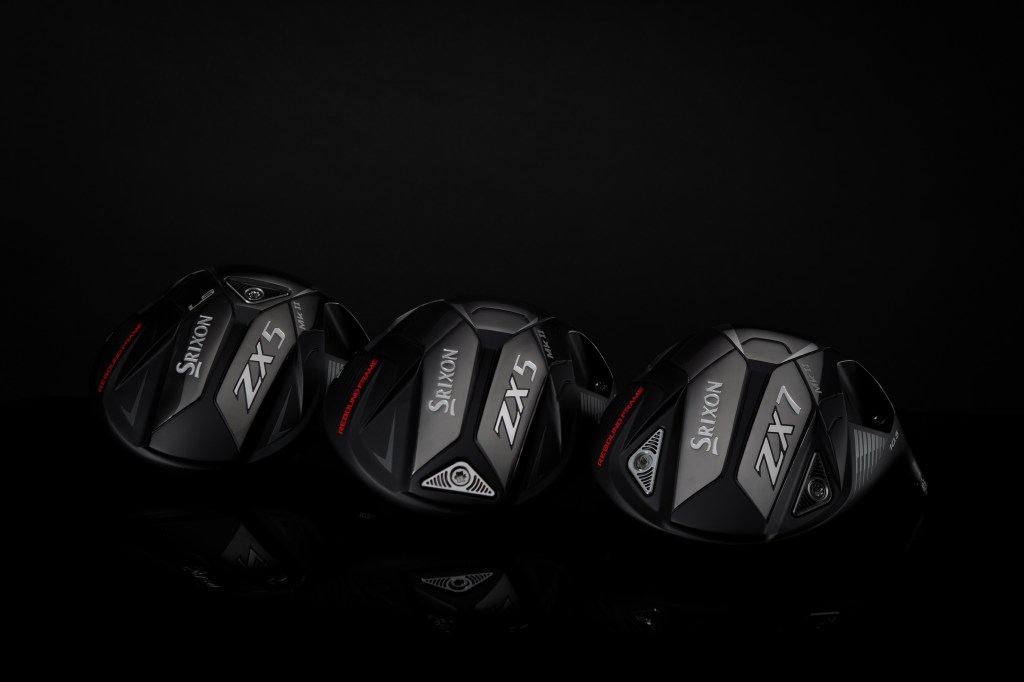
The reason for this loyalty? My view is that Srixon consistently produces rock-solid, high-performing equipment at an affordable price. The new ZX MK II Series Drivers ($500) continue this tradition in impressive fashion. ZX MK II drivers come in three flavors. The ZX7, with its more compact head, targets low-handicap players who seek to work the ball in all directions off the tee. The ZX5 offers consistency and forgiveness, with a larger footprint and weight deeper in the sole. The ZX5 LS is new in this line, with an adjustable forward weight to reduce spin rate to maximize distance while maintaining much of the ZX5’s forgiveness.
Playing the ZX5 MK II
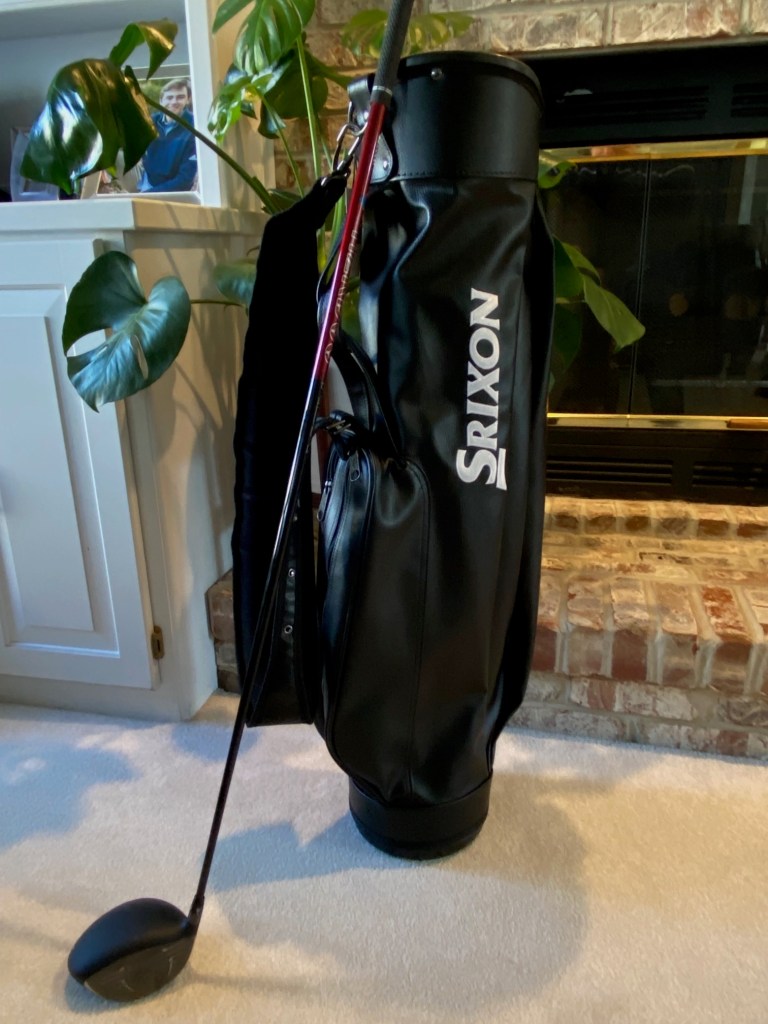
Over the past 15 years, my once-bulletproof driver swing has suffered some serious wounds. So I chose the ZX5 MK II in hopes of building back some confidence. I loaded the ZX5 into my new Srixon Sunday bag (by Jones) along with several of the latest drivers from some competing companies, and headed to the simulator and launch monitor at Lake of the Woods Golf Course. Accompanying me was my son, a former HS golfer who regularly launches 300+ yard drives, so if my swing turned balky, I could trust him to give the variety of big sticks a fair test.
We both loved the ZX5 MK II at set-up. The traditional shape and matte-finish crown felt both calming and powerful. We left the adjustable head at the factory 9.5-degree setting, and admired quality of the stock Hzrdus Smoke RDX shaft (stiff). Although my swing was inconsistent that day, drives with the Srixon were the most consistent of all the clubs tested that day: lots of fairways hit (playing a simulated Pebble Beach), spin rate that was slightly higher than some others, but with a mid-high ball flight and very acceptable distance.
The real test was my son, whose swing was still as smooth and as powerful as ever – oh, the joys of long levers, youthful flexibility, and grooved tempo. He hit all the drivers we tested well, but the real comparison for the ZX5 was against a competing driver that retails for $225 more than the Srixon. The competitor was described by my son as “a beast,” and when he hit it on the sweetspot, it seemed like the simulated ball would never come down. When it did, we both just sort of whistled at the low spin rate and 300-yard carry. But when he missed the center of the clubface, distance and direction were dramatically reduced—we’re talking 50+ yards shorter and well off the fairway. “This one feels too good for me,” he said.
Next up, the ZX5 MK II. “This one doesn’t give me the same anxiety over the ball,” said my son, setting up with the Srixon. His first swing was tentative, and a slight mishit still traveled beyond 270 and found the short grass. “I’ll take that,” he said. Next swing, all out, delivered a dead-straight, towering 310-yard bomb.” We both just smiled. “The spin rate is a bit higher than the other one,” he observed, “but that’s why both of those shots landed in the fairway. It doesn’t feel like I can miss.”
Srixon ZX5 MK II: The verdict
Srixon touts a catalog of design innovations for the new series of drivers: Rebound Frame (with multiple flex zones to focus energy on the point of impact), Star Frame Crown (ultra-thin titanium with internal ridges for strength and energy transfer), Variable Thickness Face (for maximum forgiveness all over the face), Cannon Sole (for maximum ball speed), and a deep center of gravity. But the bottom line for most is how a player feels over the ball and where the ball ends up after the swing.
So here’s the bottom line: Srixon’s consistency breeds confidence. Go ahead, swing all-out. Even most mishits will still play. And even the most forgiving of all the new ZX MK II Series produces distance that rivals every other driver we’ve tested so far this year. Underrate Srixon if you want, but real players – from golf Twitter all the way up to the professional tours – know the high level of performance Srixon continues to deliver.
Golf equipment companies introduce “new” clubs two or even three times a year. Every time, without fail, these new clubs are “longer,” “more forgiving,” “better performing.” Heck, they’re regularly trumpeted as “the best ever!”
I’ve been writing about golf equipment for over two decades now, and I am not the only person in the industry who is skeptical of this never-ending train of improvement. Over the years, I have reviewed a number of “best ever” clubs from putters to drivers that performed no better—and sometimes worse—than the model that had debuted just six months earlier.
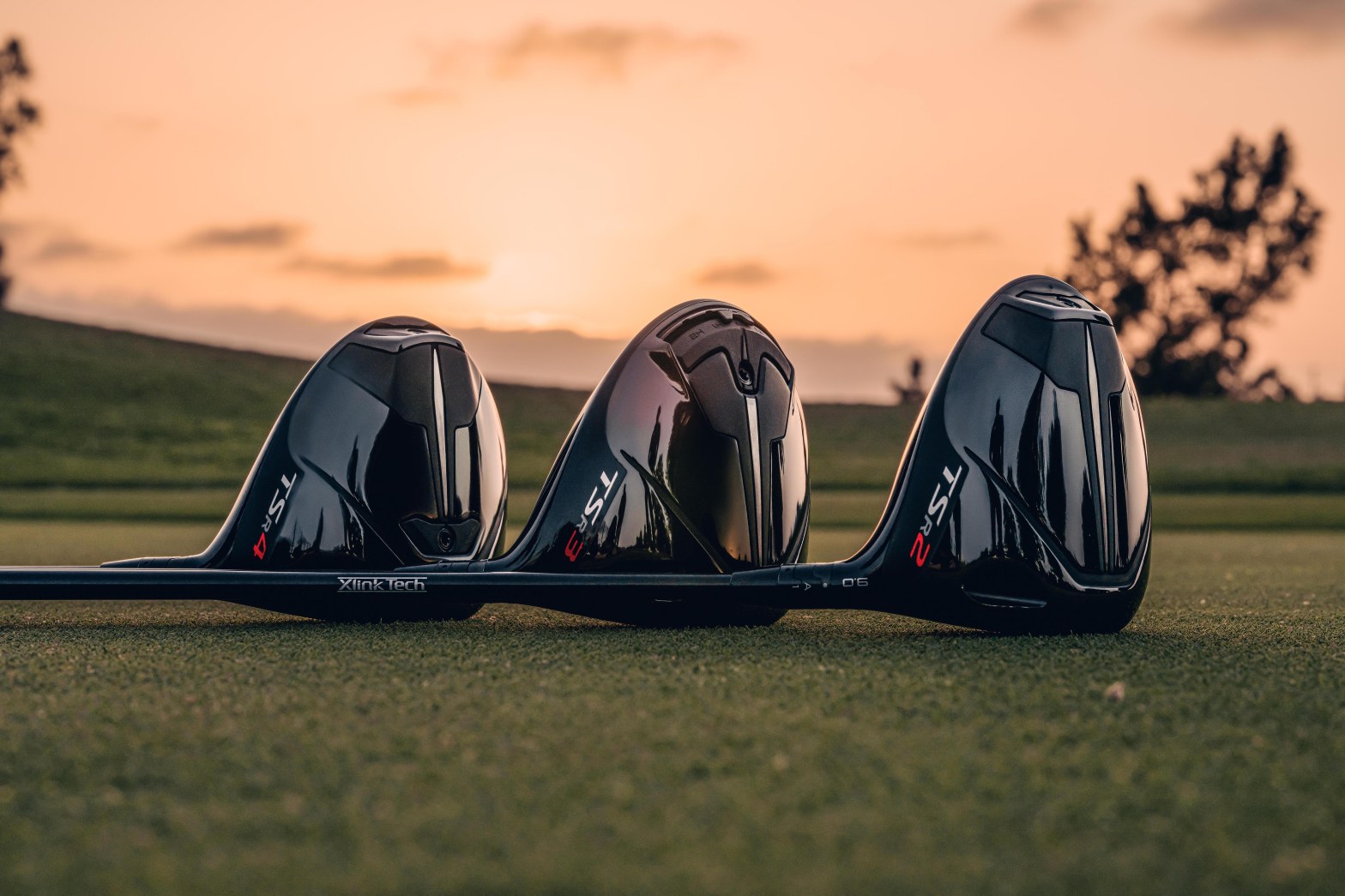
Less than a year ago, I reviewed the Titleist TSi2 driver, and I kept it in my bag throughout last season. In all honestly, I enjoyed more confidence, control, and power off the tee this past year than I had for many, many years. Forgive me, then, for allowing that old skepticism to creep in: Could Titleist do even better with the TSR2 such a short time after the TSi line debuted?
I communicated this to Titleist. They were glad to hear of my satisfaction with the TSi2, but were confident some model of TSR—TSR2, TSR3, or TSR4—could convince me. They wanted me to get custom fit, though, so an appointment was arranged. Preceding that fitting, I had played The Pfau Course in Bloomington, Indiana, where I had driven the ball quite well most of the round. Then I drove five hours to just make the fitting appointment. I hopped out of the car, hit a few wedges, and then proceeded to make the most confounding, inconsistent collection of swings—and lots of them. I felt bad for the expert fitter, who was sure he had me figured out until I changed my swing again (and again, and again). He finally settled on an R-flex shaft for both a TSR2 driver and 3-wood, which surprised me, as I’ve always played an S-flex. But to be fair, the only balls I hit straight during the fitting session were when I slowed my swing down toward the end because I got tired after 50-some balls. But maybe…
Playing the Titleist TSR
My TSR2 driver and 3-wood arrived with just a couple of outdoor rounds left in the season: windy, cold, swing out of sorts. They both looked sleek and felt solid. The TSR2 is the “max” performance driver that offers optimized distance across the entire clubface. And if my fitting taught us anything, it’s that I make contact all over the clubface.
Rather than just tweak the TSi2 driver clubhead, though, Titleist redesigned the TSR2. A “boat tail” weight port at the very back of the sole calls to mind the SIM2 driver by TaylorMade. (The TSR3 has a sliding weight port in the back of the clubhead for maximal adjustability.) The sound and feel at impact do as well. The 9.5-degree TSR2 launches as high or higher than my 10.5-degree TSi2, but with less spin. A few shots on the course with the 3-wood were respectable, but the driver felt hard to control and not as long as the previous version.
Enter simulator golf weather. I tested the TSR2 on the new Quad Pro launch monitor at Lake of the Woods Golf Course with my son, a former high school golfer who routinely launches 300-yard drives, and the local high school girls’ golf coach, who plays off a low single-digit handicap and also rips 300+ yard drives more often than not.
My son noticed the radical change from the TSi2 clubhead design, as well as the difference in sound. The TSR2 sounds more muted than its predecessor. We both noticed that purely-struck balls didn’t feel like we’d hit them at all, a feature shared by the TSi2. We swapped out the R-flex shaft for the S-flex of my TSi2, and my son especially noticed better control. (The R-flex resulted in several hooks for both of us, actually.)
The local golf coach was fitted a couple years ago for a TaylorMade SIM2. “I feel like I could look around for a new driver this year,” he said. His first drive with the TSR2 (S-flex) carried 280+ yards and rolled out to 304. After three more drives, all dead straight and all over 300 yards on the simulator, he turned to me and asked, “How much do you want for this?” I believe he would have gone to the ATM right then. (He’s still asking me about it.)
Even I, the old man of the group who doesn’t really like simulators or launch monitors, noticed lower spin and slightly higher ball speed. Eventually, I banged out some 270-280 yard drives. Titleist touts the TSR2’s and TSR4’s “Multi-Plateau Face Thickness Technology” as accounting for the hotness and forgiveness of the face. Essentially, there are concentric donut-like layers stacked inward towards the center to provide maximum ball speed across the entire clubface. The TSR3 boasts “Speed Ring Variable Face Thickness Technology,” which basically focuses the maximum power on the sweetspot—for those annoying players that hit the sweetspot consistently.
The verdict on the Titleist TSR2 woods
Honestly, I thought the TSi2 would be in my bag for the long haul. Then along comes the TSR2 driver to usurp the role as go-to. And it brought along its 3-wood sidekick, even – which, by the way, consistently delivers straight, 225-250 yard shots. The R-flex in a fairway wood actually seems helpful, as in order to make solid contact off the turf, I really do need to slow my swing down.
The TSR2 driver, though, matched with my older stock S-flex shaft, is—miraculously—an improvement over its predecessor. Titleist, somehow, has done it again.
Aizu-Wakamatsu City is remote by Japanese standards: just over two hours north of Tokyo by Shinkansen (bullet train), followed by a connection of another hour or so by local train. During the winter, heavy mountain snows can block those local tracks completely. The region’s isolation was a reason it became one of the final strongholds of the Tokugawa Shogunate – the system of shoguns and samurais so often recalled in the minds of Westerners when thinking about Japan. In the Boshin Civil War, when the feudal Shogunate ultimately fell to the unification effort of the Meiji Empire, Tsuruga Castle – stronghold of the ruling clan of Aizu – burned in 1868. This military battle is famous for the story of the Byakkotai, 19 teen-aged samurai who escaped the castle to a hill overlooking the town. When they saw smoke billowing from the castle grounds, they wrongly assumed their master had fallen, and they committed seppuku (or hari-kiri, ritual suicide). The battle raged, though, for a few more days.
The flip-side of this bloody history is the artistry of the Aizu region, which is equally famous and also owes its uniqueness to isolation. During the centuries when Japan was fragmented by feudalism, subtle but distinct differences in even the most traditional arts and products evolved quasi-independently. Today, every city in Japan claims fame for something – sake, rice, silk, blade-smithery. Kitakata, a small town near Aizu-Wakamatsu, for example, boasts arguably the best ramen noodles in the country. Aside from premature self-disembowelment, Aizu is famous for its lacquerware. Lacquer is a hard, shiny coating derived traditionally from the resin of the Chinese lacquer tree. It is applied in many coats to wood, metal, or today, even plastic to create brilliant, colorful designs on everything from jewelry to vases to golf clubs.
Did I say, “golf clubs?”
Yes.
In 2022, Japan’s premier golf equipment company, Honma, introduced the BERES Aizu line of golf clubs, all of which feature designs and flourishes inspired by and faithful to the centuries-old lacquerware tradition of the Aizu region. These eye-catching, ball-smashing clubs do require a certain amount of financial sacrifice, but they also infuse your game with beauty, honor, and performance that are well worth the price.
Playing the BERES Aizu Driver
The history of Aizu above is just a fraction of what I would like to relate. I lived in Aizu-Wakamatsu for three and one-half years in the early 1990s while on the faculty of the University of Aizu. I am extremely fond of the region, its people, history, and artwork. So when I saw that Honma was coming out with a lacquer-inspired line of clubs, I just had to try them.
The BERES Aizu Driver is every bit as stunning in person as it is in the photos on the Honma website. It comes in several different color and pattern combinations, and the artistry is unrivaled in anything I’ve ever seen on a golf club. It is true that this artistry comes at a cost — $949 for the driver in gold or rust; $1,149 for black – but if you have ever dreamt of playing clubs that will turn the heads of everyone at your course, such is the price of that dream’s fruition.
When I lived in Japan, it was common to see rather plain-Jane drivers for $1000 or more on the shelves of department stores in Tokyo, so the cost of the BERES Aizu is not so surprising, especially given inflation. Nevertheless, what you get from the Aizu today is far, far more technologically advanced than those vanity drivers of the 1990s.
The foundation of the BERES Aizu line is prime materials – the Radial L-Cup face is constructed from Ti811 titanium, for example. How this differs from other titaniums, I am not certain. What I do know is that I have never EVER seen a shinier club face. Even more amazingly, after playing a couple rounds with the Aizu, it was just as shiny as before it ever struck a ball. Behind that brilliant face is more engineering genius: a triple-groove sole that maximizes speed and launch trajectory and a lightweight crown (despite the lacquerware flourishes) that moves the weight deeper and farther back in the clubhead. Finally, the ARMRQ MX Shafts, which come standard in the Aizu, are constructed by Honma from a proprietary carbon-fiber and aluminum-strand composite. These also feature lacquerware-inspired detailing.
Shiniest club face I have ever seen. And it looked exactly the same after playing two rounds.
How does all this beauty play? Well, beautifully. Although the SR (~stiff) shaft felt a bit whippy, a controlled swing produced long, long tee shots. The ball “popped” off the face with a subdued sound that belied the length of the ball flight. I asked a local high-school golf coach and low-handicap player to hit a few shots with it, too, and he agreed: “I really like the way the ball comes off that face. It goes a lot farther than you think it’s going to because it feels and sounds so smooth.”
Elegant. Elegant is the word I would use to encapsule both the appearance and performance of the BERES Aizu. Think tea ceremony, origami, sushi, kabuki – precision, detail, beauty, skill, and execution. And power – like those fabled samurai.
The verdict
When I lived in Japan, I always connected the nation’s love of golf to its warrior history. Golf clubs are sort of like modern-day swords, and each one has its own unique role to play in the battle raging from the 1st tee to the 18th green. The BERES Aizu makes me realize that the Japanese love for the sport also taps into the people’s love of artistry – which is valued as much for its beauty as well as for its temporary nature. Neither rounds of golf nor precious art nor even dynasties last forever. But they can be memorialized and honored much longer. Tsuruga Castle burned in 1868, but it was rebuilt and stands today as the major landmark of the Aizu region. It is surrounded by hundreds of cherry trees whose famed blossoms emerge, spark great joy, and then fade each spring, and the graves of the Byakkotai still overlook the glorious, transient sea of pink-red flowers.
Honma’s BERES Aizu line of clubs are designed to honor the history and artistry of Japan as well as the noble game of golf and the dedication of all who love it. Clubs this beautiful enhance your experiences on the course, none of which are precisely the same, and all of which are fleeting. Their memory, however, will last long after the round has finished; some will even be revered like the equipment with which they were made.
Tsuruga Castle (restored) during winterTsuruga Castle during the Sakura (Cherry Blossom) Festival
Every winter, I think to myself: “Will I be able to get out to play before spring?” Despite living in central Illinois, sometimes I do – I worry about climate change while teeing it up on some random 45-degree February day. If you happen to live in a climate more conducive to year-round play, count your blessings.
No matter where you live, here’s a list of Holiday Gift ideas for golfers who yearn for “next season,” whatever that means for you.
SentryWorld 2023 U.S. Senior Open tix & stocking cap swag
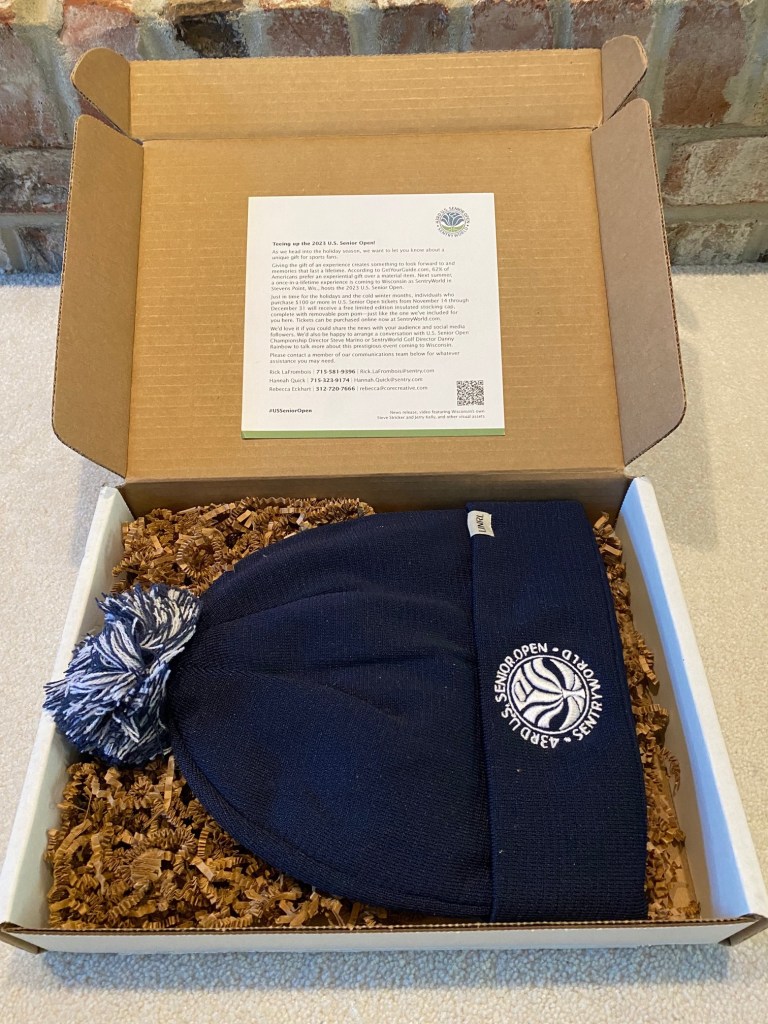
The 2023 U.S. Senior Open will be held at the spectacular SentryWorld in Stevens Point, WI. From now until Dec. 31, anyone who buys $100 or more in U.S. Senior Open tickets will receive a free SentryWorld insulated stocking cap with a removable pom pom that snaps on and off. My advice is to not only attend the Open, but also book your own stay-and-play at SentryWorld’s luxurious new Inn. Play where the legends of the game play!
Bushnell Wingman: Swing your swing and play your music
If you’ve gone all-in on technology and all the ways it’s changing golf, the Bushnell Wingman ($100) is for you. Essentially the Wingman is a top-notch Bluetooth stereo speaker combined with one of the best GPS systems in golf. Integrated into the speaker is a powerful magnet so you can stick it on your golf cart (or on your pushcart), and there’s a detachable remote control to carry in your pocket to click for audible yardages to the front, middle, and back of the green. Pair the Wingman with your phone to play music from your own library or streaming service, if the gentle strains of birdsong are too old-fashioned for you. Then download the Bushnell app onto your smartphone to display detailed maps and yardages of 36,000 courses, keep score, and more all on your phone and accessible without subscription or membership.
PUMA GS-ONE Spikeless Golf Shoes
PUMA has introduced their lightest spikeless shoe ever, the GS-ONE ($130). The softfoam sockliner and TPU saddle system in the midsole combine to hug your foot like a sock – a stylish, supportive, ground-gripping sock that also looks cool as a casual sports shoe off the course. Personally, I love not having to change shoes before and after a round. Give me a pair like the GS-ONE that I can wear to the course and wherever I go afterwards, and I’m one happy hacker. The only caution is that they tend to run a bit small and narrow, so if you’re ordering online, get a half-size larger than you think you need.
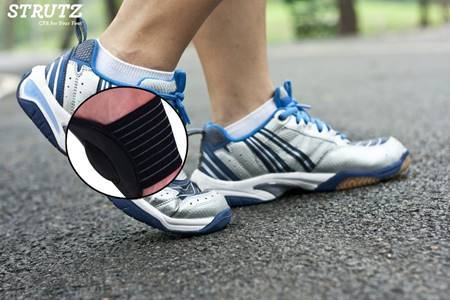
STRUTZ Arch Support
If you REALLY want to pamper your favorite golfer’s dogs, stuff their stocking with a pair of STRUTZ PRO cushioned arch supports ($28). They slide on your foot and fit unobtrusively inside your shoes to provide extra arch support while playing golf or just walking around. If you’ve ever suffered from plantar fasciitis, you know how debilitatingly painful it can be. STRUTZ can alleviate that pain and even keep it from occurring.
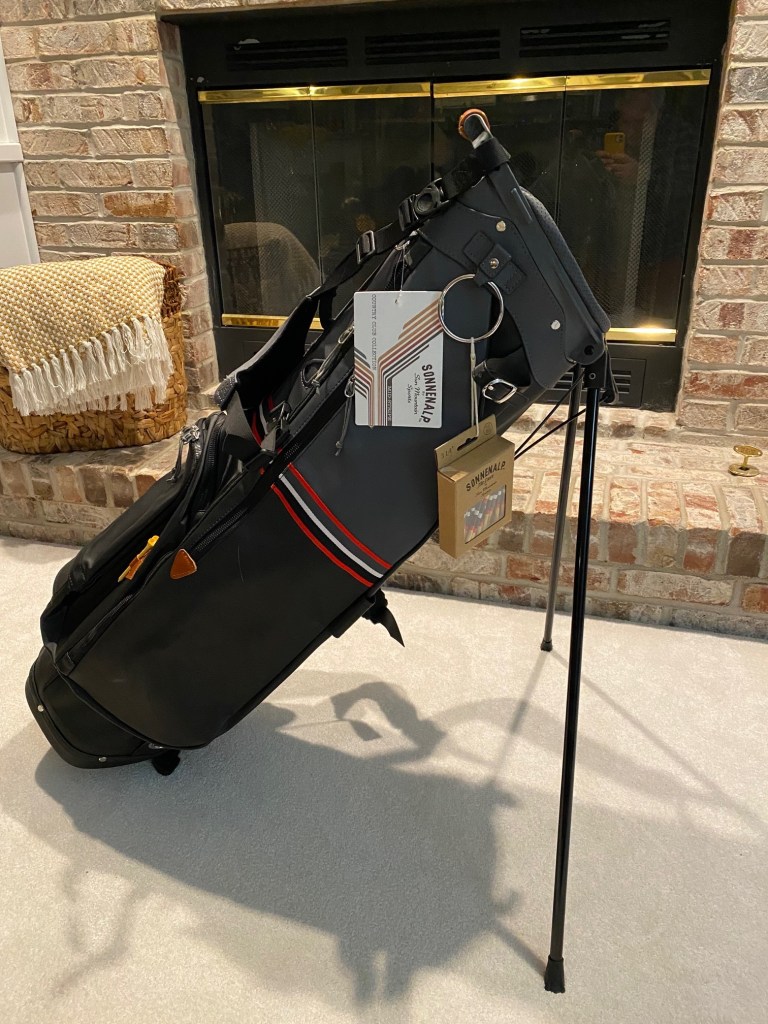
Sun Mountain Mid-Stripe Dual Strap Stand Bag
Let’s see…Your favorite golfer now has comfy shoes and arch support. Let’s add a lightweight stand bag to encourage more walking. Perfect for either walking rounds or riding rounds, the Sun Mountain Mid-Stripe Dual Strap Stand Bag ($370) is a retro-cool beauty. Weighing in at just 5.6 lbs., the Mid-Stripe features loads of spiffy detailing (like leather external tee holders), a 9” top with 4 dividers, and 7 functional, spacious pockets. I just love the way this bag looks and feels on my shoulders. After I got mine, I even started leaving my Sun Mountain push cart (also a great gift idea!) in the trunk and carrying more often—something I hadn’t done for years.
Pulling Each Other Along
When the winds whip and the snow blows, the golfer on your list could use a good book. Here’s a shameless plug for one I contributed to. Pulling Each Other Along ($25) is a compendium of inspirational stories of human kindness and perseverance, with forwards by NFL greats Terry Bradshaw and Rocky Bleier. I co-wrote the chapter by Dave Stevens, an old buddy of mine (pictured below) who is the only legless athlete to play NCAA football and professional minor league baseball. He’s also a 7-time Emmy Award Winner for his role as producer of NFL Sunday Countdown on ESPN. The chapter relates the time he pinch-hit for Darryl Strawberry in a St. Paul Saints game. And there are 30 more amazing stories like that in this award-winning volume!
Club Fitting
Club fitting used to be reserved for single-digit handicappers and private club members. Now with fitting center chains like Club Champion and mobile fitting carts in pro shops across the country, getting fit for clubs is within reach for golfers of any handicap and nearly any budget. Equipment companies send fitters to courses, too. I recently went through a fitting with Titleist for the new TSR driver and fairway woods, and I learned a lot about my swing in the process – mainly that it’s super inconsistent. The fitter certainly earned his $100 that day. Anyway, the point is, a gift card to a clubfitter is something many golfers won’t buy for themselves, but something nearly every golfer can use, whether it be a fitting for woods, irons, wedges, putter, ball, or the entire bag.
Golf Trip for Summer 2023
Although the pandemic isn’t over, travel has begun to resume. And I had the great good fortune to visit some amazing Midwestern golf destinations in 2022. When people think about taking a golf vacation, they often neglect the Midwest. This is a shame for them because some of the best golf trips in the nation are practically in Midwesterners’ backyard. Here are some of my favorites:
In northern Illinois, two golf destinations really stand out: Eagle Ridge Resort and Spa in Galena, with its three excellent courses, and The Quad Cities of Moline and Rock Island, Illinois, and Davenport and Bettendorf, Iowa. In the “QC” as it’s called, you’ll find a collection of outstanding daily fee courses on both sides of the state line, including TPC Deere Run in Silvis, venue of the PGA Tour John Deere Classic, and Fyre Lake, one of the state’s sparkiest hidden gems.
In Indiana, you can play not only two of the best public courses in state, but two of the best in the entire country (according to recent rankings). Combine a trip to Bloomington, where you’ll find Indiana University’s new Pfau Course with a jaunt down to French Lick to play the Dye and Ross Courses at French Lick Resort and Casino. If you’re feeling really spunky, finish off (or start off) with a swing up to Indianapolis to play one or two of the many excellent courses there.
In Wisconsin, there is of course the aforementioned SentryWorld, where $275 green fees allow you to put your wallet away for the rest of the day – all amenities, food, and drink are included in that fee before and during your round. You don’t even have to tip. Just north of Chicago in Lake Geneva, you’ll find Grand Geneva Resort and Spa, which used to be the Playboy Resort back in the day. Now it’s family-friendly, with two outstanding golf courses which, thanks to some redesign, are more player-friendly, too.
In Michigan, perhaps the most golf-rich state in the nation, you can stay in the southern part of “The Mitten” and play all six courses at the family-owned Gull Lake View Resort in Augusta. Or you can venture a bit farther north to the middle-Mitten for the golf paradise that is Boyne Highlands Resort in Boyne or the golf oasis of Forest Dunes Resort in Roscommon. If you REALLY want to explore, head to Michigan’s Upper Peninsula, where you can stay at the Island Resort and Casino and play courses on-site and nearby that will rock your world. (Literally – some of the land up there is very rocky!)
Even some stand-alone courses are getting into the stay-and-play business by building or renovating houses on adjacent property for foursomes or eightsomes to rent for extended visits. Kokopelli Golf Club in Marion, Illinois (far southern tip of the state) is not only in the process of upgrading every aspect of the course, but also every single amenity, including some on-site lodging.
Fuzzy’s Vodka, Cleveland HB Soft Milled Putters, and a putting drill for free!
In 1979 Fuzzy Zoeller, one of golf’s biggest personalities, burst onto the scene with his surprise win at the Masters. Today, his eponymous Fuzzy’s Vodka is made from 100% American corn, five times distilled and ten times filtered, and a portion of each batch is rested in new American oak barrels. The result is crisp, smooth, and incredibly clean. In response to Russia’s war on Ukraine, Fuzzy’s is promoting the American Stallion – same ingredients as a Moscow Mule, but different name and only all-American Fuzzy’s Vodka.
Cleveland Golf’s new HB Soft Milled line of putters provides a premium combination of features and technologies at a reasonable price ($199). HB SOFT Milled starts with each putter shape being cast in molten steel before the face and back are precision milled for performance purposes. Depending on stroke type and alignment preference, there is a new model to fit every stroke. For Slight Arc stroke types, the Golf Pride PRO ONLY Red Star is a tour-preferred pistol shape grip that is designed to help turn the putter over through the putting stroke. For Straight stroke types, the Golf Pride PRO ONLY Green Star has a rounded, oval-back shape for comfortable hand positioning and to help keep the hands quiet through the stroke.
A few strokes in my living room with the HB 11 (a dual-prong, “sabretooth” style) convinced me to put it directly into my bag. How can I be sure? Well, here’s my homemade snow-daze putting drill to work on alignment, speed, and putter path: Place a bottle of Fuzzy’s four feet away, and putt at it. The goal is to hit the round bottle squarely so that the ball bounces straight back. Push or pull even a hair, and it bounces off at an angle. And work on getting the bounce to come back about six inches – that’s ideal holing speed. After you’re done working, have a drink!
So that’s how we end this year’s Holiday Gift Guide – with a toast to you and yours! May you all be gifted health, love, and peace for the coming year…and may every golfer out there get a hole-in-one!
Big-league universities should have big-league golf courses – at least they should if they dream of competing at the top level of college golf. Indiana University in Bloomington is a stalwart of the Big 10 Conference in many sports, but their men’s and women’s golf programs have historically lagged behind many of the conference peers. A handful of IU alums can be found on the PGA Tour and Korn Ferry Tour, but none are currently on the LPGA or Symetra Tours. Perhaps one reason for this is that, prior to 2020, Indiana University’s home course was “tired.”
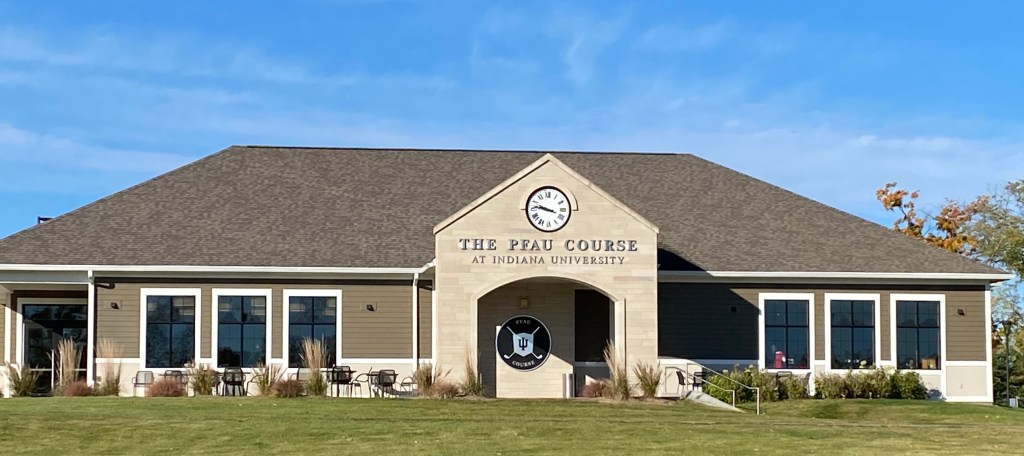
The clubhouse at The Pfau Course is all new, too.
“The old course was extremely tight and tree lined with not a whole lot of trouble,”says Pete Nelson of Visit Bloomington. “But mainly it was tired – in desperate need of some attention, and upgrades.” So the choice was to “upgrade,” or to dig it up and start all over. IU chose the latter.
The sad state of the former “IU Championship Golf Course” was not due to the land it was on. Southern Indiana has rather magnificent topography for golf, reminiscent in some ways of Northern Michigan, with its mix of hardwoods and grassland, plentiful water, and rolling hills. The property on which The Pfau Course is now located is no exception.
Behind the 2nd green of The Pfau Course is a good vantage point to get a feel for the rolling topography of the course.
Enter Steve Smyers and two-time major winner and Hoosier hero Fuzzy Zoeller. Thanks to generous gifts from alumni, especially the Pfau family, Smyers and Zoeller took the 265 acres that used to house the old IU course, a par-3 course, and the IU cross-country course and completely reimagined, reworked, and resurrected it. In 2020, The Pfau Course at Indiana University opened to rave reviews from college players, visitors, and golf media alike. It has already cracked the Golf Digest list of the “100 Greatest Public Courses,” debuting at #83 in 2022.
What qualifies The Pfau Course as one of the top 100 public courses in America? Smyers has been at the golf course architecture business for over 40 years, so a great deal of his work has been done on relatively flat land. Being of the “natural design” school, Smyers has become a master at tricking players’ eyes and manipulating angles so that power and precision cannot by themselves unlock a low score; strategy and course knowledge are also required. On numerous holes, you think your range finder must be wrong – the target looks so much closer or farther than the laser says. And many of the lines that look appealing are, in fact, not the ones you should take.
Favor the left side on the 460-yard, par-4 4th hole.
As Nelson, a proficient stick and regular at The Pfau, says, “If you’re playing a tournament here and you’re not playing a practice round, you’re in trouble.” In fact, high school and college coaches are generally required to schedule practice rounds for their players before tournaments, or the pace of play would grind to a near halt.
From the tournament tees, The Pfau plays 7,908 yards, with a par of 71 and a rating/slope of 80.2/155. Hoosier Daddy, indeed. Fortunately for mere mortals, there are seven sets of tees, ranging all the way down to 4,648 yards. The zoysia fairways are relatively generous where less-skilled players tend to land their tee shots, but fine ribbons where better players would prefer to be. The bluegrass rough is juicy, and the plentiful fescue beyond the rough is wispy enough to usually find your ball, and wiry enough to grab your hosel. Fairways are often sloped toward woodsy trouble, and the 147 “eyebrow” bunkers – circled with that same fescue – are ingeniously positioned for both strategic and visual effect. Despite the rising and falling landscape, the course is walkable, perfect for college and, maybe someday, professional tournaments.
The 470-yard, par-4 6th hole is probably the hardest on the course, despite what the scorecard says.
Playing The Pfau Course
The Pfau Course honestly has 18 great holes, so choosing a few to highlight is a daunting task that I will shy from in admitted defeat. Instead, I’ll focus on the many brilliant intrinsic traits that make each hole so great.
Trust me — you’d rather be in the bunkers than in their grassy “eyebrows.”
Aside from the flash-faced eyebrow bunkering, fist-time visitors will discern the subtly unique playing characteristics of the zoysia fairways. Zoysia is a firm, dense grass that sort of tees the ball up for you, promoting good contact with your irons. The imaginatively contoured bentgrass greens run around 11 on the Stimp meter, and although still young, they roll smoothly. Many pin positions require you to be on the proper side of the hole, or even short putts become testers.
The 630-yard, par-5 9th hole tests from the blind tee shot to the steep approach. Angles are everything here.
Throughout, the combination of topography and architectural flourishes calls to mind features of a couple of famous courses about 60 minutes away – The Dye Course and The Ross Course at French Lick Resort and Spa. Similarities to The Dye Course include infinity greens and ridge-back fairways that funnel into trouble. Similarities to The Ross Course include elevated greens and some geometrical greens – rectangular, triangular, and square. Nelson pointed out to me that the rectangular green of the 615-yard, par-5 1st hole is just five feet longer than a regulation basketball court. I personally would shorten it by that amount to pay homage to IU’s rich roundball tradition.
If there’s another weakness to the design, it’s the large gaps between yardages from the tees – about 600 yards between each set. The 6,153 yards of the middle tees (still with a slope of 140) prods the egos of many first-timers to jump up to the 6,736 back tees. But these play more like 7,000 yards, according to Nelson, when you take angles and elevation into consideration – a recipe for a lot of 15-handicappers having long days. The solution here is simple, though: rate the course for some combined tees.
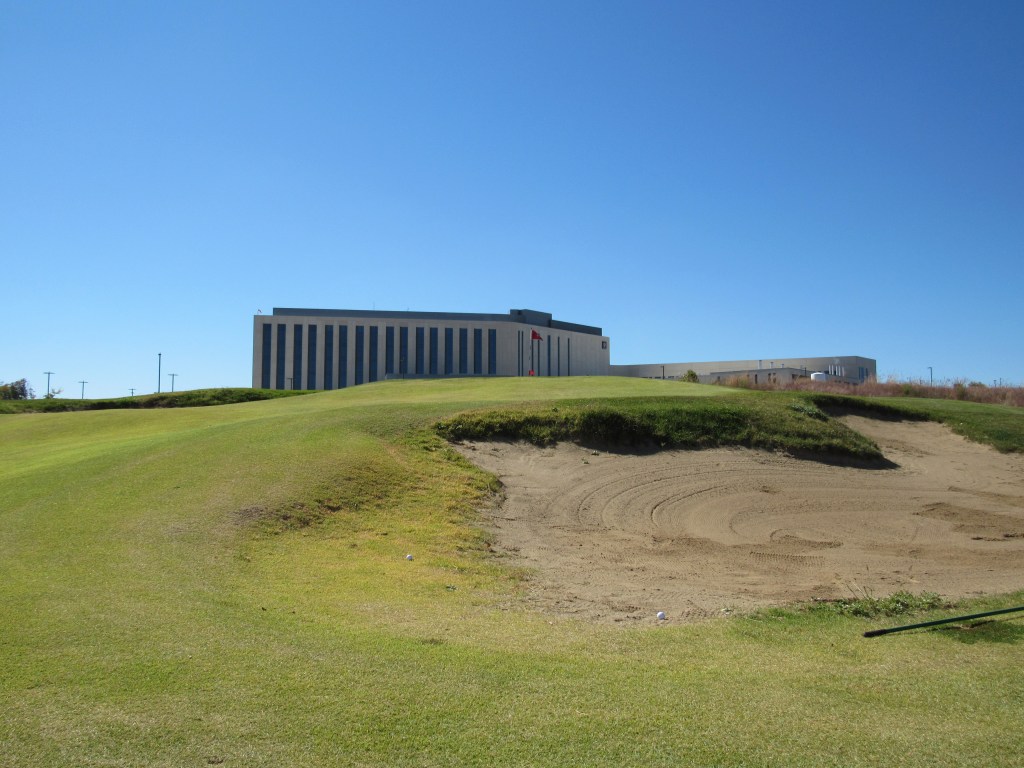
This is not where you want to be trying to get up and down for par from on the par-5 13th. But you get a nice view of IU’s new University Hospital.
Wherever you play from, when you get to the 517-yard, par-4 18th, you’ll experience one of the best closers in a golf-rich state. Although it plays downhill, even a big power fade must carry a long way over scrub from the tips. From the middle tees, that same power fade still leaves a demanding uphill approach to a mostly blind putting surface over a sea of fescue dotted with a dozen bunkers. I could have broken 40 on the backside, if not for a deflating double-bogey here.
All that’s lying between you and the perfect approch shot on the par-5 18th is 7 bunkers and all that fescue.
Take a Hoosier Golf Swing
In sum, The Pfau Course, with rates that topped out in 2022 at $95 riding holidays and weekends, is a spectacular playing experience at a spectacular price. If you want to try to score well—and to really appreciate the architectural brilliance—play it more than once. And if you want to dive deeper into the world-class golf that the Hoosier State has to offer, Nelson and his staff have a golf trip for you:
Fly into Louisville, KY, and drive about an hour north to French Lick, IN. Stay at the French Lick Resort and Spa or West Baden Hotel and Spa (same ownership) and play The Dye Course (#19 on Golf Digest’s Top 100 Public list), and The Ross Course (see link above). Enjoy the fine dining and casino at French Lick Resort, and peruse the astounding history of the place. If you want a bonus round, take a 20-minute side-trip to Jasper, IN, to play Sultan’s Run, which also ranks annually on the list of the state’s best courses.
Then drive a little over an hour north to Bloomington to play The Pfau. Stay over in one of the many affordable hotels in Downtown Bloomington (which are extremely reasonable if there is not an event in town)—Spring Hill Suites and Graduate Bloomington are both highly recommended. Walk around the charming Fountain Square area and enjoy a meal at the upscale Uptown Café (literally the classiest upscale “café” you’ve ever seen) or grab a brew and a delectable smoked pork chop at Upland Brewing Co.—all within walking distance.
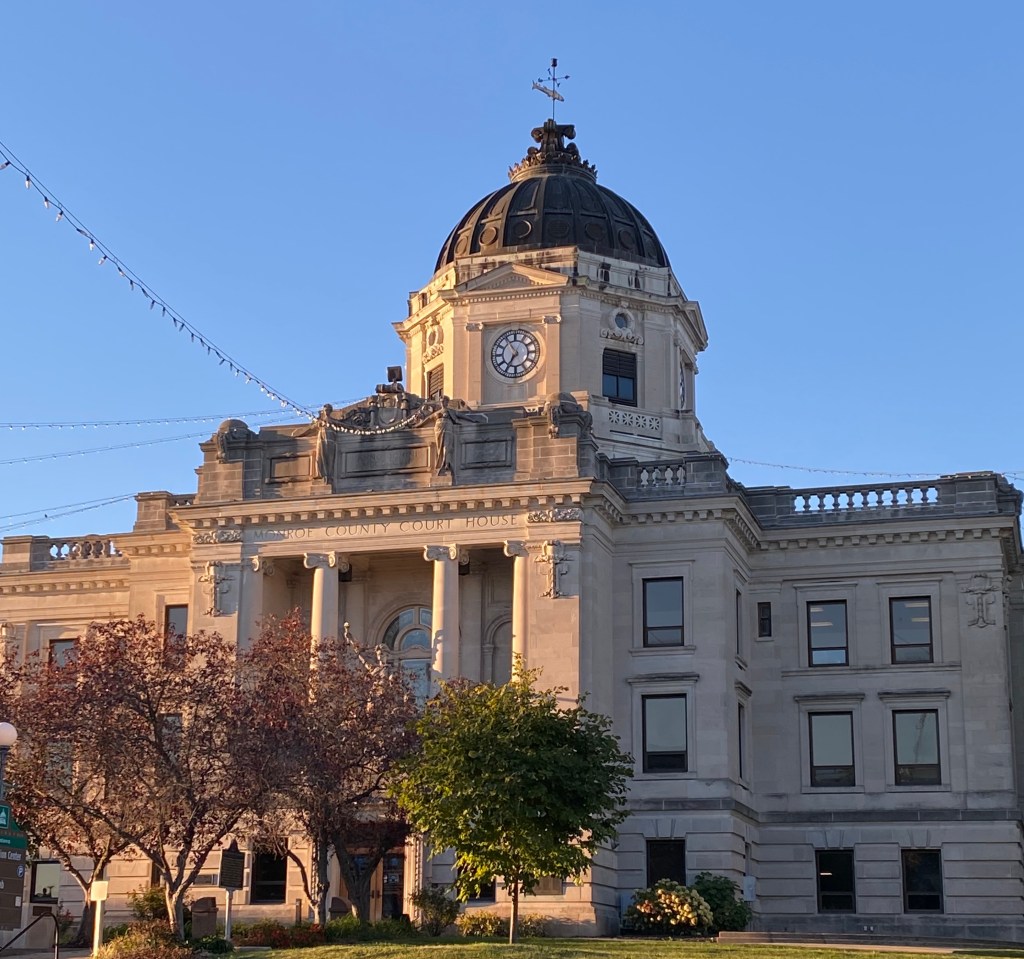
Downtown Bloomington is both historic and hip.
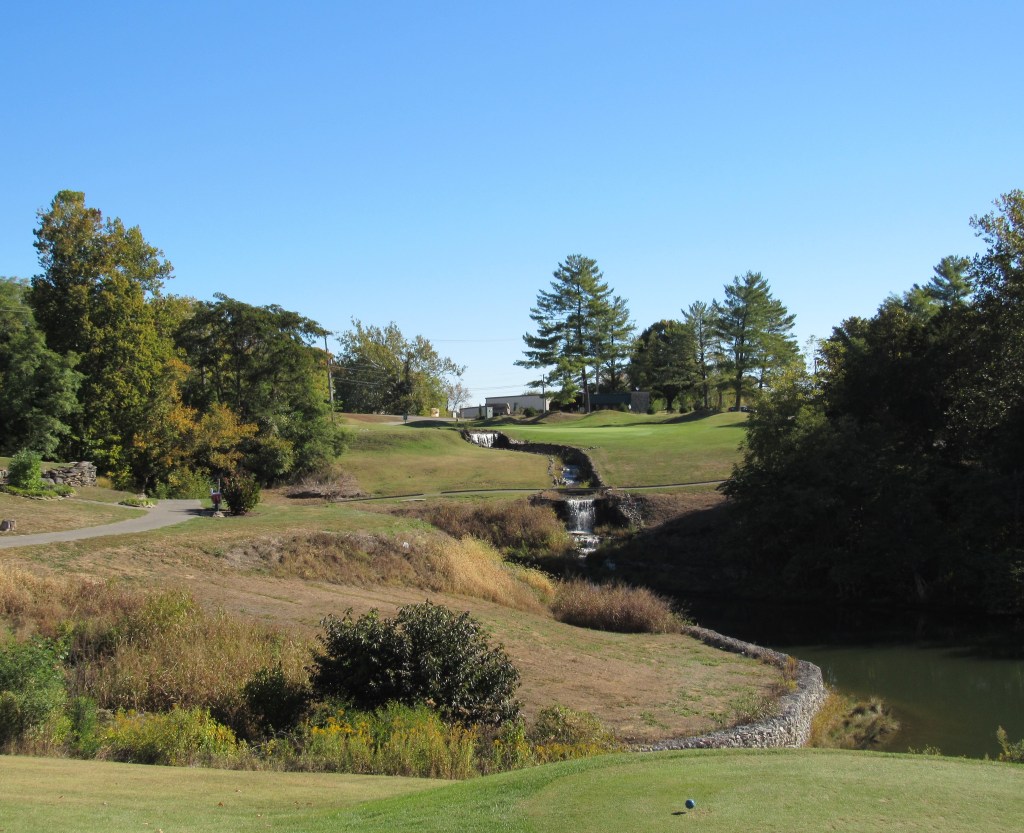
If you want another bonus round, drive about 25 minutes to The Golf Club at Eagle Pointe, a 1970s-era golf-community design with some quirky, memorable, remarkably fun holes. The 207-yard, par-3 10th hole is worth the visit alone, with its uphill tee shot over a multi-tiered waterfall.
The par-3 10th hole at Eagle Pointe is worth the price of admission all by itself.
From Bloomington, head about another 90 minutes north to Indianapolis, and choose from famous tracks like Brickyard Crossing – the Pete Dye track with four holes inside the track of the Indianapolis Motor Speedway – The Fort, Purgatory, and The Trophy Club. Seriously, Indianapolis might offer the best selection, quality, and affordability of golf of any urban area in America.
Then fly back out of the Indianapolis International Airport. Of course, you can fly into Indy and out of Louisville, too. Either direction, it’s win-win-win-win-win… Well, you get the idea.
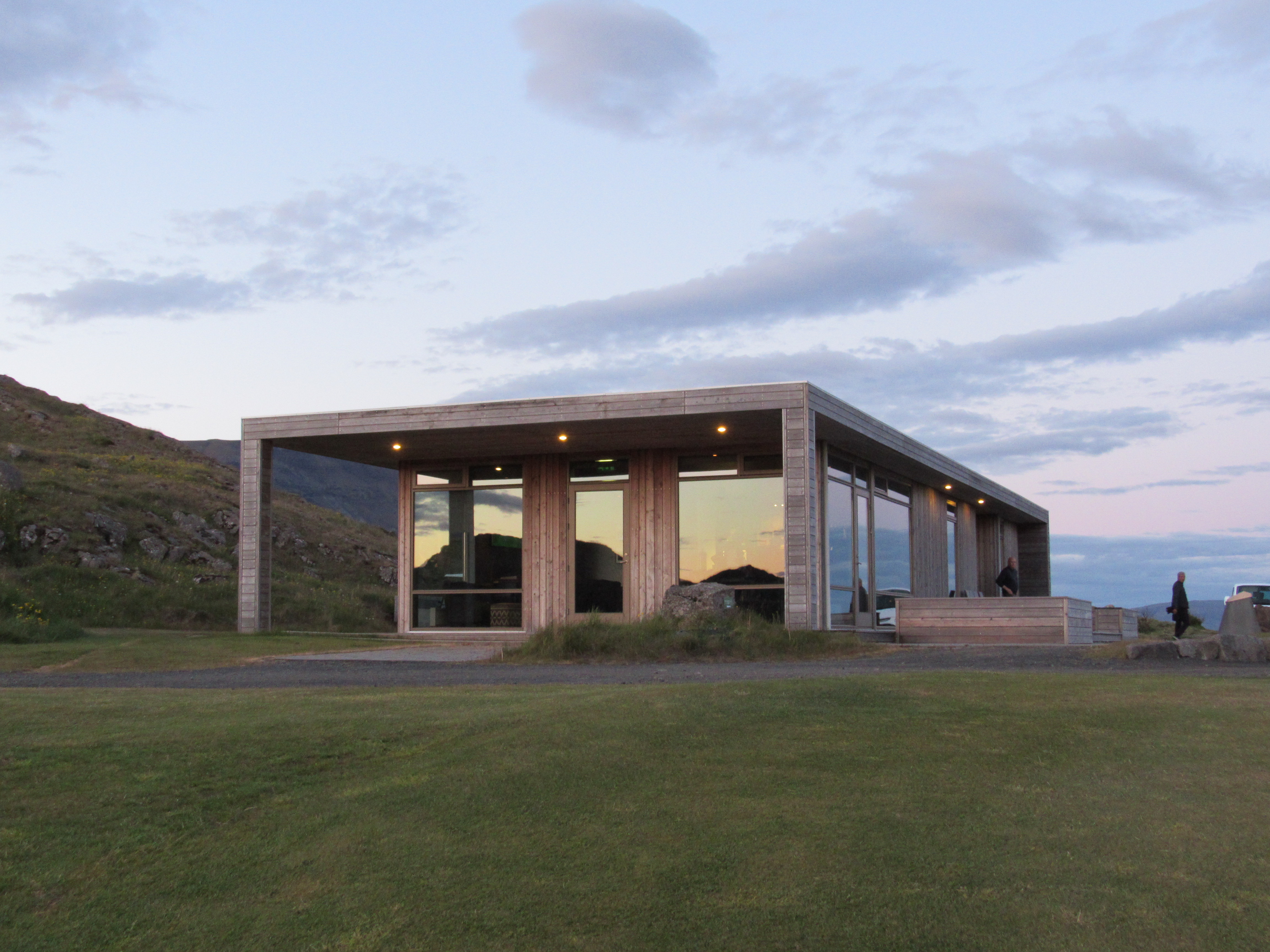
The clubhouse at Brautarholt Golf Course outside of Reykjavik, 2 a.m. on the Summer Solstice
It was 9:30 p.m., June 21—Summer Solstice, 2019—when Gunnar Pálsson picked me up at Hotel Frón in Reykjavik. Soon joining us in the Brautarholt Golf Course shuttle were four test pilots from Phoenix and a couple from outside Toronto. We were all heading to the course to play a round of golf under Iceland’s never-setting Midnight Sun.
“This is a bucket list experience,” said the woman from Ontario. “I’ve been planning this since October last year.”
“We decided to do it last night,” said one of the test pilots, clearly more comfortable flying by the seat of their pants, as it were.
If you’ve never thought about golf in Iceland, you wouldn’t be alone. You also wouldn’t be from Iceland. In fact, there are some 65 golf courses in Iceland, according to Gunnar, including the Golf Club of Reykjavik, which has over 3,000 members, making it one of the largest golf clubs in Europe.
“But what sort of season do you have here?” I ask Gunnar, exposing the depths of my ignorance about golf in Iceland.
“At Brautarholt, because we are on the coast, we usually open on the first of May and close at the end of October,” he says to my obvious surprise. That season’s not so different from some of the fabulous courses in northern sates like Minnesota, Wisconsin, or Michigan.
When the shuttle pulls into the gravel Brautarholt car park, we see what Gunnar means by “on the coast”: the North Atlantic is literally a driver and a mid-iron from the first tee (driver, 7-iron to be exact – trust me, I know, though I wasn’t trying).
Brautarholt Golf Course opened its first 9 holes in 2012, with three more opening last year. “We have 12 holes so far,” explained Gunnar in the shuttle, “with plans for 18 and land for 36.”
Out on the course, Gunnar provided a bit more history: “Before the financial crash in 2008, my brother-in-law was bought out of two businesses. Then the crash came and prices fell. He said, ‘When are we ever going to be able to build a golf course this cheaply again?’ So we began building the course.”
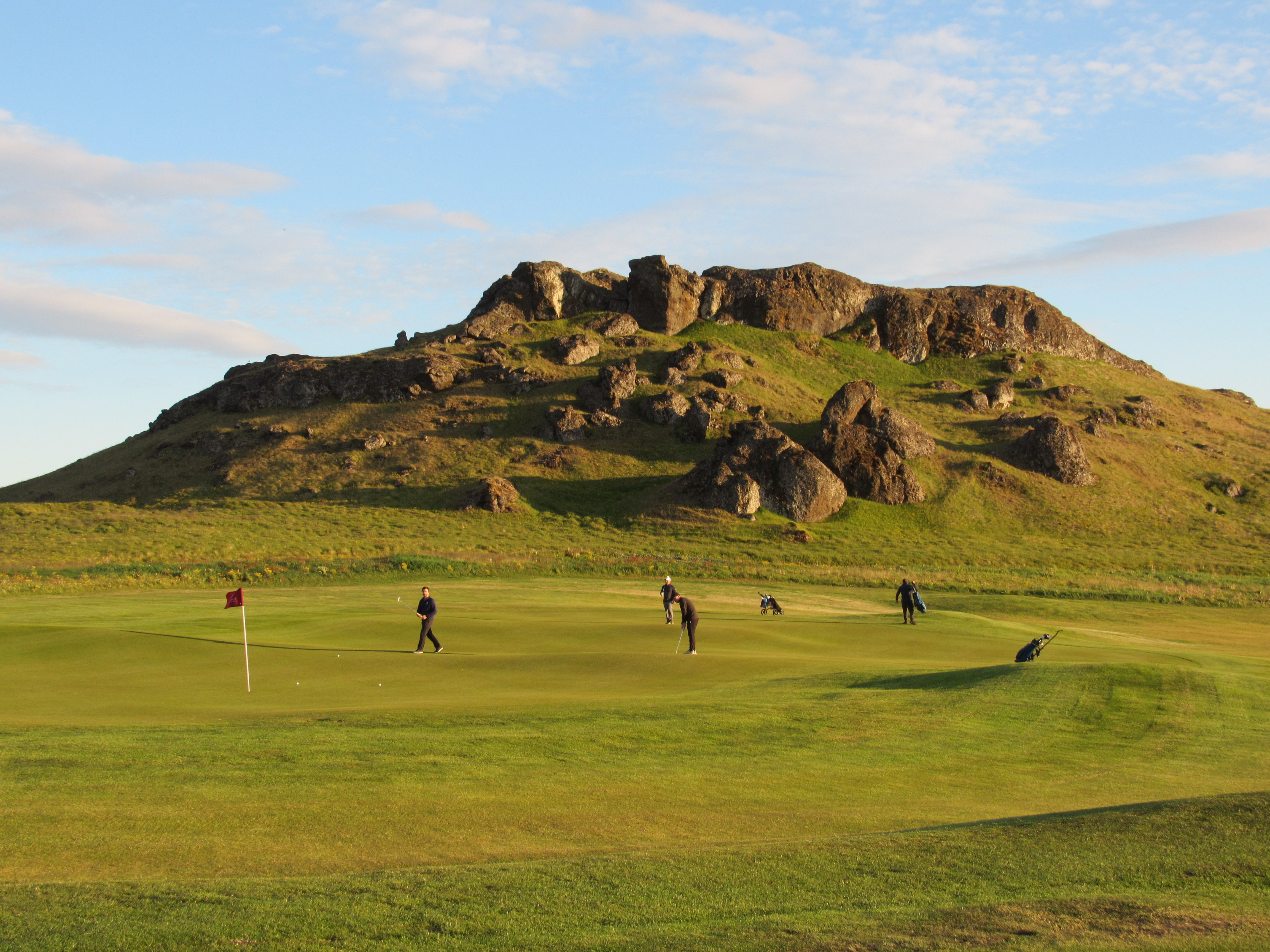
The former hay fields, most of which had been in the family for 100 years, occupy stunning headland – with the look, feel, sound, and soil of true linksland – along the shore about a 30-minute drive west of Reykjavik. The clubhouse is modest but modern and sleek, with large windows looking out toward the sea and onto the rocky outcroppings that define many of the holes. The air inside the cozy space is redolent with the aroma of homemade soup, simmering in a pot for golfers making the turn or ending their round. A delicious bowl of soup with some crusty bread seated in the clubhouse seems far more civilized than scarfing down a hotdog in the golf cart as you race to the 10th tee. But I digress.
First tee, Brautarholt Golf Course, 10 p.m. — An impish par 5, elves or no elves.
10:00 p.m. seems like a reasonable time to tee off when the sun is still high in the southwestern sky – in fact, from the elevated westward-facing first tee, the solstice sun is fairly blinding. Although not yet complete, Brautarholt has already been nominated to the Top-100 in the World list by Golfscape website, and 40th among Scandinavian courses by Golf Digest. All comments I’ve read about it online say, “Bring a lot of balls!” and I have brought a new dozen with me; there will be only two survivors.
From the back tees, the 2012 Edvinn Roald and Michael Kelly design plays 2,674 yards for 9 holes, 5,348 for 18, and 3,424 for 12, to a par 70. The total yardage, at present, doesn’t seem overwhelming, but between the ocean winds and heavy maritime air, cool temperatures, copious expanses of knee-high fescue, and wildly shaped greens that often drop off into the sea, there is plenty of challenge here. This is all especially true for all first-time international visitors; it’d take a good half-dozen rounds to figure out the optimal angles and landing areas, not to mention the club selections.
That final task, club selection, is especially tricky if you’re using one of the many sets of rental clubs at Brautarholt, all of which were top quality (Callaway, PING, TaylorMade, etc.). Still, you’re never quite sure how far strange clubs will go, and distances are tough to judge against backdrops of water and mountains.
The 437-yard par-5 1st hole is a perfect example. The hole plays from an elevated tee down to a fairway the angles to the left, with the ocean on the right and a marshy pond on the left and cross-bunkers just beyond the pond. Now, the ocean on the right is out of play, but it’s hard to judge this, and my tee shot ended up too far left, catching the pond. The second shot is to a blind green up above the fairway, with a rock outcropping on the left and a cliff on the right. After playing it once, you realize to favor the left – a lot – because everything funnels left to right once you get up to the green, and if you aim left but push it, you might miss the ocean.
First green, from the cliffside above, on the way up to the 2nd Hole
From the first green it’s quite a hike further up the cliff to the tee of the 125-yard 2nd. But players are rewarded generously upon arrival. From the elevated tee on a clear day (or clear middle of the night, during summer solstice), you can see off in the distance the dormant volcano Snæfellsjökull, which appeared in the Jules Verne novel “Journey to the Center of the Earth” as the passage into the center of the earth.
The green at the 125-yard 2nd Hole features a prominent hump in its middle, and a severe drop-off behind
After you’ve been sufficiently impressed by the view, you tee off with a wedge to a green in whose middle lies a rather imposing hump. “There was a huge boulder there. Michael Kelly decided to leave it. He’s a proponent of laying the golf course on the land and using the natural hazards.” If your tee shot finds the opposite side of the pin location, traversing the turfed-over boulder makes a three-putt a distinct possibility. If the pin is in the back, and you go long, you might find your ball in shin-high fescue. (It’ll be there, but you might not find it.)
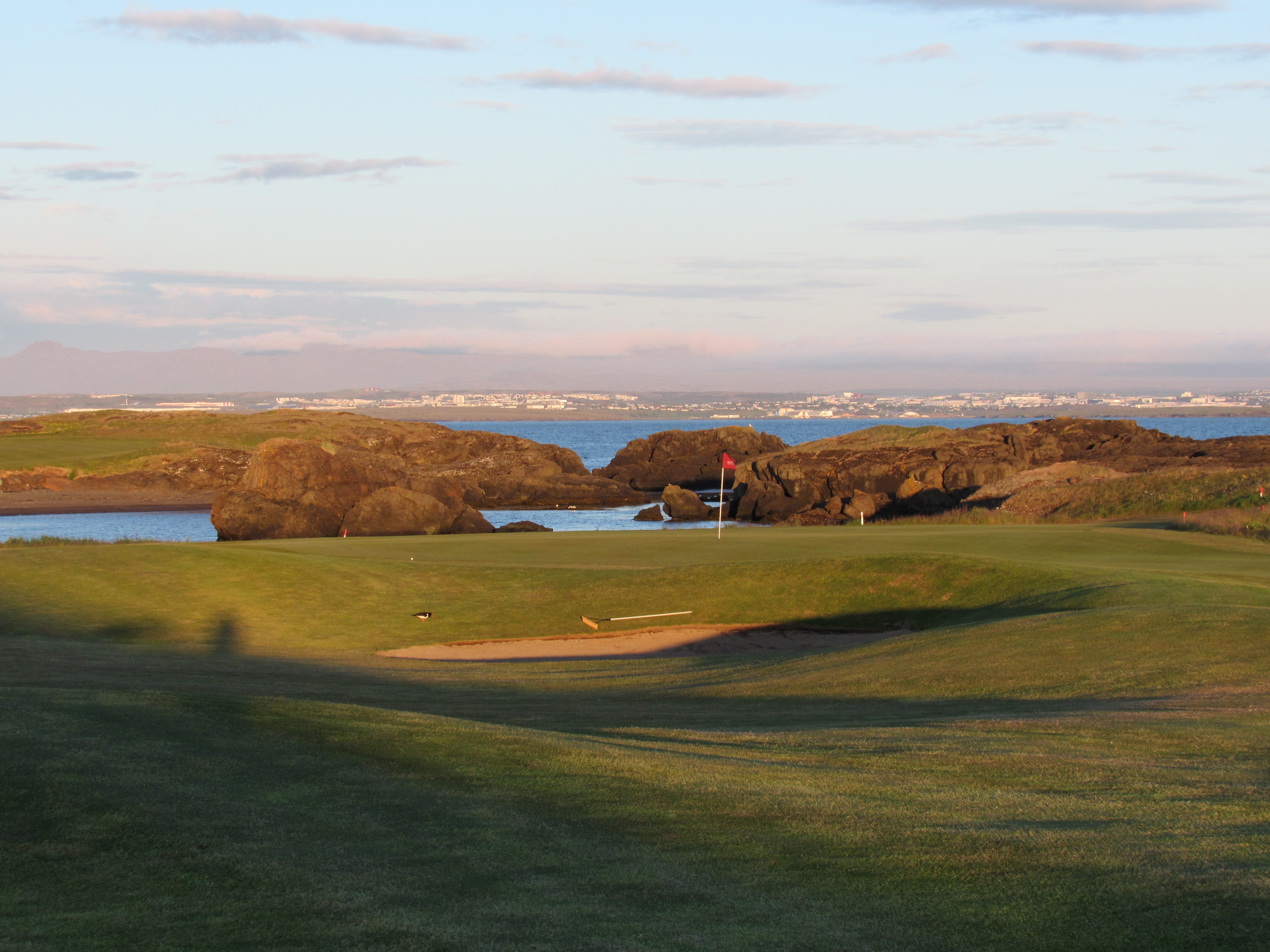
The 223-yard, par-3 5th is a left-to-right cape hole that dares you to challenge a small bay and rocky beach with your tee shot—a challenge almost worthy of its own Icelandic saga. The prevailing wind balloons shots, and the green is partially encircled by rocky shoreline. I happened to land on the beach, from which I knocked a recovery sand wedge to 12 feet and sunk the putt for one of my favorite all-time scrambling pars.
The green of the 223-yard, par-3 5th Hole at Brautarholt Golf Course delivers a gorgeous, rocky view of Reykjavik across the bay.
The 359-yard 7th is brutal. It plays back up away form the ocean to a snaking sliver of fairway that angles awkwardly away from the tees. On either side lurks water and knee-high grass. To top everything off, there’s a ditch bifurcating the fairway pretty much exactly where you hope to land your drive. Things don’t get any easier on the green, which is sloped severely uphill, and if you don’t get your ball back to the top level, it’ll come back to your feet.
“Michael Kelly believes every green should be special,” says Gunnar with classic Icelandic stoicism as we both wait to see of our balls are actually going to stay up on the green.
The 491-yard par-5 9th plays from an elevated tee down to a fairway that is only partially visible from the longer tees. Favor the right side here, as the fairway cants to the left toward high grass and a stream. There is a pot bunker in the middle of the fairway, though, where even well-positioned drives can find themselves. Approaches to the green must carry a deep swale fronting the putting surface.
The tee shot on the par-5 closer must navigate fescue right, more fescue and water left, and a pot bunker in the middle. Aim right side of the fairway off the elevated tees and hope for a favorable bounce.
The 9th green is a memorable finish, if you decide not to play 12 or 18.
Behind the tee of the 262-yard par-4 11th, you can see in the distance the location of the first Christian church in Iceland (there’s still a church on the spot, but the original, and several replacements, have long since burned down). Then off to the right a way, if you know where to look, you can see an old house on the former site of a temple to Thor. There were, according to Gunnar, epic battles between the keepers of these two houses of worship around, which served as the basis for one of the Icelandic sagas.
“This is elf land, according to folk history,” says Gunnar, as I realize how many balls I’ve lost in just 12 holes. “Perhaps elves took some of them?” Gunnar wants to put up a sign that tells golfers to behave or the elves will get them. It used to work on Icelandic children to keep them away from dangerous places. And who knows, supposedly you can meet elves at midnight on the summer and winter solstices.
10th green at Brautarholt, about 12:45 a.m. The sun is behind that mountain, but visibility is still just fine on the solstice.
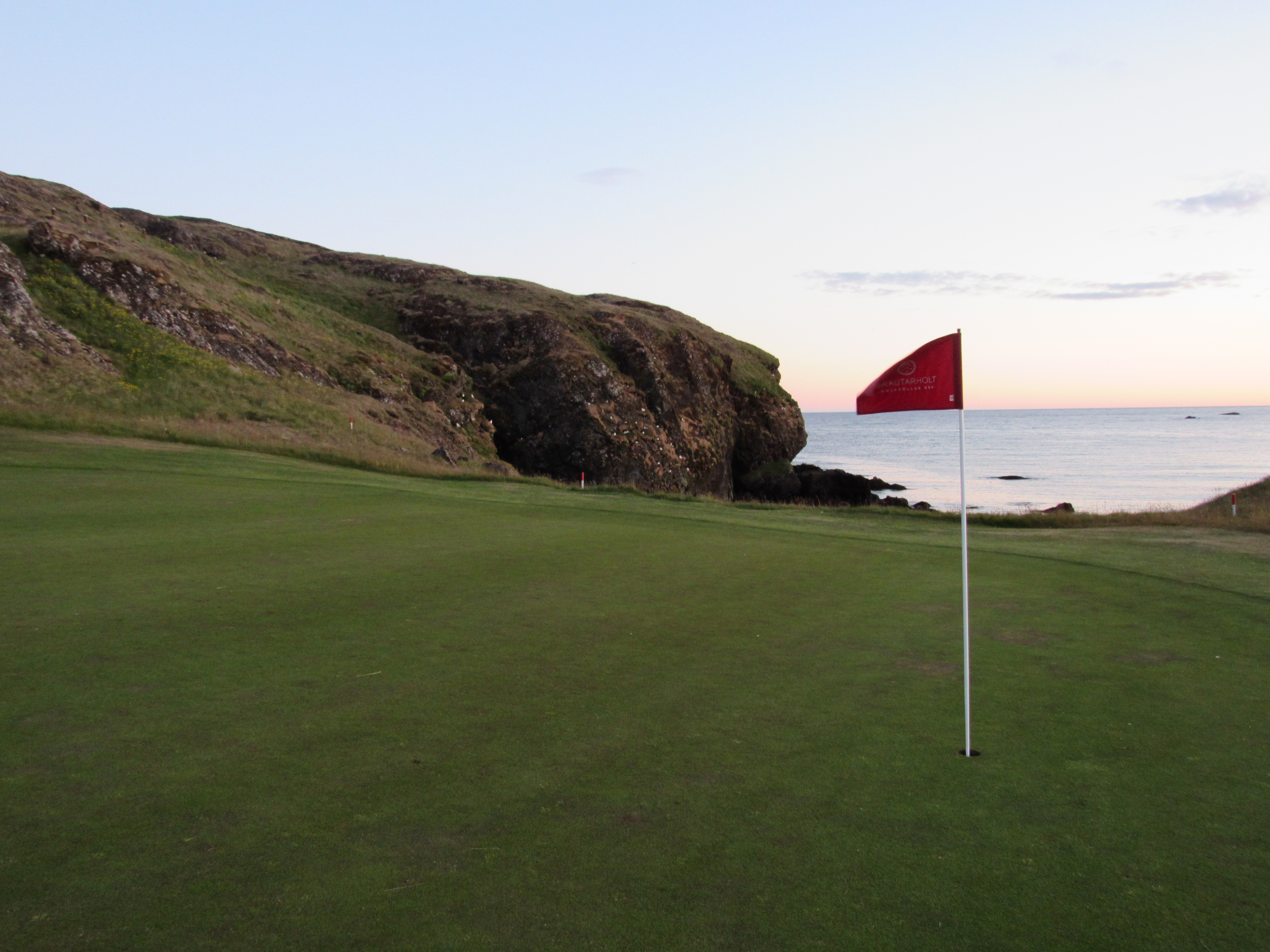
I saw no elves, but experienced perhaps the pinnacle of unique golf experiences at Brautarholt Golf Course this solstice. We concluded our round (and I played a couple more holes because I didn’t want to leave) close to 2:00 a.m., and even though the sun was low behind a distant mountain, there was plenty of light. The word “magical” came to mind again and again. Indeed, if the entire cast of “Game of Thrones” showed up in full costume to play Brautarholt, they would fit right in.
I took another crack at the 1st hole, but still bogeyed. On the plus side, I captured this nice view of the flag and sea at 2:00 a.m.
Midnight golf packages at Brautarholt run about $200 total, including rental clubs and transportation to and from any hotel in Reykjavik. Even if you’re not lucky enough to be in Iceland during summer solstice, any trip to Iceland between May and November should include a round of golf here. The views of the sea, of Reykjavik itself across the bay, and the surrounding mountains are imminently memorable. 12-hole fees are around $70, 18-holes run about $85. Both pull carts and golf cars, along with rental clubs, are available.
“I can check ‘midnight golf in Iceland’ off my bucket list,” says the woman from Ontario as we load into the van to head back into town. “This was perfect.”
Magically perfect? Perfectly magical? Either one works just fine, for us and the elves.
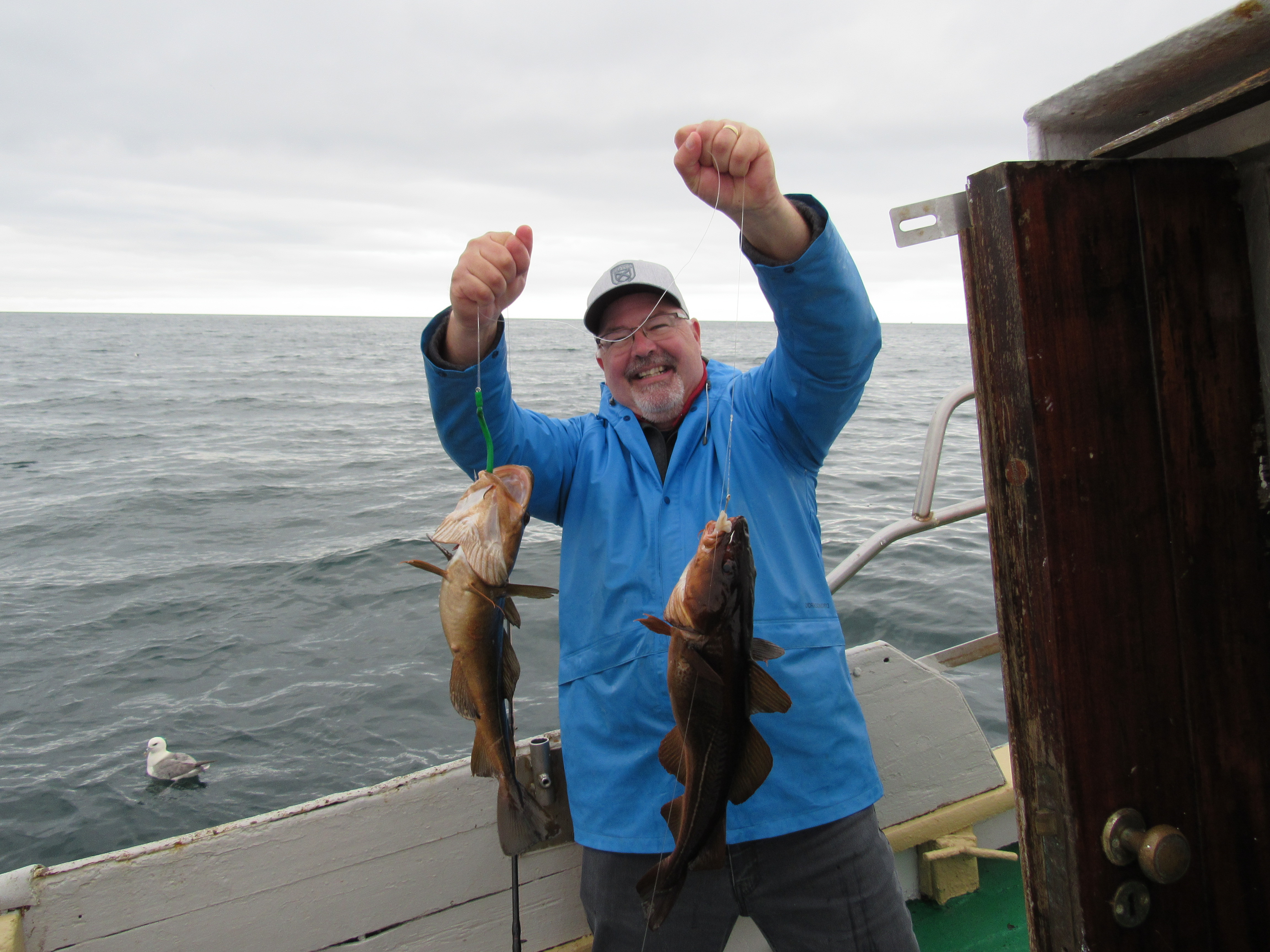
If you find yourself in Iceland during the summer and want to do something besides play golf, I recommend Happy Tours for some excellent cod fishing (which they cook up on the boat for you–delicious!).
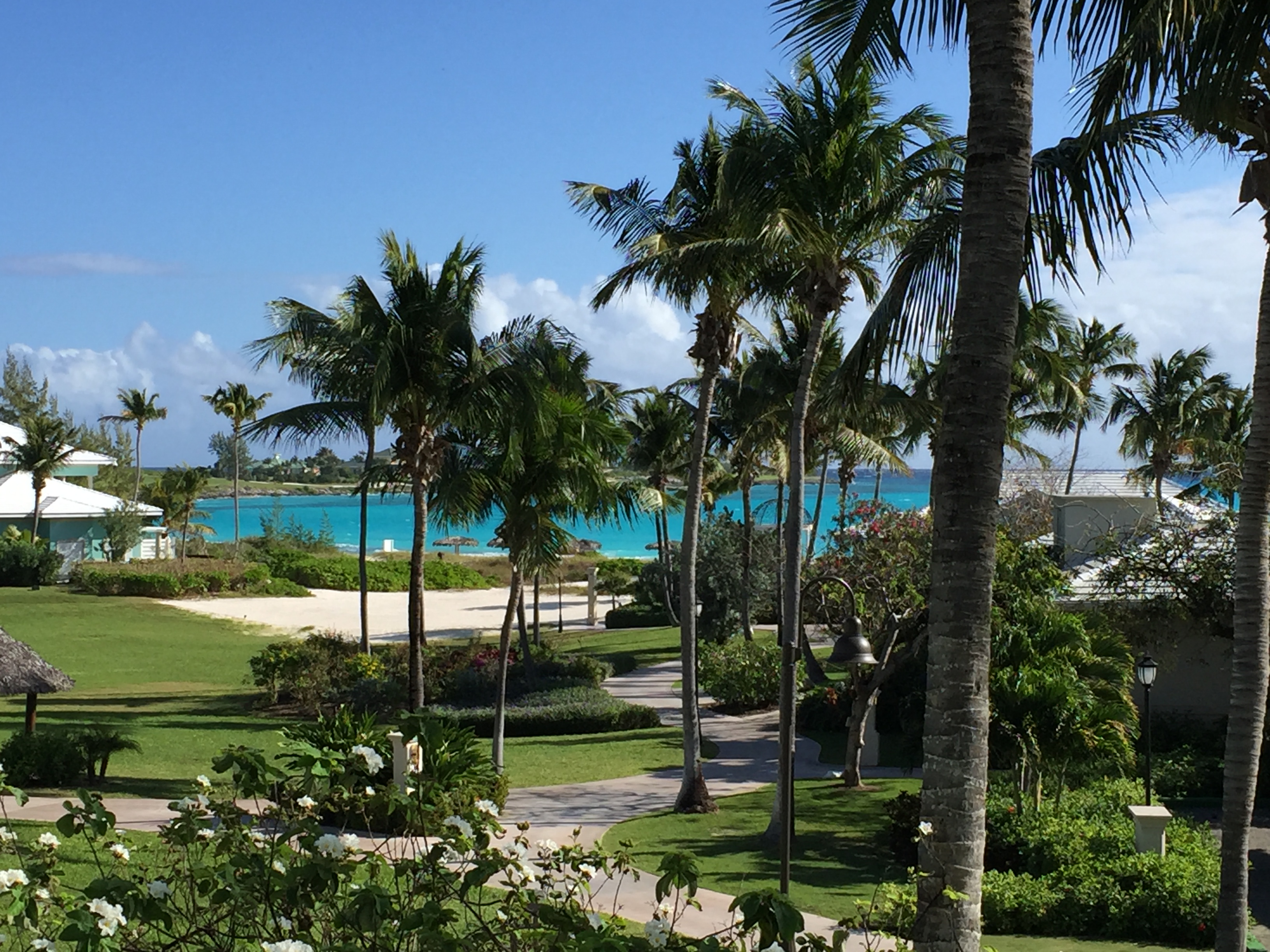
The view from our room was awfully hard to say good-bye to when it was time to head home.
The water around Great Exuma Island in the Bahamas is one of the most recognizable landmarks to astronauts 249 miles overhead. The irradiant blue-green hues are unrivaled elsewhere on the plant, as tides rush in and out through shallow channels between Exuma’s 365 islands and cays. The ocean seems to glow, as if lit from below.
Sandals Emerald Bay Resort and its championship Greg Norman-designed golf course boast panoramic views of these waters – vistas that look like they’ve been filtered by some hyperbolic Instagram photographer. But there is no smart-phone trickery here. Only paradise wherever you look.
Sandals Emerald Bay Resort
Sandals has been synonymous with “all-inclusive resort” since the first one opened in 1981.
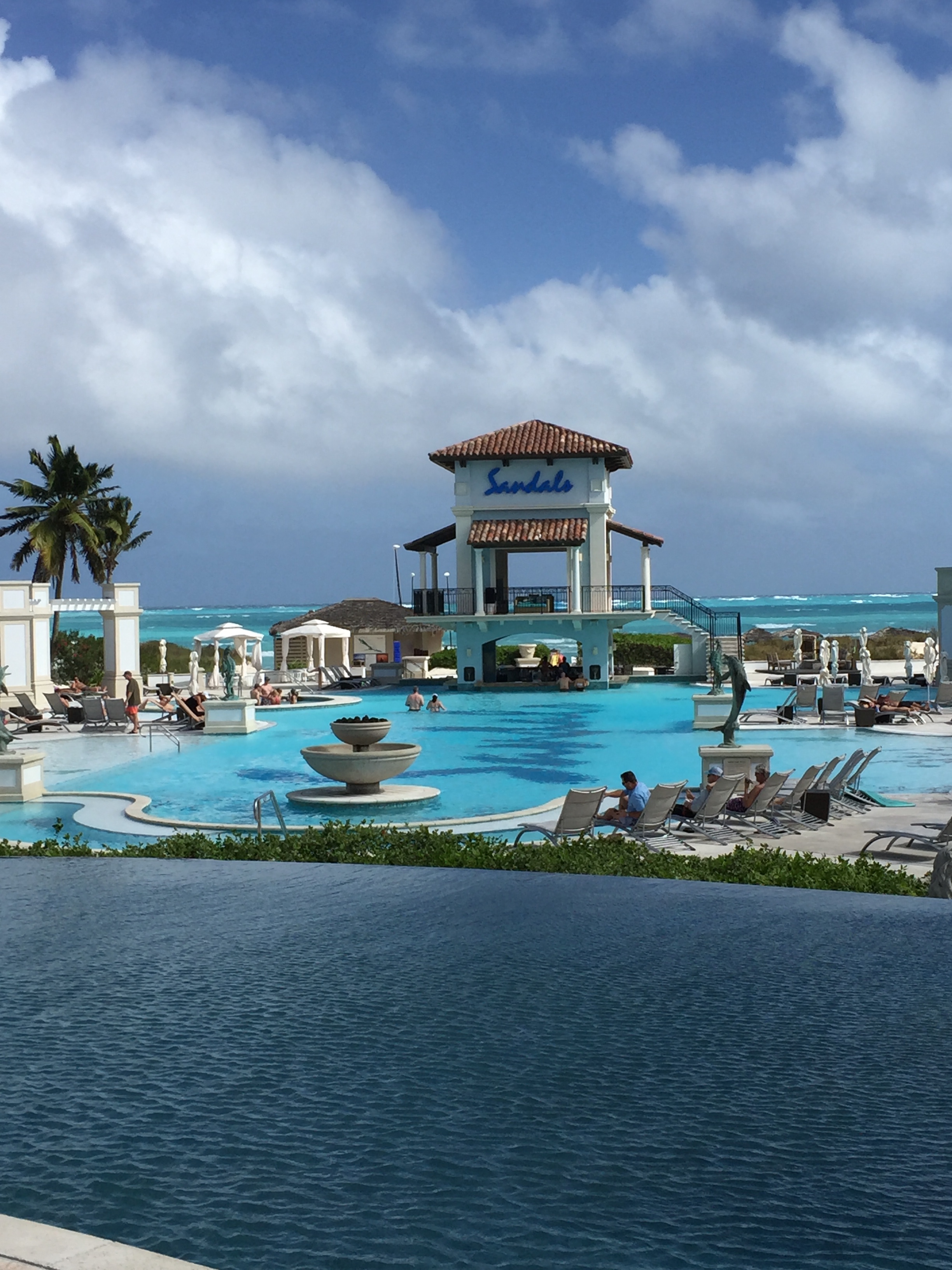
The name Sandals is synonymous with Caribbean getaways. The first Sandals opened in 1981 in Montego Bay, Jamaica, and pioneered the concept of the all-inclusive couples resort. Sandals Emerald Bay opened in 2010 when the company took over and expanded the Four Seasons on Great Exuma. Sandals Emerald Bay is the larger of two Sandals in the Bahamas and is expansive by any measure. Sandals employs 650 on this island of 4,000 residents. Many of the staff come from other Bahamian islands other Caribbean locales (we met several from Jamaica). There are 11 restaurants on property, two large pools, and a nearly mile-long private white-sand beach.
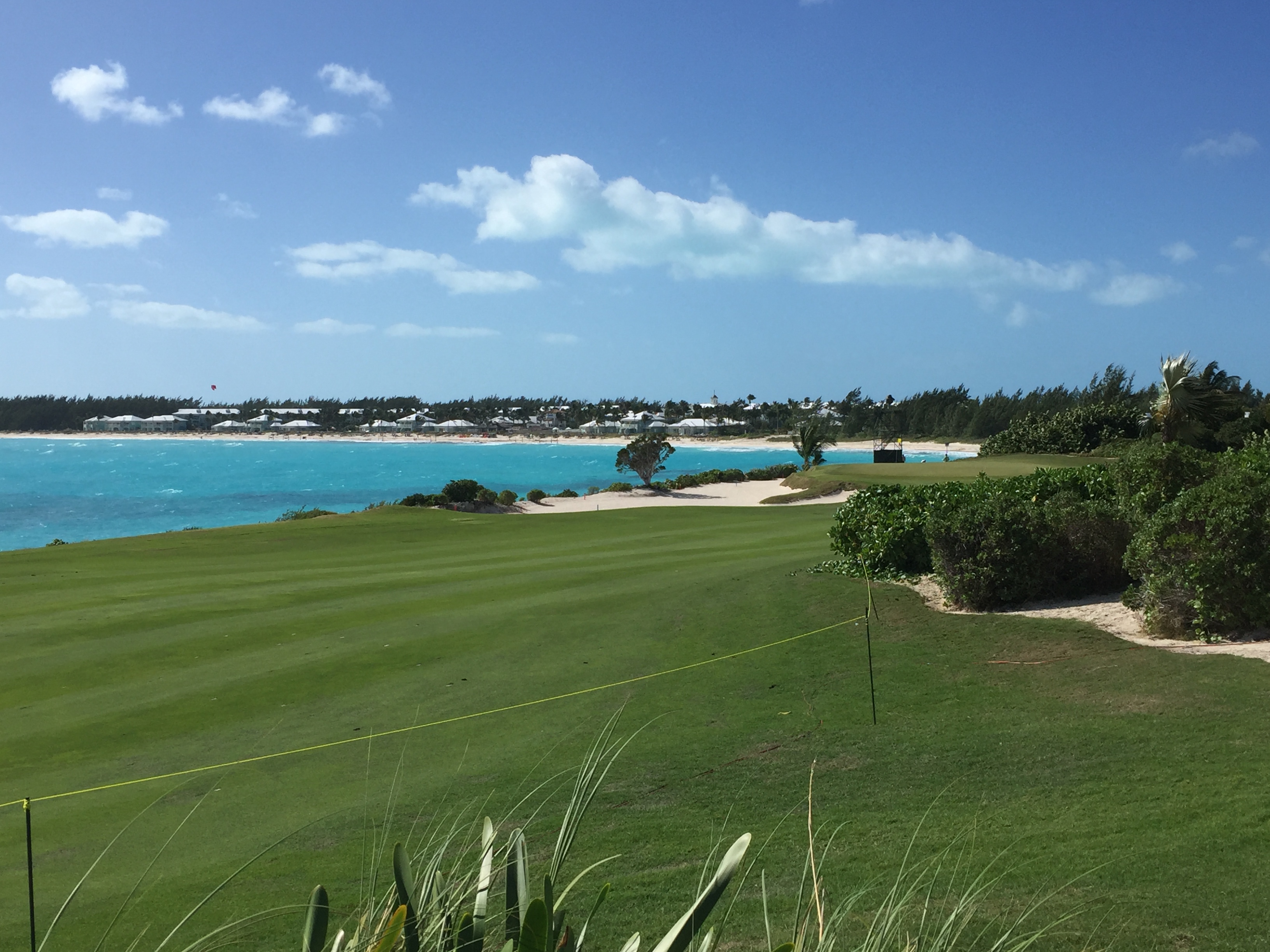
From the 16th Hole of the Sandals Emerald Bay Golf Course you can see the full expanse of the resort’s private beach.
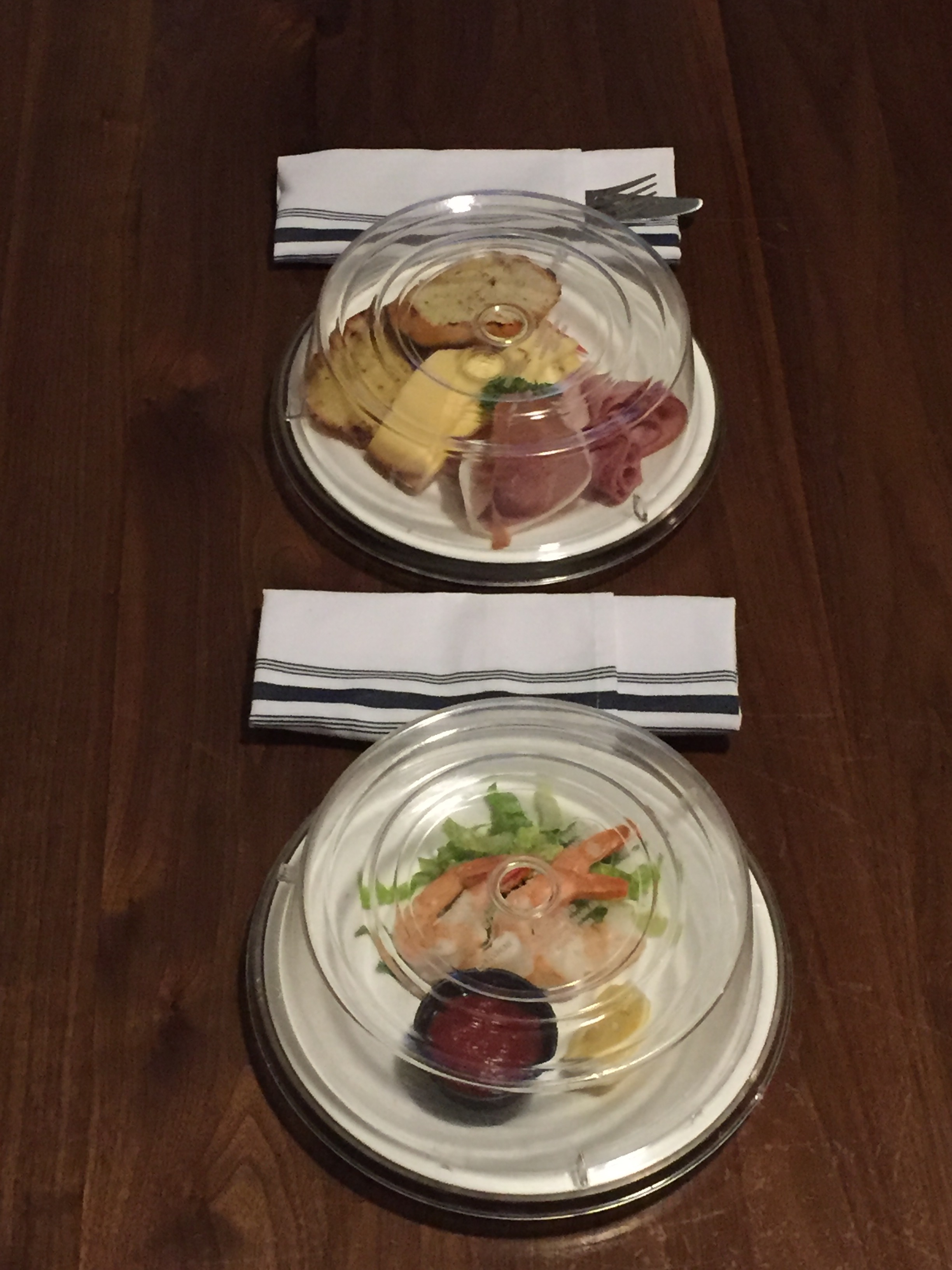
Service at Sandals is outstanding. Guests have the option of upgrading to butler service, complete with a private cell phone to call their butler any time of day or night. Our primary butler, Kevin, seemed to anticipate our every need: surprise charcuterie boards were waiting for us in our room. Hot bubble baths were drawn to meet us when we returned from our strenuous days of sightseeing, golf, and laying about. Prime lounge chairs and cabanas were saved for us by the pool. Signature cocktails magically appeared in our hands precisely when we started thinking, “Hmmm…I might go get a drink.”
Our butler Kevin made sure treats and snacks were always waiting for us in our room.
Food at all-inclusive resorts sometimes takes a back seat, given the “captive” audience. My wife and I tried nearly every restaurant at Sandals Emerald Bay and were struck by the consistent quality, ranging from very good to excellent. The Jerk Shack chicken and yams were my favorite casual fare (perfect by the pool with a cold beer). For dinners, Soy sushi, Bombay Club Indian, La Parisienne French, and il Cielo Italian were frankly neck and neck in terms of our favorite meals—all excellent, all very different. Dinner at il Cielo was especially opulent, as we attended a small private dinner with Adam Stewart, Deputy Chairman of Sandals Resorts, whose father, Gordon “Butch” Stewart, is Founder and Chairman of Sandals Resorts. Also in attendance was Greg Norman, World Golf Hall of Famer and designer of the Sandals Emerald Bay Golf Course.
Dinner with Greg Norman and Adam Stewart, Deputy Chairman of Sandals Resort
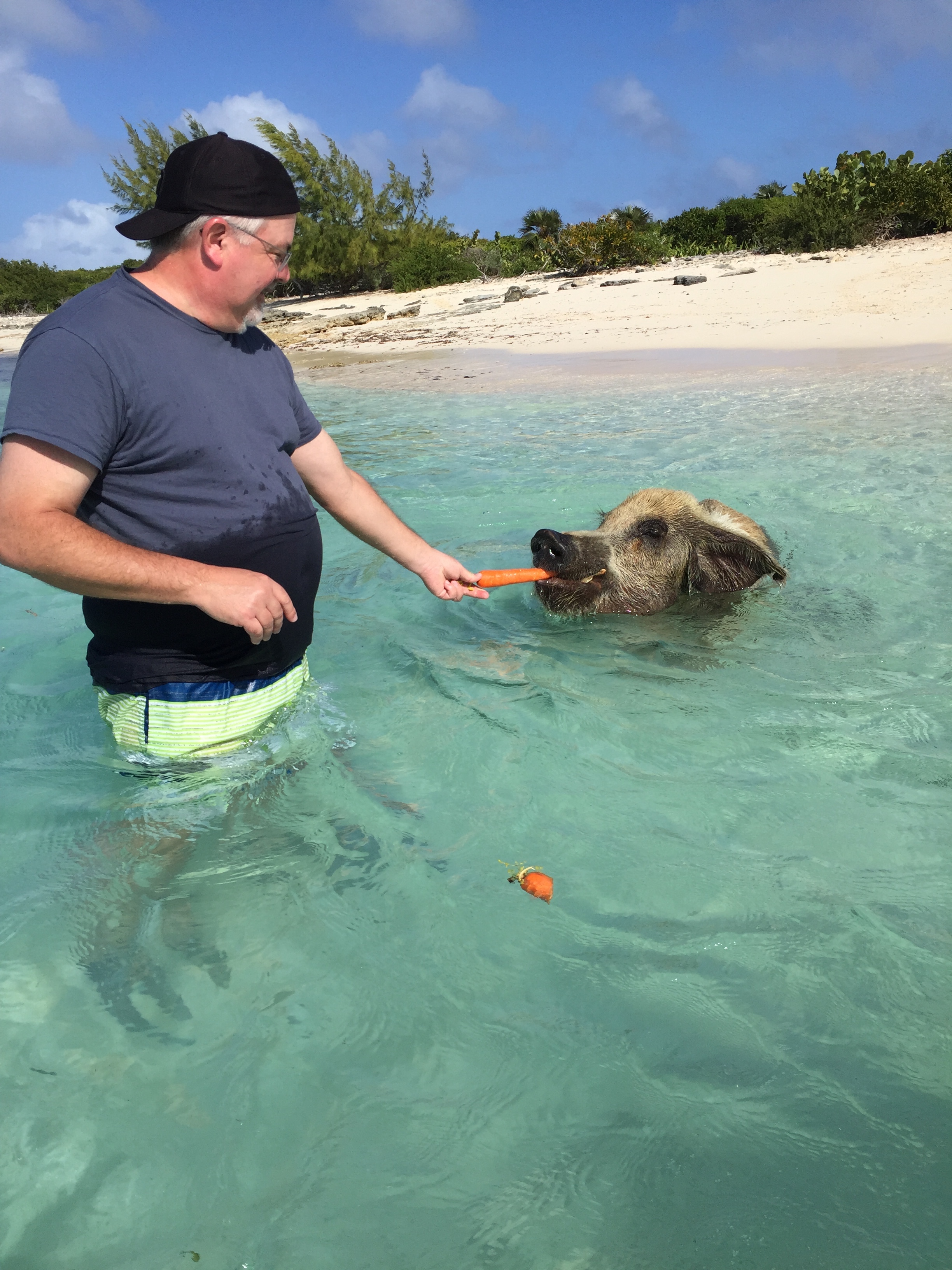
Sandals amenities are legendary. From the boisterous main pool with swim-up bar to the Quiet Pool, from the bountiful hammocks strung between palms around the property to the nearly mile-long beach complete with complementary watersport equipment, there is plenty to do. Treatments at the sumptuous Red Lane Spa are extra but highly recommended. If you feel like exploring off-site, Island Routes has a desk opposite reception, where you can book island tours, bone fishing trips, or excursions to swim with the famous pigs of the Bahamas (as seen on “The Bachelor” and soon to be a feature-length film), feed grapes to endangered Bahamian rock iguanas, and snorkel in the crystalline waters of Great Exuma.
Swimming with the famous pigs and scratching some iguanas behind the ears.
Sandals Emerald Bay Golf Course
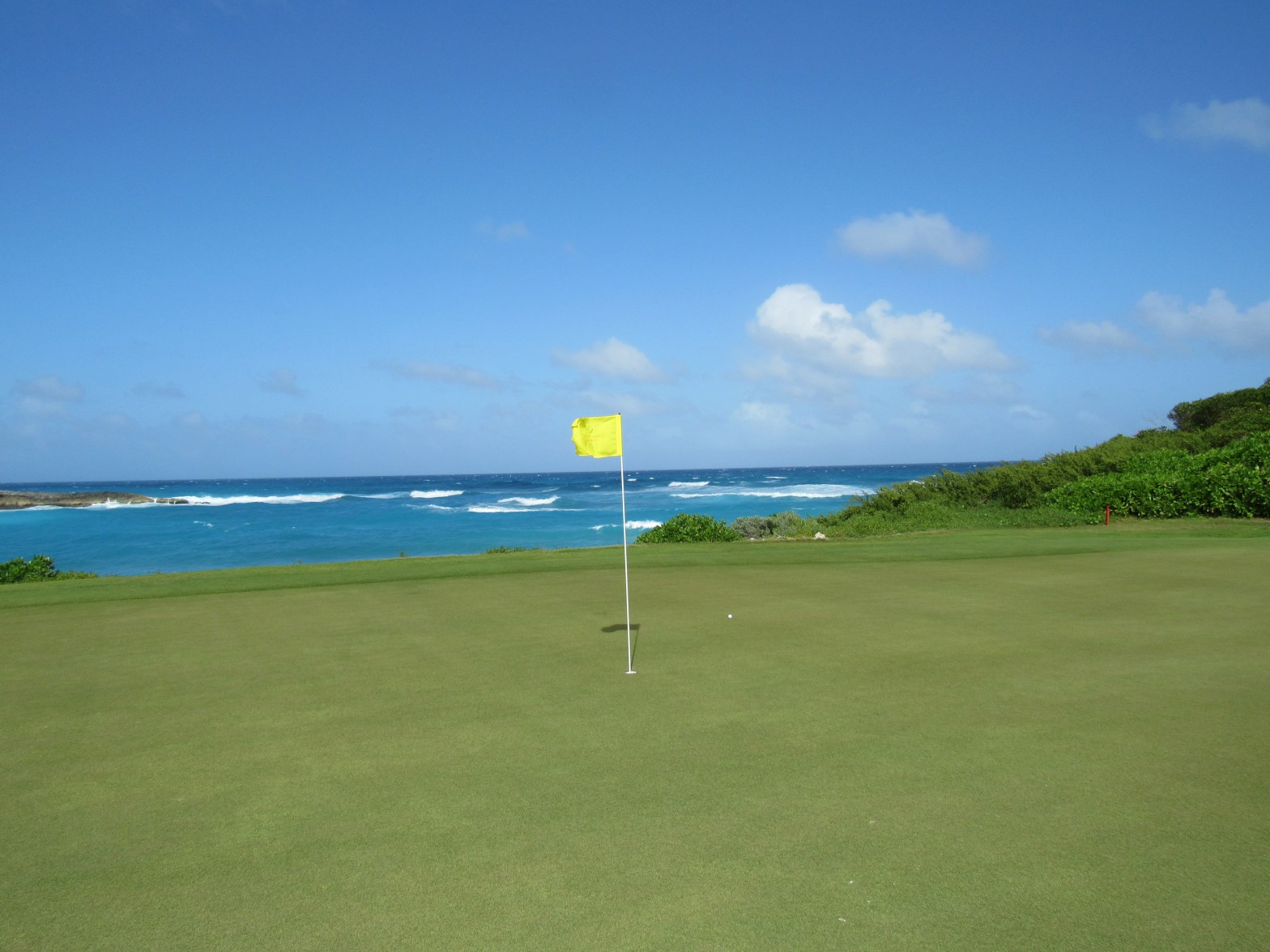
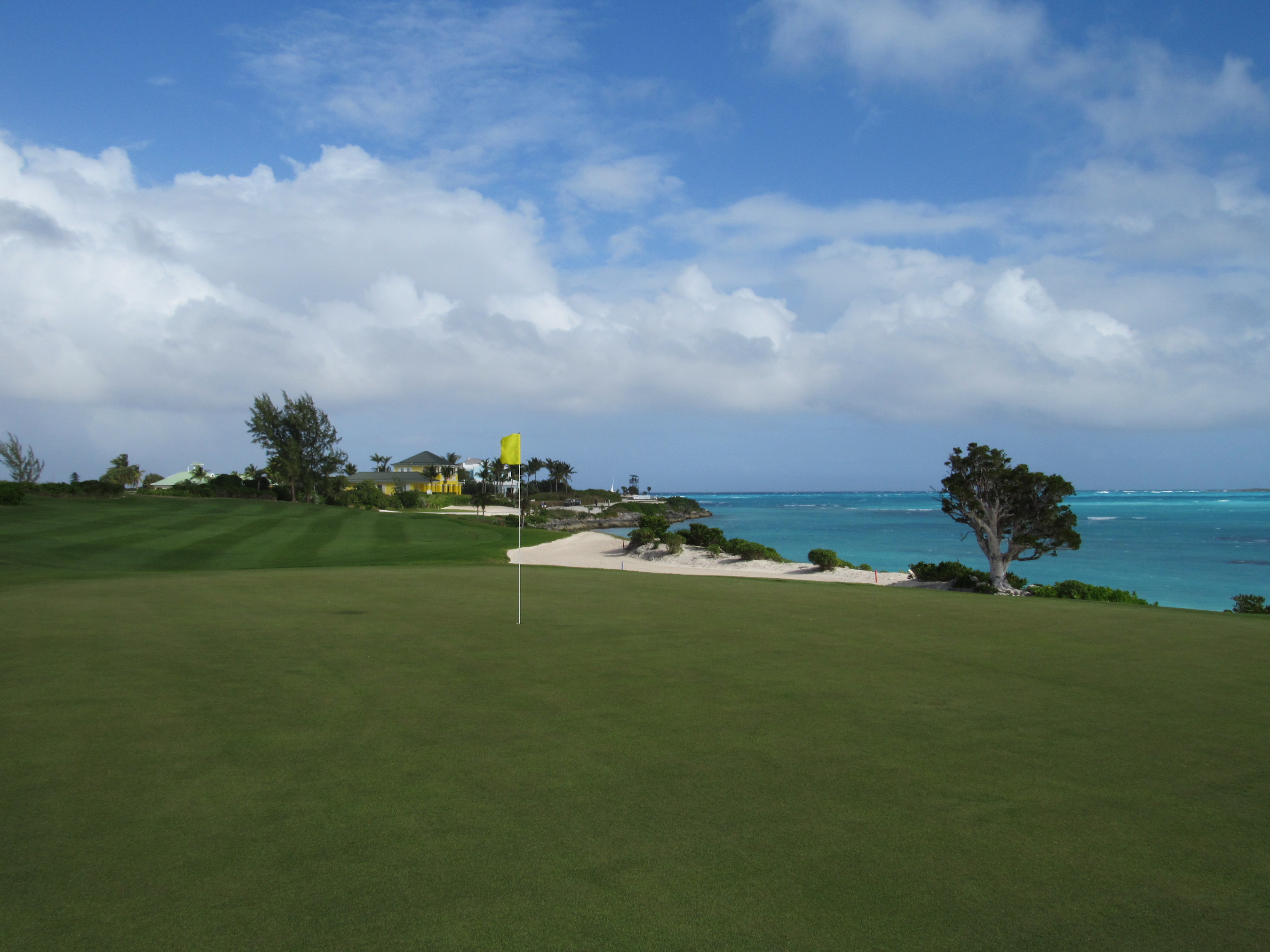
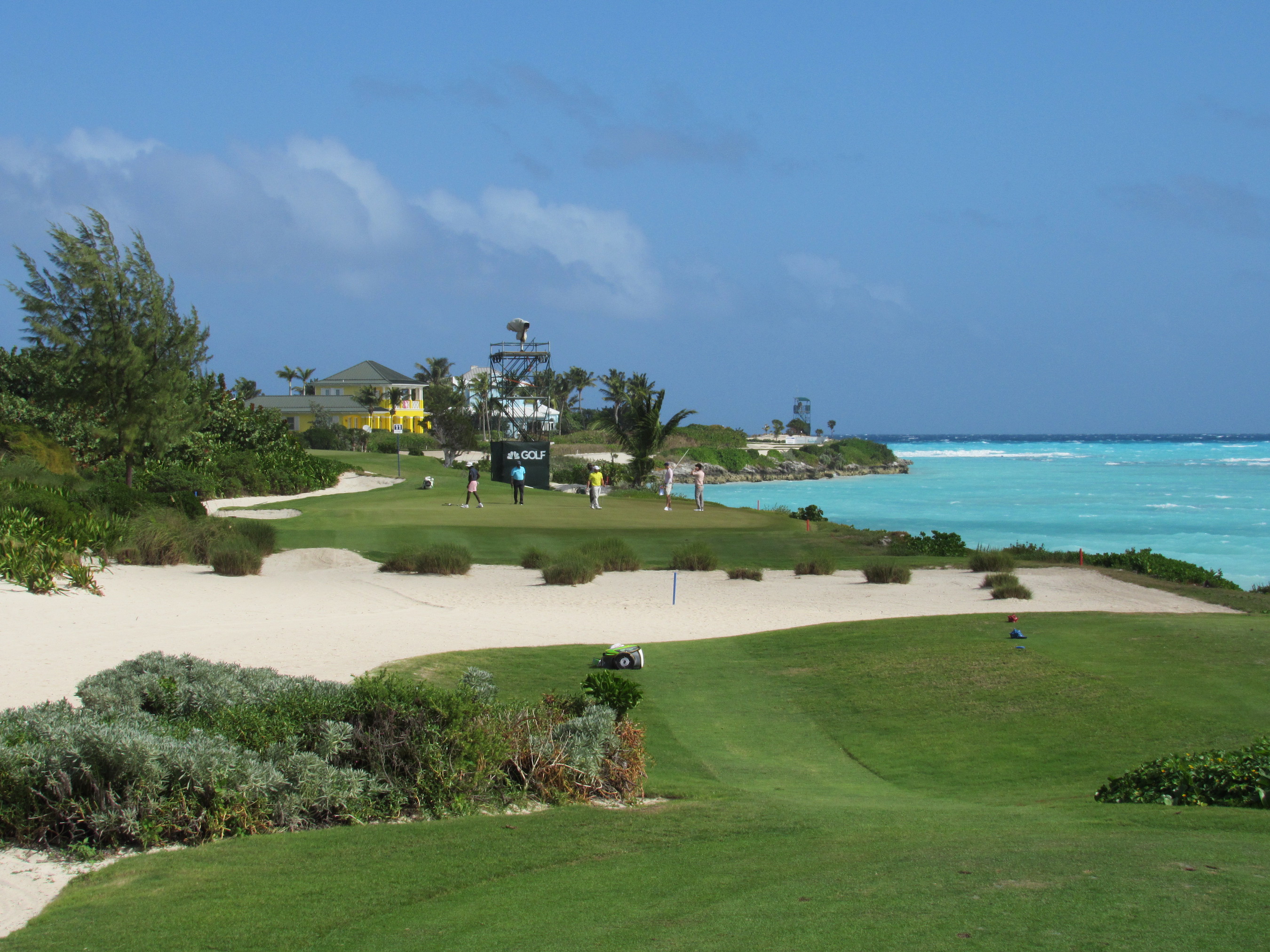
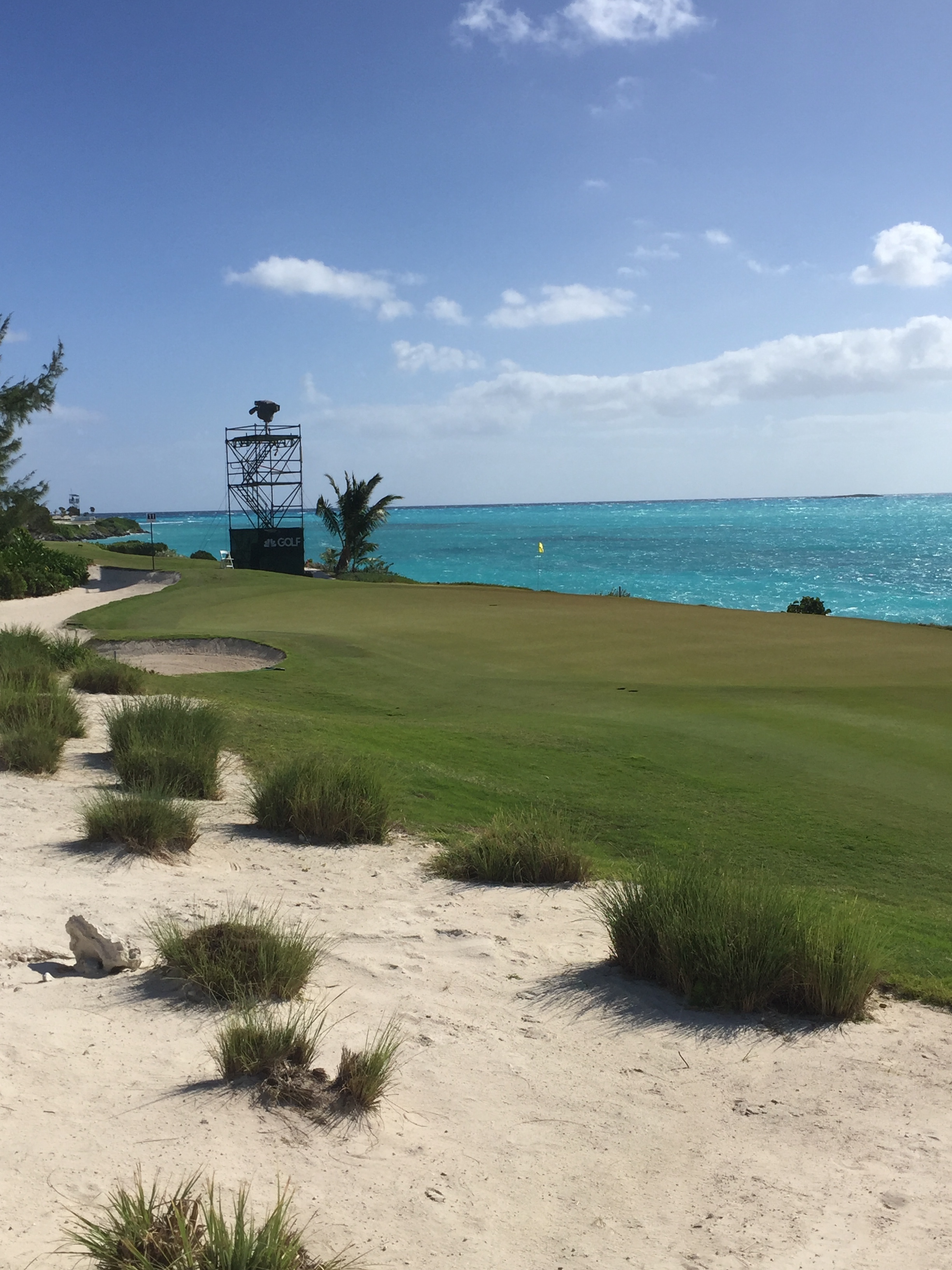
The Sandals Emerald Bay Golf Course is a stunning 7,001-yard championship Greg Norman design that has hosted the Korn Ferry Tour’s Bahamas Great Exuma Classic since 2015. The six-hole stretch from hole 11 to hole 16 are some of the prettiest oceanside holes I’ve ever seen. There are no dramatic forced carries over frothing coves, but with the electric sea as a constant companion, the vistas are nothing short of heavenly.
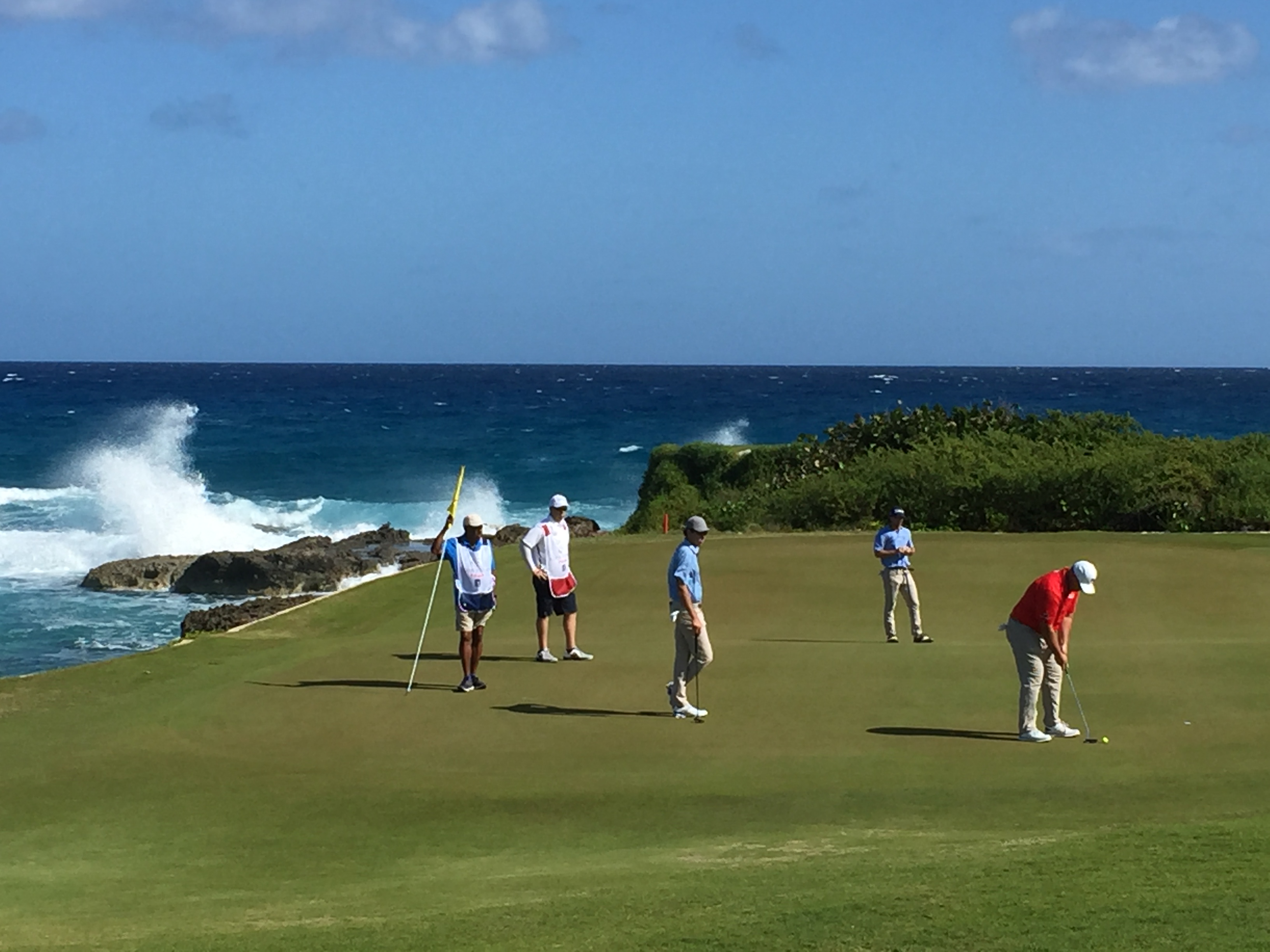
Players in the Korn Ferry Tour Bahamas Great Exuma Classic had to block out the crashing waves.
During an exclusive one-on-one interview with The Shark himself, Norman shared the history of the course, and how those stunning views were nearly hidden from golfers.
“I became involved with the course in 2002/03. The original developer was from South Africa. Originally, it was a real-estate constrained designed. That’s why some holes are short. All those holes on the back along the ocean were supposed to run between houses, which would line the shore on both sides. Boring! Then they realized how expensive it would be to run utilities down two sides of the property. I convinced them to save money by running it just down one side and allowing for seaside holes. Then Four Seasons took over, and the course sat fallow for a while. When Sandals took over, Butch [Stewart, Sandals’ Founder] listened and carefully protected and managed this course back to life.”
It would have been a shame to hide views like this from golfers. Good on ya for bringing them to us, Shark!
Thanks to Stewart’s stewardship and Norman’s aesthetic, the course today not only hosts the Korn Ferry Tour Bahamas Great Exuma Classic, but also offers Sandals guests one of the best golf deals in the Caribbean. Non-guest green fees are $155, with cart fees $25-$35. Sandals guests pay no green fees, so a golf-addled vacationer could play 36 holes (or more!) of tournament-quality seaside golf—every day—for practically pennies. (Rental clubs and shoes are also available for the more casual player for $65 and $15, respectively.)
While the ocean features on six holes of Sandals Emerald Bay Golf Course, the trade winds feature on all eighteen, though the inland holes are somewhat sheltered. This is especially true at certain times of the year, including the week of the Korn Ferry Tour tournament. According to Brooks Downing of BD Global Sports, who runs two Korn Ferry Tour events in the Bahamas (Exuma and Abaco), the week of the tournament has been extraordinarily windy every year so far.
“The first year,” says Downing, “the tail of a nor’easter hit us. That tournament had the highest scoring average in the 30-year history of the Tour. The par-4 12th had a stroke average of 5.8. Guys couldn’t bring themselves to aim 30 yards out over the ocean and let the wind bring it back. So their tee shots kept landing OB right.”
The green of the par-4 12th is the only safe place on the hole when the wind blows hard.
Because of the tempestuous winds, the course plays differently every day. Even the gorgeous par-3 11th, which stretches to only 148 yards even for the pros, can be a demon if the wind is in your face. My pro-am partner, Paul Barjon, who was 2019 leading money winner on the Canadian PGA Tour, hit a 6-iron into the 11th in the pro-am. I tried a 9-iron from 100 yards…and failed to make the green.
The 148-yard 11th Hole is not a pushover if the winds dictate a mid-iron from the tee.
For all the postcard beauty of the seaside holes, the real test of an oceanside golf course is the inland holes. At Sandals, Norman has hewn memorable holes from scrub brush and wetlands, and incorporated several water hazards that aren’t the Atlantic Ocean. One of the real beauties is the 165-yard 6th, a downhill par-3 to a peninsula green that is wide but shallow.
The 165-yard 12th (top L), 228-yard 2nd (top R), and 460-yard 10th (bottom) have their own non-ocean water hazards.
For visitors, the secret to enjoying your round (or rounds) here will be choosing the right tees not just for your skill set, but also for the conditions. If the wind is whipping, play up. In addition, always prioritize hitting it in the fairway over hitting it a long way. On nearly every hole, you will find water, rocks, brush, or waste areas 10 yards off of nearly every fairway and green. What you likely won’t find is your ball if you hit it in these places. So make sure to bring or buy plenty before your round, or you’ll be re-stocking at the turn.
No matter how you play, take plenty of time to soak in the sun and sea, along with plenty of photos of what might just be the most beautiful corner of the Caribbean. There may be astronauts overhead wishing they were playing golf in the midst of that otherworldly blue.
The 572-yard 15th (top L), 401-yard 16th (top R), and 122-yard 13th (bottom) holes all dazzle with ocean vistas.
Golf resorts in the Midwest and Great Lakes regions are often overlooked in favor of southern or coastal golf getaways. But some of the best family golf vacation spots in the nation – and some of the best deals – can be found in America’s heartland.
One Midwest golf resort that arguably more history and pedigree than any other is French Lick Resort in French Lick, Indiana. French Lick Resort (which includes the historic French Lick Springs Hotel and West Baden Springs Hotel) is the only golf resort in the world at which masterpiece courses by both Donald Ross and Pete Dye co-exist. And it has a history like no other.
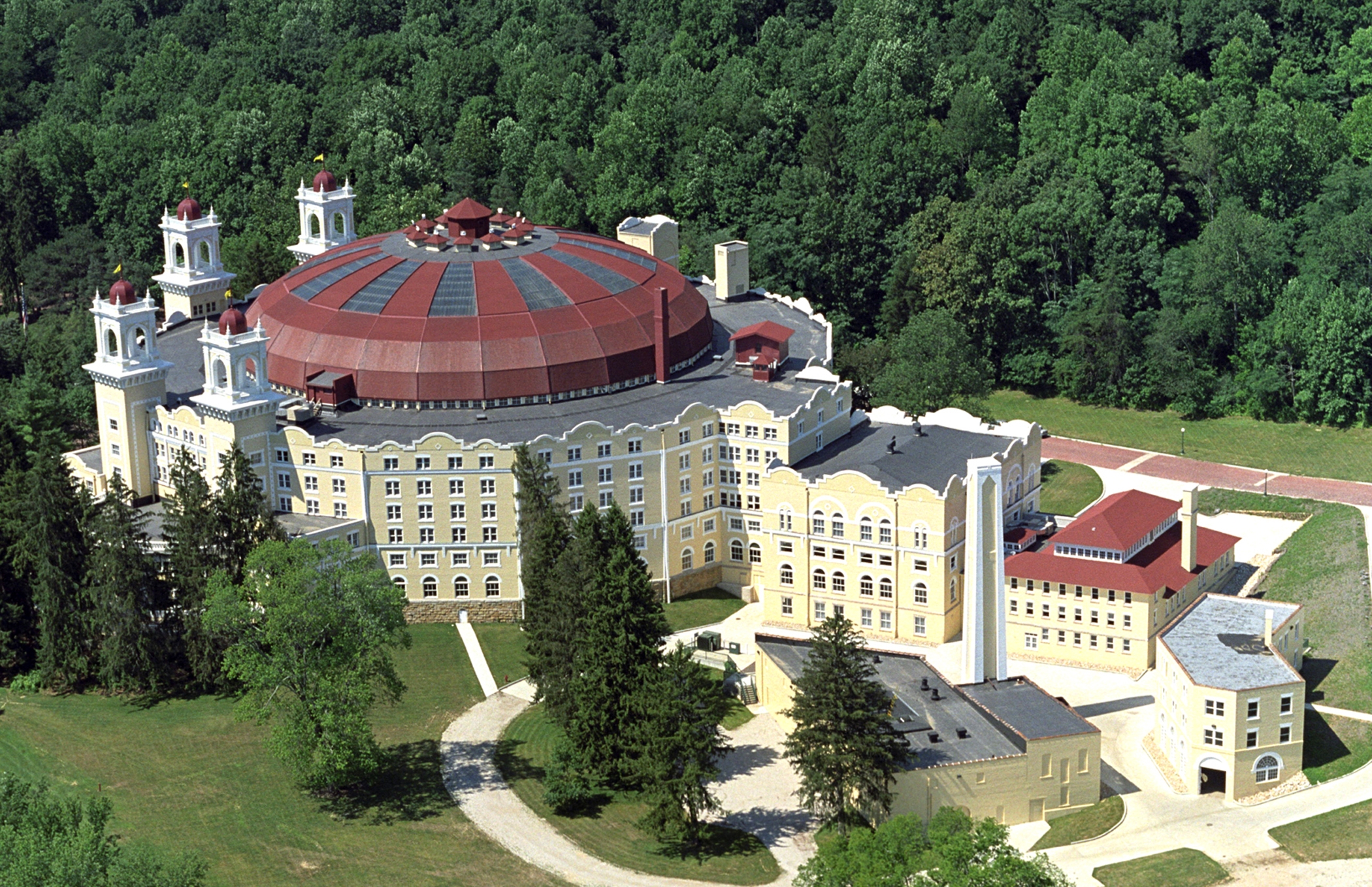
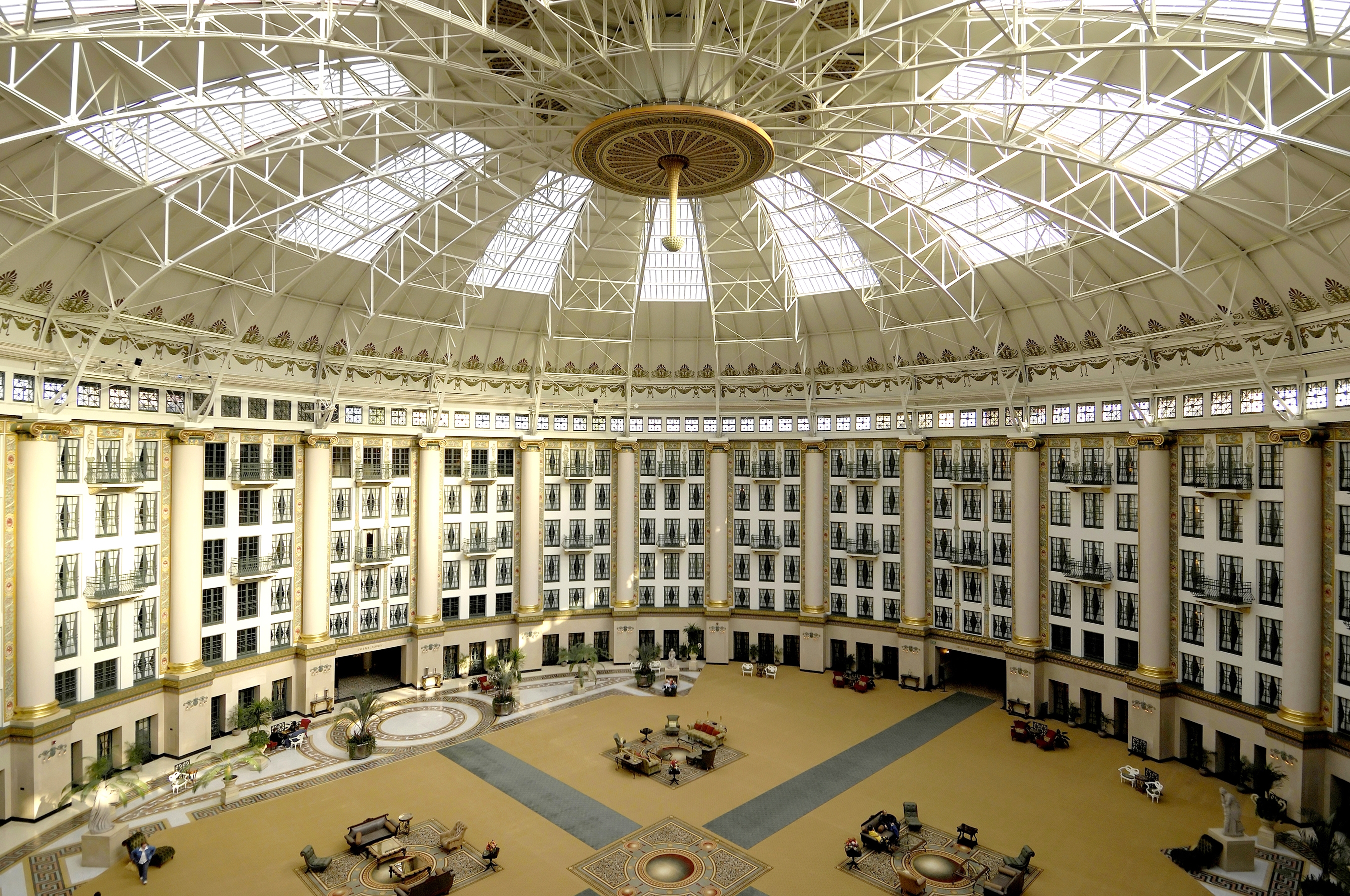
West Baden Springs Hotel was dubbed “The Eighth Wonder of the World” when it was opened in 1902. Looking like a fantastical drawing from a Jules Verne novel, the hotel had been built on a budget of $414,000 in just 277 days, and it was the largest free-span dome on earth until the Houston Astrodome opened in 1969.
From the outside, West Baden Springs Hotel looks like a cross between a circus tent and The Taj Mahal. From the inside, it looks like a grand Venetian Palazzo.
Along with the French Lick Springs Resort and its acclaimed Donald Ross golf course, West Baden Springs Hotel was literally one of America’s most popular vacation retreats from the mid-1800s to the 1930s. What happened in the 1930s? There was a little dip in the economy called The Great Depression. The resultant privation triggered a morality shift as well. Gaming was outlawed, and the casino at French Lick closed up. Railway lines, which carried five trains full of visitors per day to French Lick from Chicago, were usurped first by state highways and then by interstate freeways, none of which came near the area. No longer would major golf tournaments be played on the classic Ross course, and the once-steady parade of Hollywood stars and U.S. presidents escaping to southern Indiana ended with little fanfare. At one point, the “Eighth Wonder of the World” West Baden Springs Hotel was sold for one dollar, and then allowed to slouch for decades into a dangerous state of disrepair.
2005 was a turning point for French Lick, though. The Indiana-based Cook Group purchased both hotels and facilities (including the Ross Course). Gaming laws changed, allowing the Cook Group to open a casino again in the French Lick Springs Hotel. Gaming revenue funded a $500 million renovation of French Lick Springs, West Baden Springs, their lavish spas, and the Donald Ross Course.
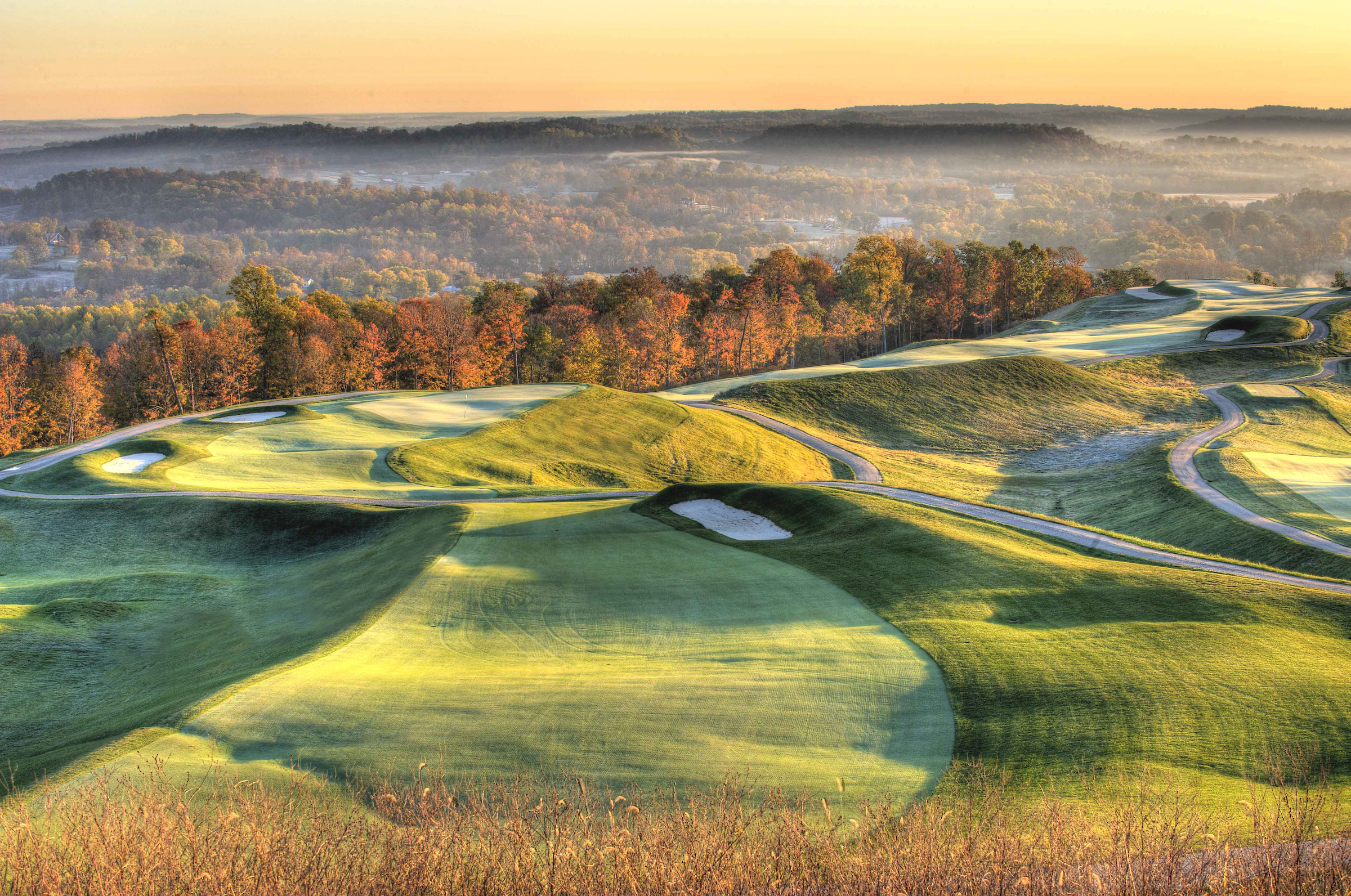
The pièce de résistance of the renovation—as far as golfers are concerned, anyway—was the contacting of Pete Dye, who gladly accepted the task of turning a hilly, forested swath of land on the hilltop overlooking French Lick Springs Hotel into the one—and only—course bearing his name: The Pete Dye Course at French Lick.
The Pete Dye Course at French Lick sits atop some of the most beautiful ridgelines anywhere in the Midwest.
Whether you’re a golfer, a gambler, a rider, or a relaxer, there’s a wealth of activities available in at this surprising luxury resort.
Golf
When I first visited the French Lick Springs Hotel (around 1999), there were two courses, the Valley Course and the Hill Course. The Valley Course was a Tom Bendalow design that has since been remade as a 9-hole family, learner’s, and instructional course. The teaching and practice facilities at the Valley Links and Learning Center, directly adjacent to the hotel, are now first-rate.
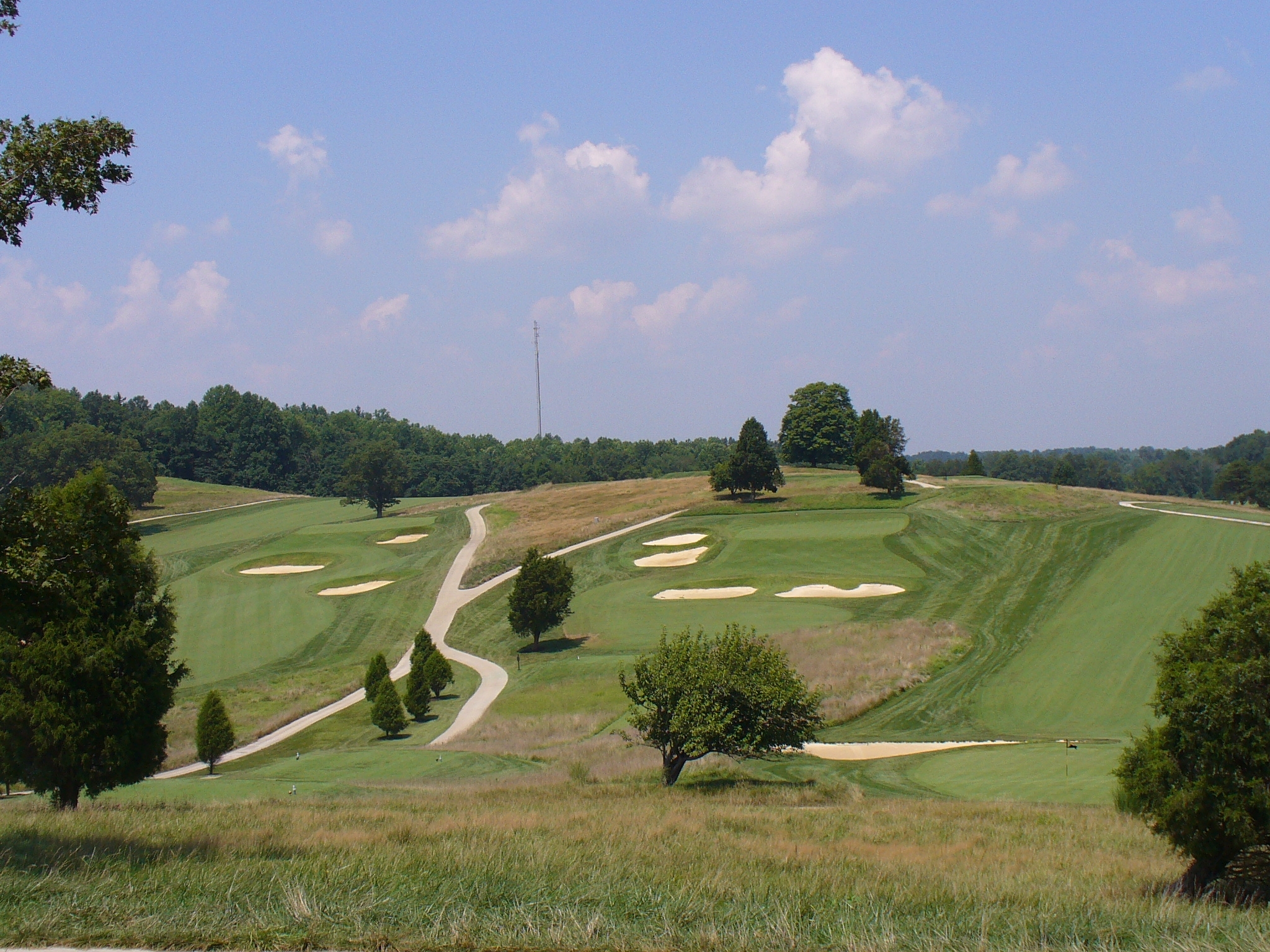
The Hill Course, renamed The Donald Ross Course, is a 1917 Ross classic on which Walter Hagen won the 1924 PGA Championship. Measuring 7,030 yards from the tips (par 70), the Ross Course benefited from the resort-wide renovation, including a $1 million-dollar upgrade of the clubhouse alone. The original Ross design was restored, including 30 previously filled-in bunkers, squared off greens, and completely rebuilt tee boxes. The black tees (6,517 yards) are the original tees, and aside from a pond on holes 11 and 14, the present-day design is as close to the Ross original as ever.
The sinusoidal landscape upon which The Donald Ross Course is situated makes for some wonderful vistas (here, on the 10th tee) and difficult club selections.
After your round, take time for a cool drink on the Ross Clubhouse veranda.
The hallmark of the Ross design is the elevation change from fairway to green on just about every hole. This old-school defense is extremely effective – at least against golf writers who can’t figure out to add one to two clubs on every approach shot until, oh, the 17th hole or so. If you’re as dense as me, you’ll come up short time and time again. Add this to the one- to two-club penalty from the thick rough, and you’ve got some serious issues with choosing the right stick. And if you don’t take enough club, balls can roll 40 yards from the front fringes back into the fairways.
Besides deceiving distances, the Ross Course features devilish greens with some radical slopes and mounds and wonderful vistas across the valley. Visitors to French Lick may be mesmerized by the Pete Dye Course, but they shouldn’t overlook the Ross Course, which holds its own against the modern masterpiece in terms of shot value. The collection of par-3s is especially beastly; three of the four require at least a hybrid from most players, even from the regular men’s tees.
The 8th green on The Ross Course has three levels. Putts from above the hole to a front pin can easily roll off the front and down into the valley.
The 10th hole on The Ross Course (left) plays down from the tee and then back up to the green. The 14th (right) plays uphill off the tee, over a hill, and then steeply down to the green.
As for the Pete Dye Course, according to pretty much every American golf publication, Dye’s eponymous gem was the best new course of 2009. Over 2 million cubic yards of earth were moved in the creation of the course, which hurtles and dips across a landscape that, according to Dye, “was as severe as I’ve ever worked.”
The view from the Dye Course clubhouse really brings home the severity, and serenity, of the course setting.
The result is an 8,102-yard brute with a rating and slope of 80.0/148 from the tips. Golfers who want to experience the best course in Indiana, and arguably one of the best in the nation, will need to pony up some serious cash for the pleasure of being thrashed about by a design that is arguably Dye’s most difficult track. But the challenge and views are so marvelous, that the splurge is recommended for all devoted players. There are also a number of stay-and-play packages that allow for play at one or both Ross and Dye courses, and even the nearby Sultan’s Run in Jasper, Indiana, at rates that may not be cheap, but also won’t break the bank.
The Dye Course is not only a darling of the media, but also of the USGA and PGA. The 43rd PGA Professional National Championship was played on the course, and the U.S. Women’s Senior Open has been played here the past three years (ever since the long-awaited championship was first sanctioned). The one barrier to hosting a larger tournament is the location, which is still nowhere near a major highway. And despite the 243 guest rooms in the West Baden Springs Hotel and 443 at the French Lick Springs Hotel, and 71 new rooms in the just-opened Valley Tower (see below), there wouldn’t be sufficient accommodations to host a regular PGA Tour stop, much less a major…yet.
Based solely on the merits of the Dye course, though, the various tours are still figuring how to work out logistical concerns. At the press conference for the 43rd PGA Professional Championship, Dye was asked whether this course or Dye’s Straits Course at Whistling Straits—site of three PGA Championships and the 2020 Ryder Cup—is the better design.
“Since Mr. Kohler isn’t here,” said Dye in his inimical deadpan, “this is a much better course than Whistling Straits.”
What makes the course so special? First of all, according to Dye, there’s a “new kind of rough here—fairway fescue.” This rough is “meant to be kept short and played out of, so the fairways can be made much more narrow if necessary.”
Second, there is literally every sort of bunker I’ve ever seen on any other course in the world: pill box, pot, coffin, flashfaced, waste—you name it.
Dye Course, 4th Hole — you do NOT want to be in the bunker to the left (and well below) the green.
Third, taking full advantage of the hilly landscape, Dye has dabbled with elevation changes from tee to green like a wizard dabbles in the Black Arts. Many of the elevated greens appear from the fairway to simply disappear into nothingness, making the approach shot on nearly every hole nerve-wracking.
Holes 2, 6, and 12 (left to right) are some of the best examples of the many “infinity greens” on The Dye Course.
In Dye’s own words, “It is an entirely different kind of course than anything I’ve ever done.”
For the first-time visitor, it is a course that grabs you by the collar on the opening hole and doesn’t let go. The 519-yard, par-4 1st features a 50+ foot drop from the tees to the fairway, which curls right to left around a pond.
On the tee of 1st Hole on The Dye Course, you feel like you’re perched on the edge of an abyss, and there is nothing to do but swing.
You’re thrown directly into the fire on the first tee, and the challenge doesn’t end until you’ve successfully navigated the 657-yard, par-5 18th, whose ribbon-like fairway snakes along a ridge to a massive elevated green.
The 18th on The Dye Course is a long par 5. Don’t try to carry the ravine to reach in two. Just. Don’t.
The Pete Dye Course at French Lick anchors a seven-course Dye Golf Trail, which stretches from the Purdue Kampen Course in West Lafayette, Ind., in the north down to French Lick. Golfers not familiar with the fine courses in the Hoosier State will be bedazzled by the variety, depth, and quality of “Midwestern” golf.
Activities
Should you be one of those weirdos who needs more than golf to make you happy, French Lick Resort and West Baden Springs can satiate any craving for non-golf entertainment that may possess you.
The spa culture in French Lick has its roots at the very founding of the resort. “There must be something in the water” is literally the explanation for why the resorts even exist. Both the French Lick Springs Hotel and West Baden Springs Hotel sit atop natural springs, as the names suggest. The Pluto Water of French Lick and the spring water of West Baden were strongly laxative and believed to cure whatever ailed you. Eventually, the Pluto Water was also outlawed, however, when it was discovered that it contained such high levels of lithium so as to be beyond “restorative” (to put it mildly). But man, was that water popular back in the day. Author Chris Bundy likened French Lick to the Disney World of the late 1800s, saying that if Europeans could afford to visit the U.S., “it was assumed that they’d come to French Lick.”
Today, both hotels have world-class spas, featuring treatments with the famous, magical water (lithium removed, for your safety and sanity).
One mania that not even lithium could cure is gambling. The casino at French Lick was Indiana’s first land-based casino, and just about any game of chance you can imagine can be found on the 51,000-square-foot single-level gaming floor. My biggest slot-machine win ever happened here ($75!). I cashed out and had an excellent dinner in the Power Plant Bar & Grill (one of my favorite pubs in all Indiana). The casino now also offers a sportsbook along with an adjacent sports-viewing lounge. All of these new features complement the new Valley Tower, which houses 71 palatially appointed rooms and suites, and a new bar, within easy reach of the casino and aforementioned sportsbook.
Other activities include horse-back riding at the resort’s stables, bowling in the basement alleys, kids’ activities in the Just for Kids hangout, bike rentals, swimming pools (the original mechanical retracting glass dome is sadly gone, however), golf academies, and any number of concerts and shows hosted by the casino. French Lick Springs and West Baden also house boutique shopping, wineries, and many options for dining and drinking.
The verdict on French Lick Resort and West Baden Hotel
As you drive into the still rather isolated valley that holds West Baden and French Lick, you can almost feel the hands of time turning back. Strolling through the historic grounds of the hotels, taking a treatment at the spas, or rocking on the front porch with an icy beverage transports you fully back in the early years of the past century. You almost expect Al Capone or Diamond Jim Brady to wander past. If the ghosts of Gilded Age Past start rattling at your heels, though, the new Valley Tower surrounds you with modern comforts. And the immaculate, unique golf links are literally timeless. No other Midwestern golf resort feels quite like this, and no other resort anywhere pairs Donald Ross with Pete Dye.


































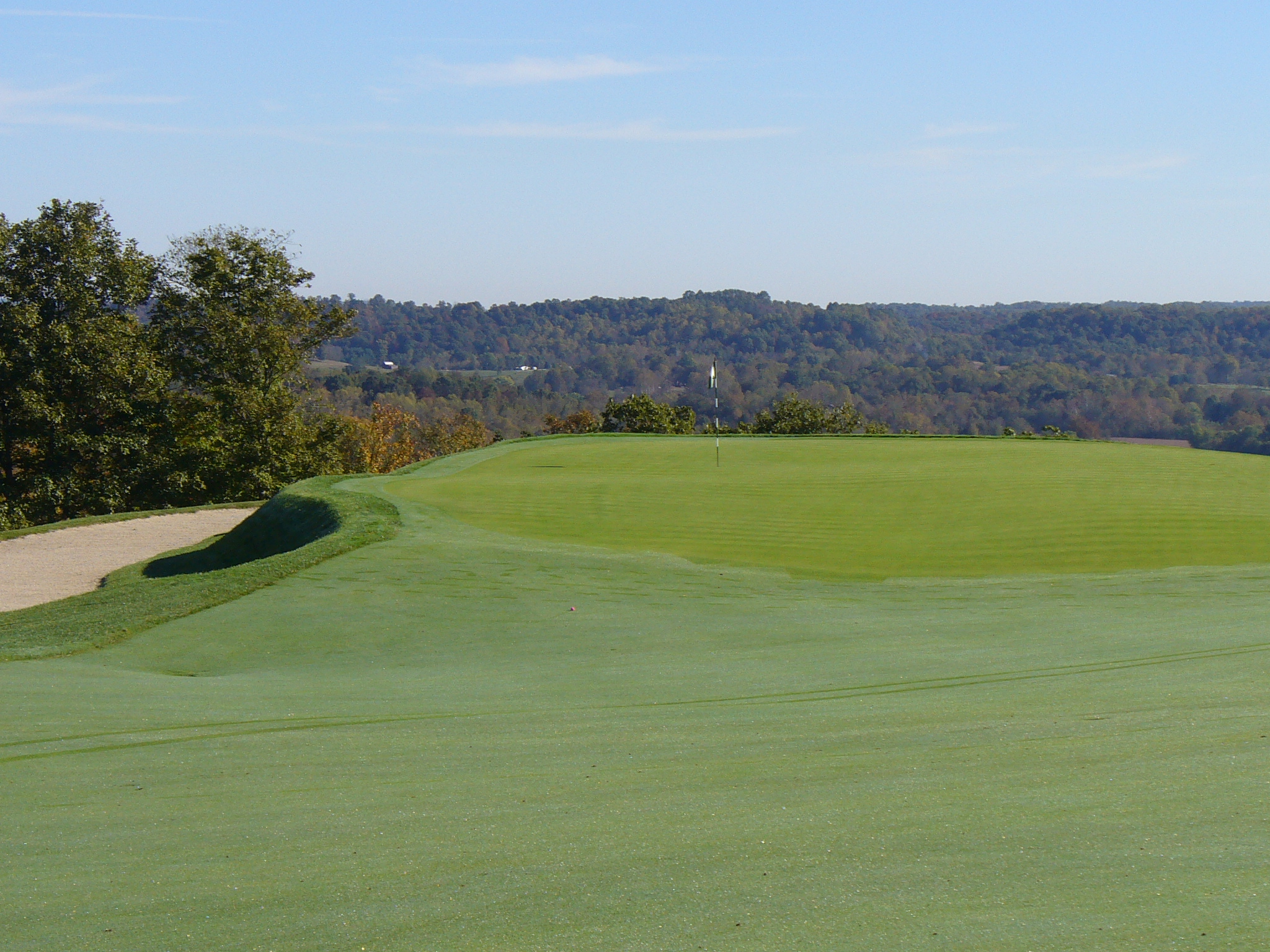
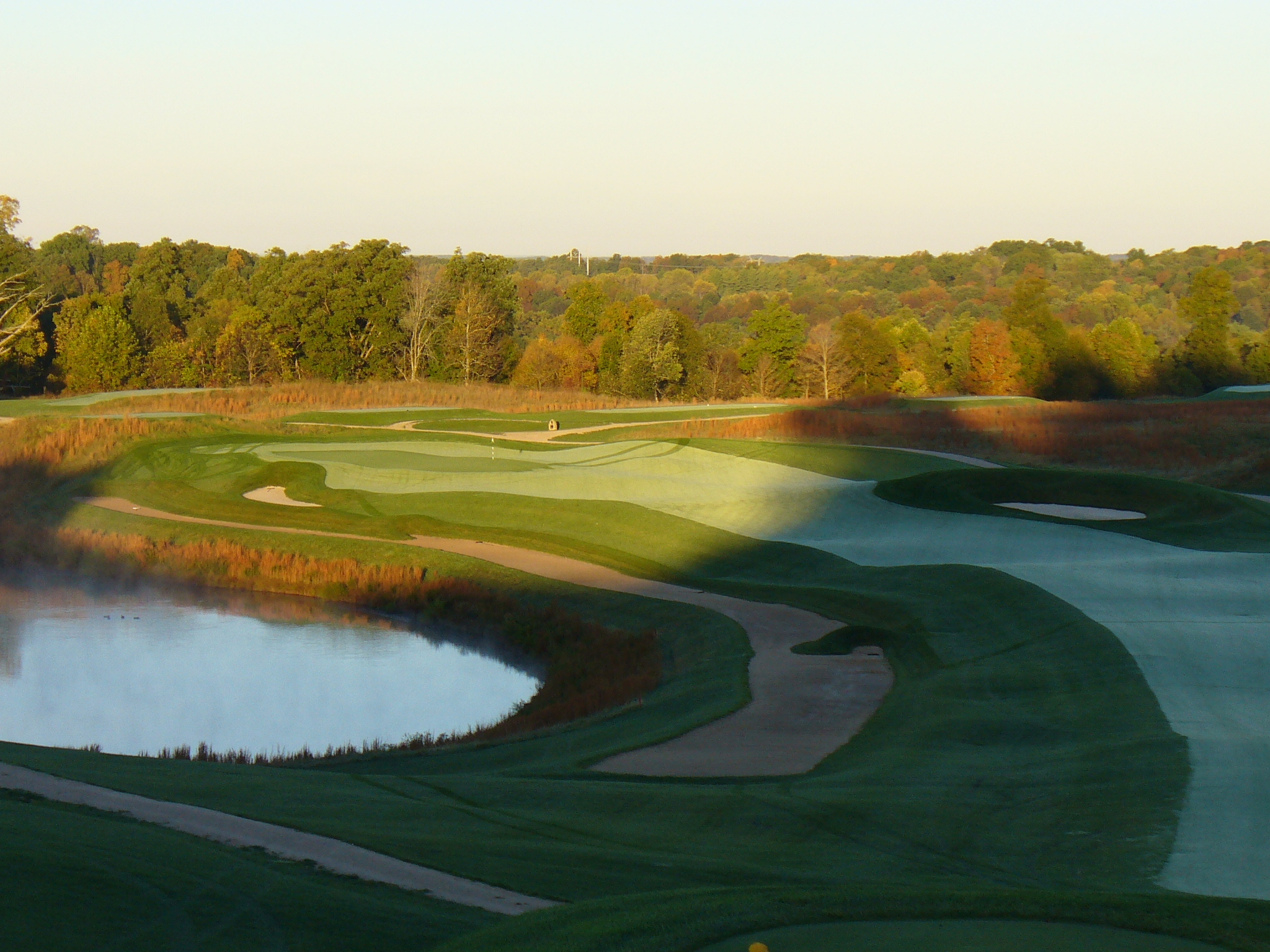
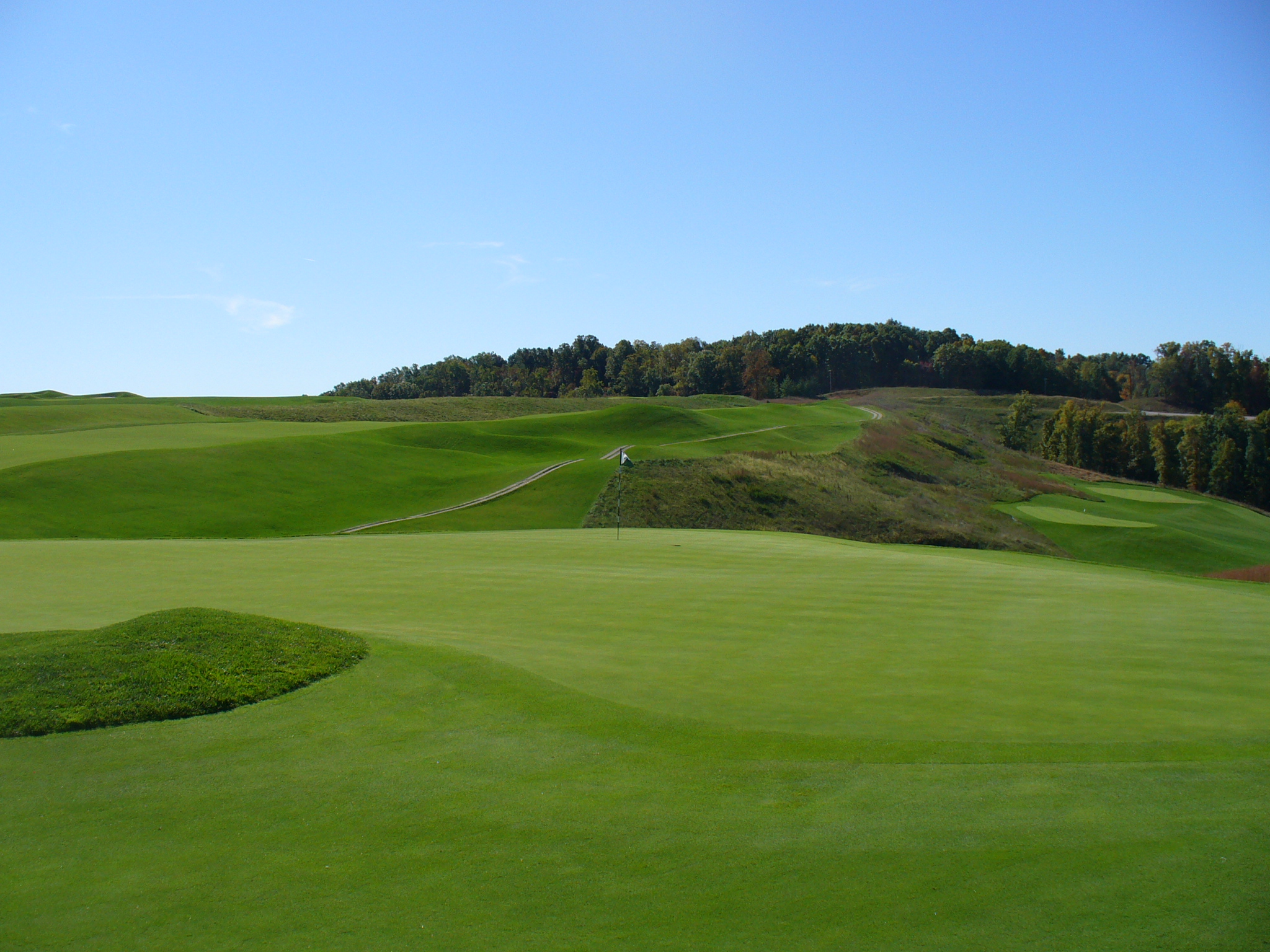
 Midwestern Golf
