Get ‘em before they go (up): Holiday Golf Gift Guide 2024

Another year is almost done. I hope it was full of memorable golf, camaraderie, and fun. I have no idea what’s in store for 2025, but if certain widely promoted plans come to fruition, I do know that the vast majority of golf clubs, balls, gadgets, and apparel will be significantly more expensive next holiday season. So if you can, this would be the year to stock up – for yourself and for the golfers on your holiday shopping list.

Custom club-fitting session

I’ve been going through my equipment blogs from the early 2000s, and I’ve been struck by how many drivers nearly 25 years ago were selling for $400+. The prices were not much different from today, even though a dollar bought so much more then. All major OEMs fabricate (and even assemble) their clubs abroad, with most clubheads forged or cast in China. It would be great if we did this all here, but it certainly won’t happen within the next 5 years, if it happens at all. So this holiday season, a wise investment would be a visit to a clubfitter who can build you a set of custom sticks at today’s prices.

Club Champion has pretty much every clubhead and shaft combo you can imagine, and they always have holiday fitting specials, including gift cards for your favorite golfers.
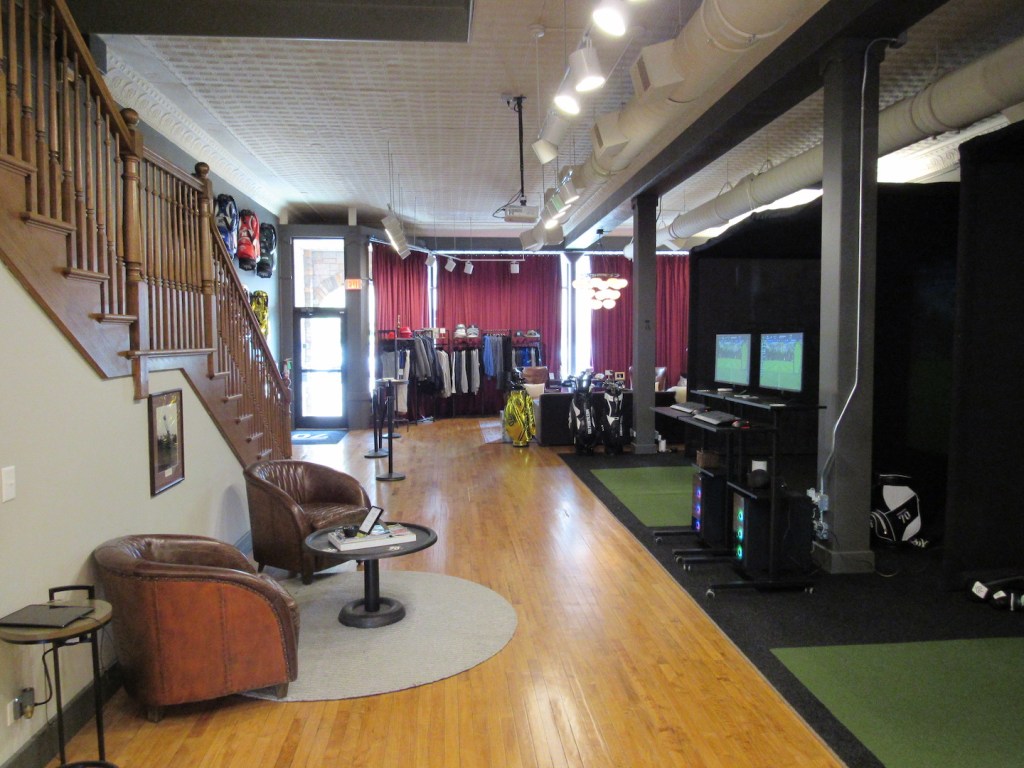
Sub70’s state-of-the-art fitting HQ, where fittings are free!

Alternatively, many “boutique” companies like Sub70 often offer free fittings and discounts on subsequent purchases of their equipment. And don’t overlook your local proshops, where local pros can usually get the lowest possible prices direct from the manufacturers for all the golfers on your list.

 TRUE Golf Shoes & Apparel

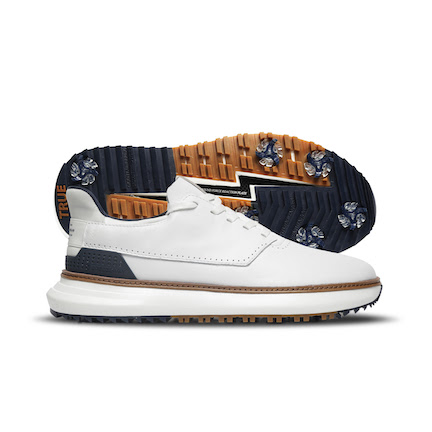
From finely crafted shoes to hoodies to pants to flip-flops, TRUE Linkswear carries just about everything for both men and women who want to look stylish on the links AND out and about before or after a round. I’ve got three pair of TRUE shoes (LUX OG Tour ($143-$205), LUX G ($175), and ORIGINAL ($134)), and I get more compliments on them than any other shoes I wear. The detailing, down to the metal-capped aglets on one pair, is impeccable. The toe boxes—which are critical for avoiding blisters on toes—are spacious. The website has a shoe sizer for ease of reference, but they do run a tad small, so I’d recommend going up ½ a size. The Limited Edition Members Only collection includes a range of on- and off-course apparel and accessories that mix and match seamlessly no matter the occasion – perfect for Christmas dinner! (I hope, because that’s what I’m wearing.)
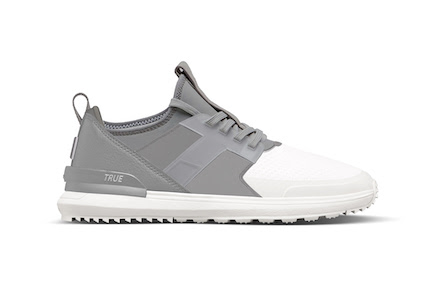
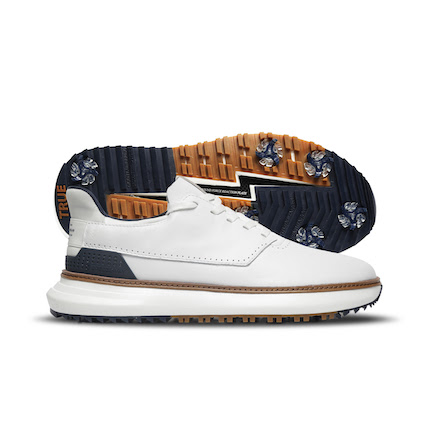
TRUE Lux
TRUE Lux 2

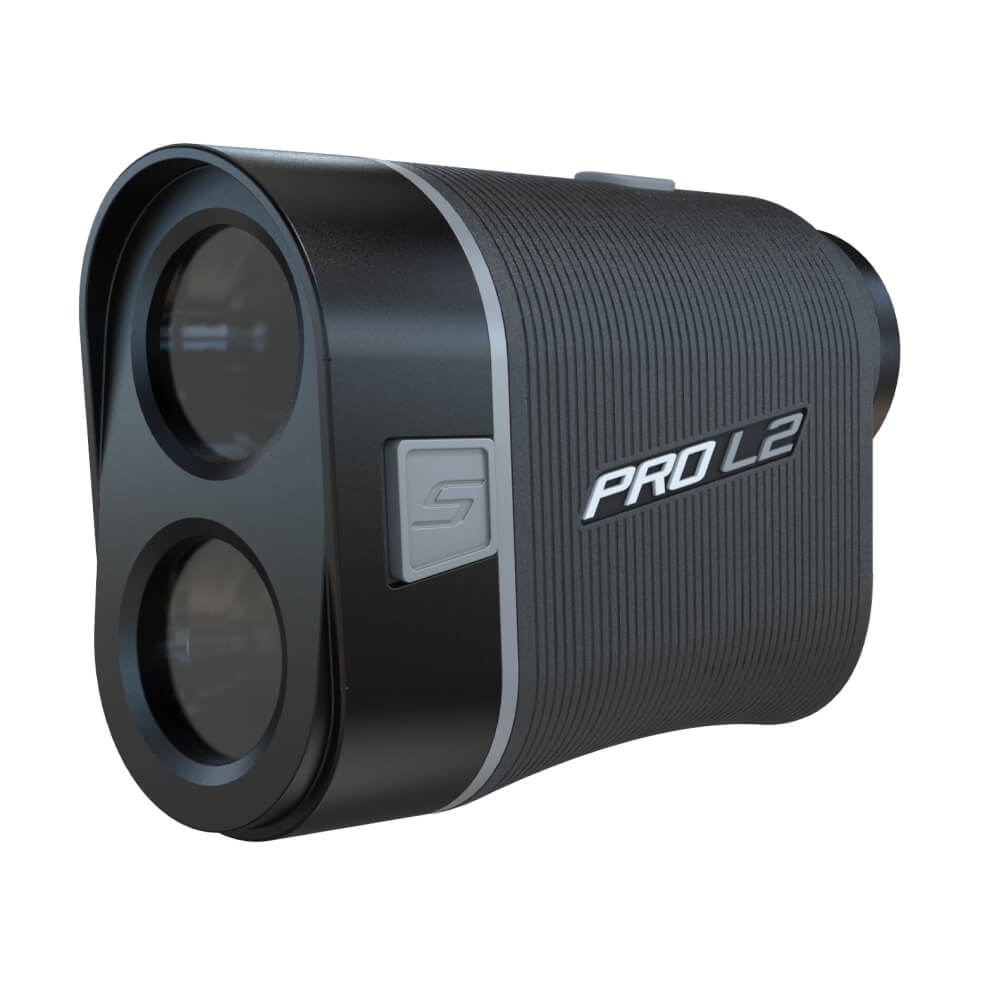
Shot Scope Pro L2 Rangefinder

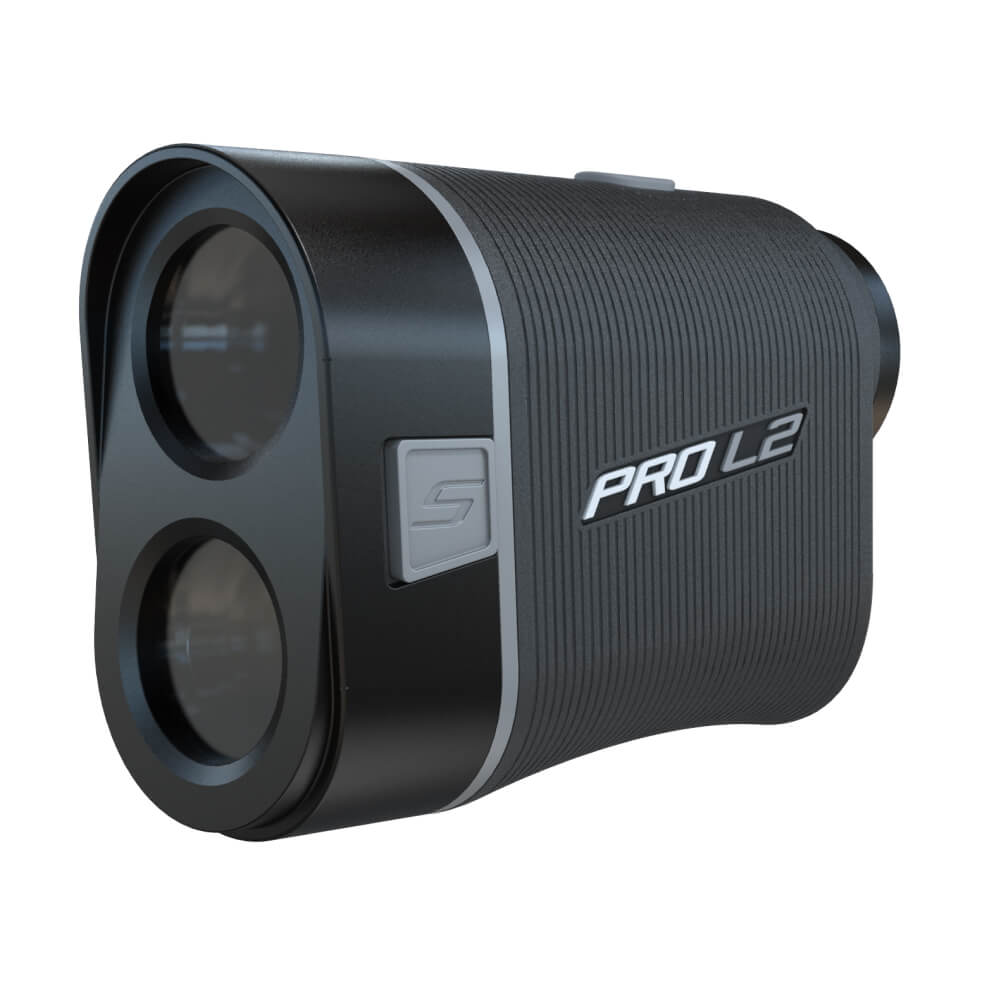
Shot Scope has an extensive line of GPS watches, rangefinders, performance trackers, and online platforms dedicated to lowering your scores. Their most popular laser rangefinder is the Pro L2 ($130). It’s got an adjustable eye-piece for crystal-clear graphics and view, a 700-yard range, a scan mode for quick distances, optional elevation adjustment, and a vibration “lock” when your target is identified. It’s extremely compact and durable, too.
Tiger, Tiger: His Life, as it’s Never been Told Before by James Patterson

Who better to bring a transcendent sporting figure like Tiger Woods to life than a transcendent writer like James Patterson? Tiger, Tiger (Little, Brown, $32) takes readers from Tiger’s pre-kindergarten days up through early 2024 via short, punchy, tightly interwoven vignettes and accounts, lifting the veil between the icon’s public and private life. The taught prose of an accomplished action-adventure writer like Patterson combined with the fact that readers know, at least in broad strokes the disasters that are coming, make this biography read more like a thriller than any bio I’ve ever read. It’s nearly impossible to put down!

Sun Mountain Ridgeline 3 Push Cart

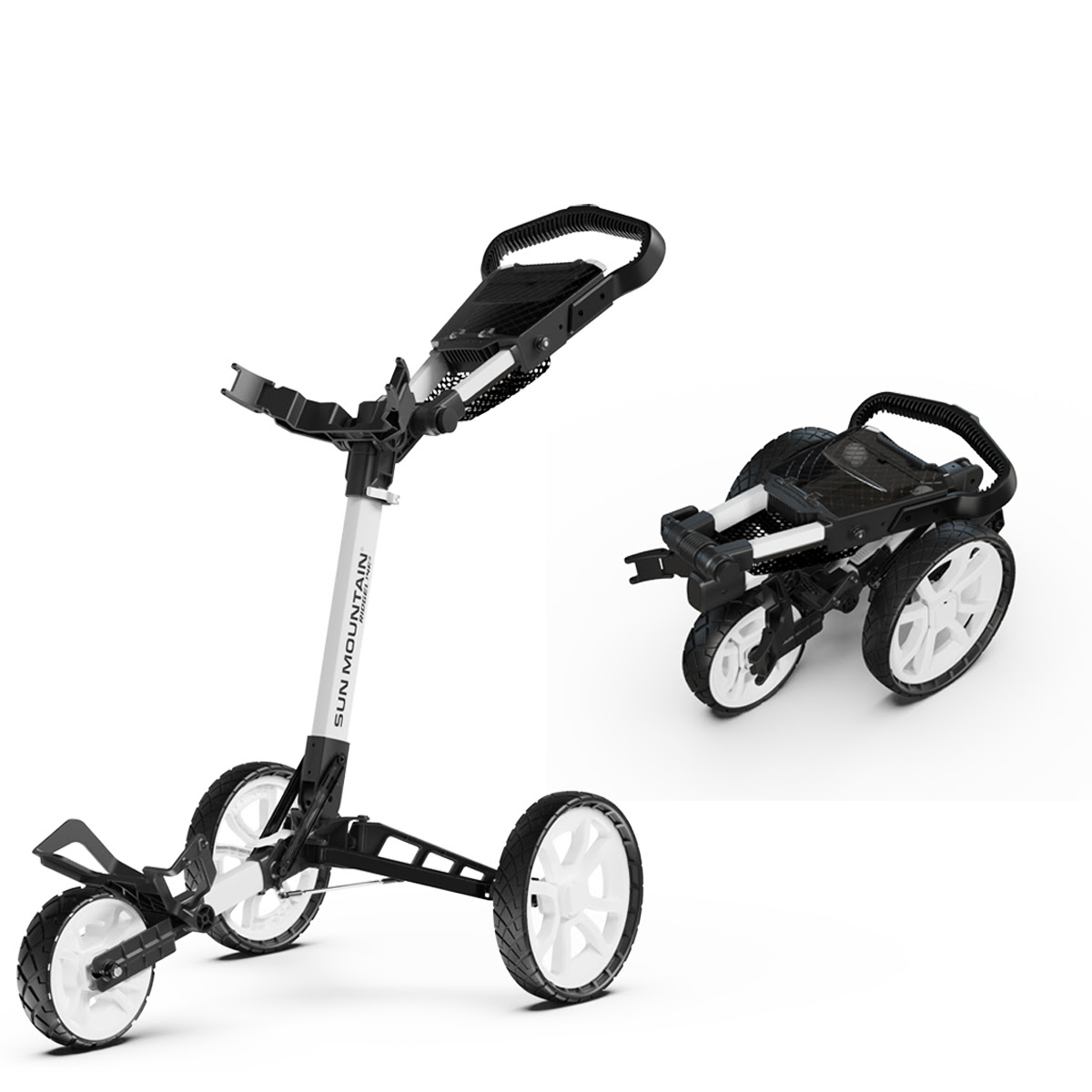
The exercise potential for golf is enormous – if you walk. Entice your favorite golfer into walking more often with a gift of the Ridgeline 3 push cart by Sun Mountain ($350). This luxurious cart opens and folds easily, with just one lever and one latch. It’s fully adjustable to every golf bag thanks to a bracket on the main vertical handle support. The bracket has a lever that can be loosened or tightened to adjust the height of the bracket. It rolls smooth as silk – almost too smoothly. Last weekend, I kept forgetting to set the brake and the 30+ mph wind kept whisking it away from me across the level fairways.

 SuperStroke Putter Grips

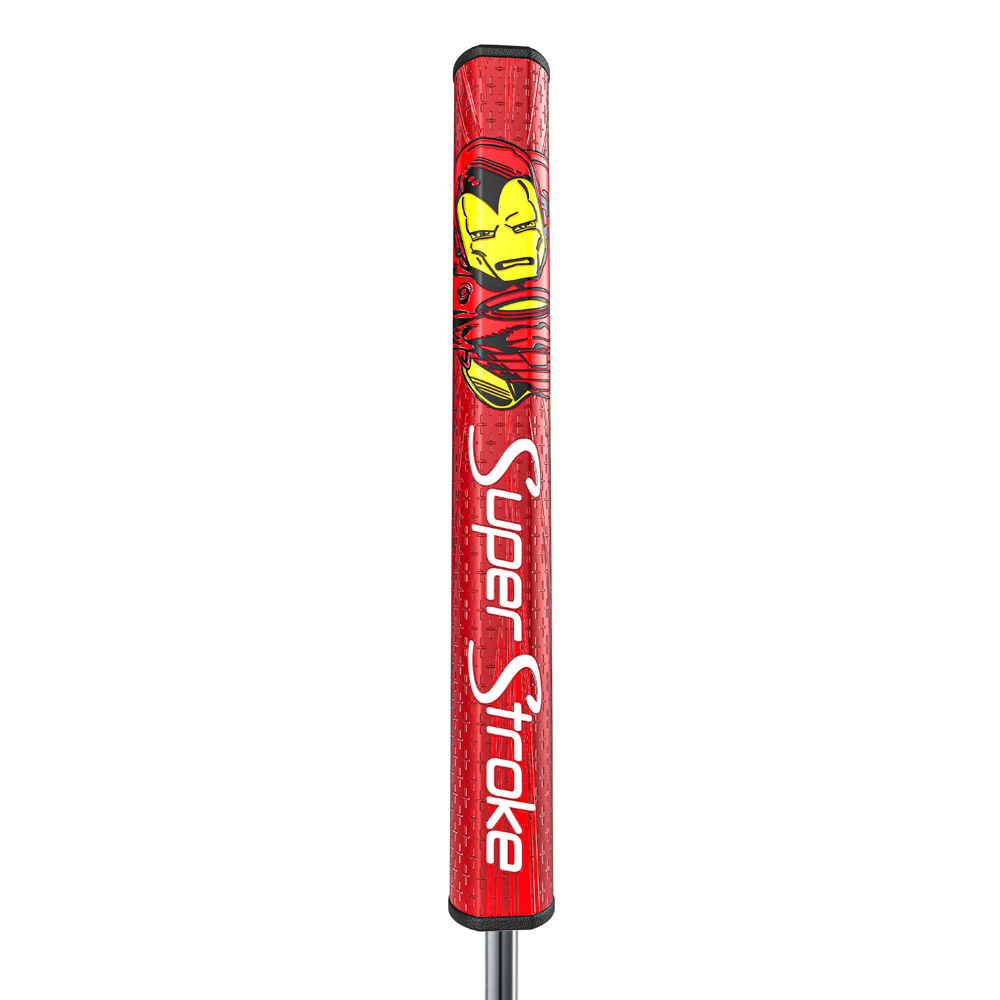
Perhaps the best feeling in golf is feeling comfortable – and confident – on the greens. An essential part of achieving this blessed nirvana-like state is your putter grip. Your putter should feel so natural in your hands that it’s like an extension of your body. SuperStroke Putter Grips ($30-$40) have in a very short time become ubiquitous on greens everywhere from local municipal courses to the PGA Tour, where it seems like the winner every week plays them. My current favorites are the Marvel Comics Series grips – Iron Man, Hulk, Spider-Man, even Venom – great fun for superhero fans!
 Bushnell Wingman View

For golfers who like music on the course, there is one accessory that has become essential: The Bushnell Wingman. Bushnell’s newest version of the their revolutionary yardage-provider and speaker, the Bushnell Wingman, is the Wingman View ($150). The View incorporates visual yardages and music information on an integrated LCD screen, so if you want to play in silent mode, you can still get your yardages. And even if you don’t want music (or yardages) on the course, the Wingman serves as an excellent Bluetooth speaker anywhere (it’s not just for golf!).

Golf Balls: Srixon Z-Star and Bridgestone Tour B Turkey Ball

Srixon is, in my view, the most under-rated equipment company in golf. Their clubs are consistently some of the top-performing sticks on the market, and their golf balls rival those from any other company. Their top-shelf offerings are the Z-Star line ($50/doz.): Z-Star, Z-Star XV, and Z-Star Diamond. These all have different spin and flight characteristics, so every golfer on your list will find something to fit their game.

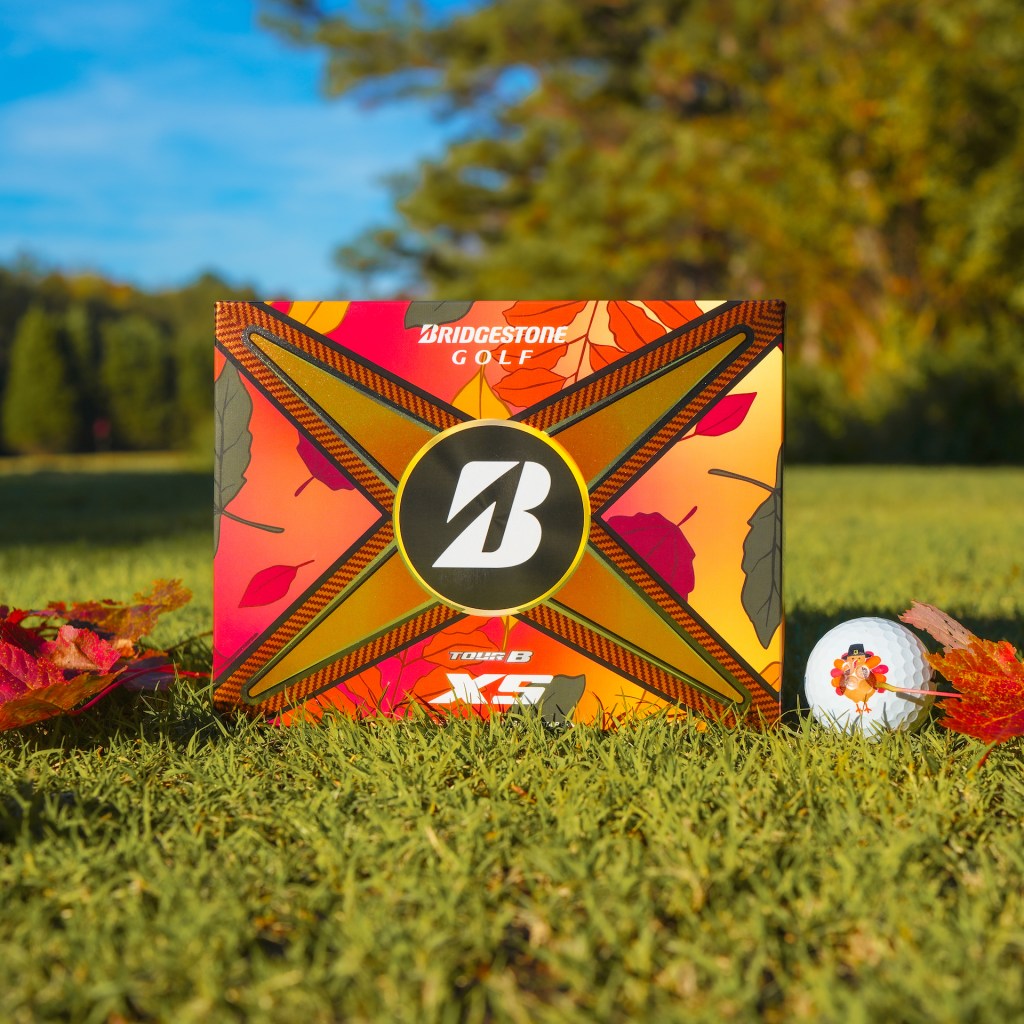
For performance AND extra fun, the limited-edition Bridgestone Tour B Turkey Ball ($45/doz., while supplies last) celebrates my own personal favorite holiday: Thanksgiving. I wish these balls had been around during the years when my golfing in-laws would always play golf together Thanksgiving morning while the feast was being prepared by my non-golfing in-laws. Those were great days, and these whimsical balls would have been a real hit.
Big Ticket Item: Your own golf course?

So maybe one’s very own private golf course is too extravagant for even a “big ticket item.” Fair enough. But what if you could give the most special golfer on your list and a few friends their own course for a day or two? At the ultra-exclusive Bunker Hill Farms Resort, just 90 min from downtown Chicago, this is precisely what you can do. For $1250 per person per day, not only will your golfer get exclusive access and private caddies at the 18-hole golf course, they’ll also get all-inclusive gourmet food and beverages and access to the myriad other activities and amenities of this one-of-a-kind resort, which is also a non-profit that donates all proceeds to local charities. You need to read all about it to believe it, which you can do here.

Your Golf Santa tees off at Bunker Hill Farms — checking “my own private golf course” off my bucket-list.

This wraps up yet another installment of the MidwesternGolf.com Holiday Gift Guide. Enjoy the holidays – from Thanksgiving through New Year – and may 2025 be gentle to us and our wallets. Peace.  

Bunker Hill Farms: Your Own Course for the Day (or Week)

What’s your golf fantasy? Ask most golfers this question, and the list will probably be predictable: A membership at Augusta National? A round with Tiger? Your very own private golf course? I can’t help you with the first two, but I do have advice about attaining the third, at least for a day or two or…more. For the cost of a few rounds at Pebble Beach, you and your golf buddies can experience what it is like to have your own private course—and chef, caddies, staff, and an entire estate to yourselves at Bunker Hill Farms, in Woodstock, Illinois.

You’re forgiven if you’ve never heard of Bunker Hill Farms. There are people who live within a few miles of the place who don’t know it exists. The photo below is of the front gate – with no sign at all to belie the “secluded opulence” that lies beyond.

The unmarked entrance to Bunker Hill Farms

History

Bunker Hill Farms started off in 2005 as a 150-acre family retreat for Mike and Amy Domek and their family. Mike is the founder of TicketsNow.com, which he sold to TicketMaster in 2008 for a handsome sum. With a portion of the proceeds from that sale, the Domeks embarked on a project that today includes 450 acres, a lodge and a cottage, a Silo Spa, a fishing and recreation lake, a 6,709-yard 18-hole golf course, miles and miles of trails, trap and target shooting, and, to be honest, pretty much anything else you can think of – which, I was repeatedly assured during my visit, the staff can arrange to bring in.

The Lodge at Bunker Hill Farms

The golf course officially opened in 2011, with a ceremonial first shot and commemorative concert by 80s hard-rock sensation Brett Michaels. In 2014, this musical tradition was scaled up with the first annual Rockin’ the Hill concert, when Cheap Trick was invited to play an outdoor concert to raise money for local McHenry Country charities through the Domeks’ foundation. During these years, access to the property and golf course was strictly by invitation only. Celebrities, politicians, corporate giants – they were all welcomed and pampered on the down-low, just 60-some miles from downtown Chicago but a million miles from the flashbulbs of the paparazzi.

Photos of A-list Bunker Hill Farms guests like Darius Rucker line the walls of The Lodge.

In 2023, the Domeks moved from an invite-only model to opening bookings for the expansive, luxurious property, all geared to raising even more money for their charitable foundation. All proceeds from event and group bookings of Bunker Hill Farms go into the foundation, which to date has donated over $3 million to McHenry County charities.

Signed guitars from all the musical guests and performers adorn the mantel in The Lodge.

Booking Bunker Hill Farms

Although Bunker Hill Farms is still a “celebrity haven” – as the property only books one group at a time and no one knows who is there or when – regular folks can book the entire property, including the golf course, now, too. Perhaps this needs to be qualified a bit: Regular folks who can afford $1250 per day (with a one-time $500 overnight fee if they stay overnight from one to however many nights) can book the entire property. The rules are pretty simple: $1250 per person (basic fee), minimum 8 people, and the property and staff and all amenities are yours, all-inclusive. This means you get the run of the lodge (which sleeps 12-14), the cottage (6 more suites), all the activities (guided ATV rides, shooting, water sports, cooking classes, wine tastings, etc.), a personal chef, all the food and beverages you want, and an 18-hole golf course complete with your own personal caddies and top-notch loaner clubs. Operations Manager Gretchen Pembrook assures me that pretty much any other activity can be arranged, too – from hot-air balloon and helicopter rides to horseback riding to full-service spa treatments to…well, whatever you can imagine, assuming your budget can accommodate some additional charges.

Ride an ATV to the high point of the Bunker Hill Farms property.
The Cottage at Bunker Hill Farms
The Silo-Spa at Bunker Hill Farms
The pneumatic elevator in the Silo-Spa (VERY cool!)

Not everyone who books Bunker Hill Farms is a golfer (one recent group booked the resort for two days to play Dungeons and Dragons), but if you are, and if you have the budget for it, Director & Inside Sales Manager Kayla Forschler assures me that they can even bring in PGA Tour players to play golf with you on what is, for all intents and purposes, your own private golf course.

The plaque behind the 9th green commemorating PGA Tour player Brandon Hagy’s monster tee shot.

Playing Bunker Hill Farms

Mike Domek loves golf. And his original plan, according to Joe NAME, TITLE, was for a full 18-hole golf course to cover around 120 acres of the original property. But Amy, his wife, did not want to look out her windows and see just a golf course. After some intense negotiations, Mike got approval for his full-sized golf course – 18 holes, 6,709 yards – to be built on just 60 acres of the property.

The routing diagram for the 18 holes at Bunker Hill Farms

How, you may ask, can a championship course fit on 60 acres? Enter landscape architect turned golf course architect Harry Vignocchi, whose other credits include Bull Valley in Woodstock, IL, and Bittersweet Golf Club in Gurnee, IL. Vignocchi stitched together a routing that shares fairways and greens in such a way that the back nine holes look and feel different from the front nine, even though all but one green is played to multiple times. The secret of pulling off such a design is two-fold. First, the angles and yardages into the greens on the front and back nines vary so much, it’s difficult to recognize them the second time through. Second, because the resort property is so exclusive, everyone on the course is from the same group – meaning just one or two foursomes most of the time. Occasionally, the property books larger groups for a corporate golf outing, but even then, every group will have their own caddie, and those caddies are equipped with walkie-talkies, so they can ensure everyone stays spaced out and won’t hit into each other.  

The tee shot on the 12th Hole — over the 11th green. One of the routing quirks at Bunker Hill Farms.

I cannot stress enough how impressive it is to play a course with such a small footprint but completely regular-length holes. Impressive and confusing! Without a personal forecaddie and being shepherded around by Joe Domek, Director of Outside Sales, I would have had no idea where to go – signage is non-existent. In this way, Bunker Hill Farms is similar to some historic Scottish Highlands courses, including the most famous of all, The Old Course at St. Andrews, where fairways cross and multiple greens are shared. The immense inventiveness also brings to mind The Loop at Forest Dunes in Michigan, which can be played forwards and backwards.

Equally impressive is the unmatched exclusiveness of Bunker Hill Farms – it is YOUR course while you play it: YOUR staff, YOUR beverage and food service, YOUR loaner clubs (also included, if you don’t have your own) – your EVERYTHING. You can hit 20 tee shots in a row on a par 3, if you want, to see how close you can get to the hole. You can replay the entire course as many times as you want in a day – sunrise to sunset, if you wish. In 26 years of golf writing, I have never experienced anything quite like it. No wonder it’s so popular with celebrities.

Hole 1, Bunker Hill Farms
Hole 3, Bunker Hill Farms

As one might imagine of a course that gets VERY limited play, conditions are immaculate. The 450-acre property is run with just five full-time employees, but there are a few who are dedicated solely to the golf course. Greens are large and subtly contoured, and they run around 12 on the Stimp meter. Good luck finding even one unrepaired ball mark. Fairways are generous, but there are plenty of hazards – seen and unseen – including dense underbrush, high fescue, and water. The fairways are all native fescue, and the tees and greens are bentgrass. Ironically, given the name of the resort, there is just one sand bunker on the entire course (but it is a deep one).

The lone bunker at Bunker Hill Farms

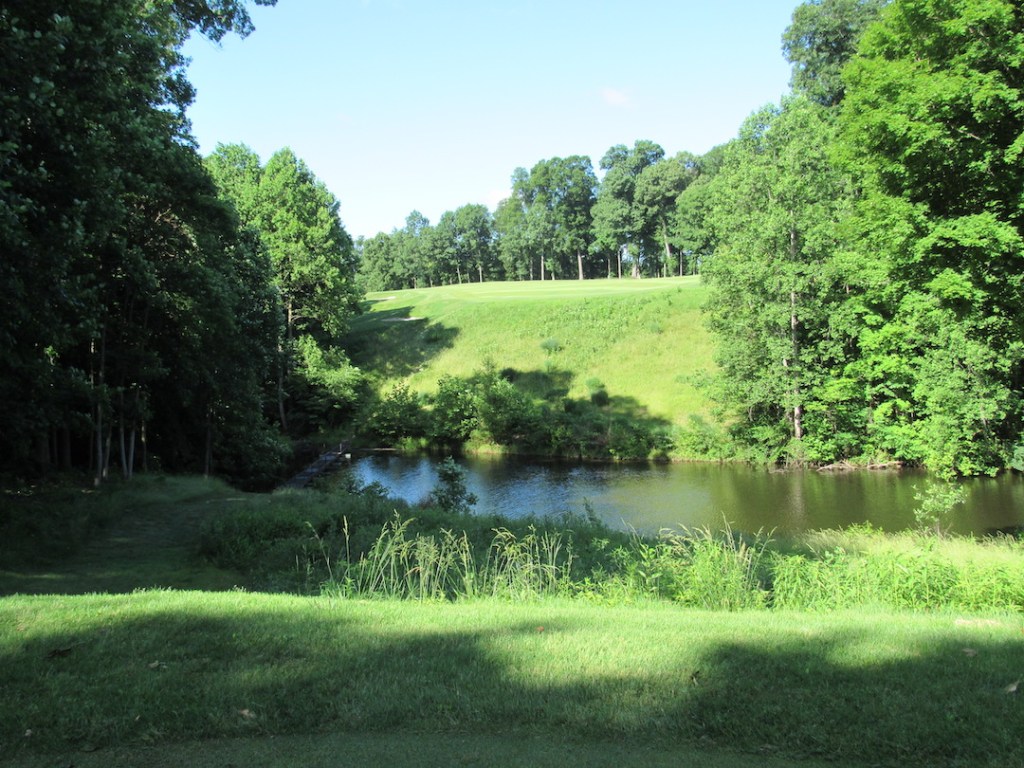
The entire course design radiates out from a pond at the center of the layout, sort of like a watery hub. Five holes (four on the front, one on the back) play across the pond in some way, with another couple skirting its shores. Most memorably, the tee box of the 137-yard 8th Hole is a small island in the pond, accessible via a stone walkway—a great photo op.

The author, teeing off on Hole 8
Hole 8 tee box (minus the author)

There’s only one set of tees per hole – the full 6,709 yards. However, for families or groups with mixed skill levels, the staff can set up tees at really any distance for every hole, so that even the course set-up is customized to your group’s needs.

It’s worth repeating again, too, that despite the petite footprint, this is a brawny, difficult course. The opening and closing par 5s measure 580 yards and 560 yards, respectively, there are four par 4s over 400 yards, and only one “short” par 4, at 303 yards. I felt like I was hitting some solid drives, but then discovering repeatedly that I still had a mid- to long-iron into many greens.

There are, nevertheless, some routing quirks imposed by the diminutive size of the course. For example, on your way to the 3rd green, you take your driver with you to tee off on the 530-yard, par 5 4th. On the 505-yard, par 5 12th Hole, you tee off over the 11th green. And the green on the 392-yard, par 4 15th Hole is the only one you play just one time. Fortunately, your personal caddie will guide you through these potential confusions, so you hardly even notice them.

Approach, Hole 5
Approach, Hole 6
9th Hole, behind the green
The 15th green at Bunker Hill Farms

Bunker Hill Farms: The Verdict

Bunker Hill Farms is by far the most exclusive golf course I have ever played, or likely ever will. It is as unique in its routing as it is in its philanthropic mission. For anyone looking for a corporate retreat, family reunion, luxury “destination” wedding (without having to fly across the globe), or just an ultra-exclusive, ultra-pampered getaway, Bunker Hill Farms is without peer. For golfers in particular, it is THE place to live out one of your golf fantasies: your own private course for a day (or two or three)!

Royal County Down: A Bucket-list Golf Experience

Imagine this: You’re playing golf. It is 38 degrees Fahrenheit. You are hitting off of a little plastic mat you’re carrying around with you. You are playing very, very badly. Yet, when you hole out on the 18th green, you can barely hold back tears because you’re so sad that the round is over.

There are few courses in the world where every step feels like a dream. Royal County Down in Northern Ireland is one of these precious few courses. None other than Bernard Darwin described golf at Royal County Down as “the kind of golf people play in their most ecstatic dreams.” And no matter what the conditions or your score, you simply do not want to wake up.

The links at Royal County Down nestle into the undulating dunescape with a natural ease that belies any human intervention. Nevertheless, in the clubhouse, you will find a photograph of Old Tom Morris and the original 1889 document that contracted him to lay out the second nine holes of the links “for a sum not to exceed £4.” That was a hell of an investment.

Royal County Down Golf Club is currently hosting the Amgen Irish Open, one of the premier events on the DP World Tour schedule. Player interviews so far  convey the deep respect and admiration players have for these links. Frankly, it is difficult to see how anyone fortunate enough to tee it up here would not immediately become a big fan.

The world-class golf at Royal County Down comes with a 360-degree panorama of mountains, sea, and village views.

Playing Royal County Down Golf Club

Like The Old Course at St. Andrews, the worst trouble (i.e., out of bounds) at Royal County Down lurks to the right, punishing slicers. The most claustrophobic OB stakes are found on the first few holes, in fact, so try to warm up a bit before your tee time. Unlike The Old Course, however, these links feature shaggy, tumultuous dunes and explosions of gorse throughout the layout. These features give the links a barely tamed feel without veering into unkempt wildness.

Unusually for historic links courses, Royal County Down opens with strong holes. The 539-yard, par-5 1st hole ushers you down the rabbit hole and offers views of the Slieve Donard Resort and the town when you look back up the fairway at the world you’re leaving for a while. The green of the 475-yard, par-4 3rd hole is tucked into a gorsey knoll and protected by a treacherous front bunker. The best views of the sea and shoreline come early, on the elevated tees of the 229-yard, par-3 4th hole.

Hole 3, Royal County Down
Hole 7, Royal County Down

The deceivingly evil 144-yard 7th was described by my caddie as, “The shortest par 5 in the world.” When I looked quizzically at him, he explained how everything runs off the putting surface into the back left bunker. When I landed short right and tried to chip to the back pin – and ran past the hole into that very bunker – he just nodded and muttered, “See what I mean?”

The 483-yard, par-4 9th is one of the most oft-photographed holes in all of golf. From the tips, the tee shot must find the right-to-left canted fairway some 260 yards off the tee. If you play more forward tees, a long drive can run off the end of the top part of the fairway, and the approach downhill to the raised green will have to be played from a terrible stance in thick rough. Good luck with that.

Hole 9, Royal County Down — one of the most photographed in golf

The 446-yard, par-4 13th is the #2-handicap hole, but it feels much harder. If your drive isn’t perfect, it’ll need to be played as a par 5. And even if your drive is perfect, the blind approach to the gorse-encircled green is never a picnic, especially if the wind is blowing (which it almost always is).

Hole 13, Royal County Down. The pole is where you aim on your approach.

Finally, the 548-yard 18th is relatively straight, relatively trouble-free. Perhaps this is because Old Tom intuited that so many future golfers would tread this fairway with misty eyes as they emerge from the dreamy, linksy wonderland. The course is open to visitors weekdays and Sun. afternoon (limited times available) mid-April to October. Green fees are £425 (£575 for 2 rounds in one day).

The 18th tee at Royal County Down — nearly time to wake up from the ultimate golf dream…

Travel Tips

The Northern Ireland seaside town of Newcastle has plenty of quaint bed and breakfasts and historic hotels, but a room at the Slieve Donard Resort and Spa is the ultimate stay-and-play experience when playing Royal County Down. The hotel was built by the railway to entice city folk to take a train ride to the coast to play golf, and opened in the same year as the back nine of the course, 1897. The famed linksland lies directly behind the back parking lot of the resort and can be seen from some of the rooms.

Slieve Donard’s red brick Victorian façade is simultaneously inviting and a bit foreboding. There are ample views out into the North Sea, and the interior has been completely refurbished with all the modern amenities, including a 5-star spa. Nevertheless, classic details have been preserved, such as the enormous carved wooden mantelpiece in The Oak Room.

Venturing beyond the exquisite confines and cuisine of Slieve Donard, gastronomes will be richly rewarded by a dinner at Brunel’s in Newcastle. The local mussels are probably the meatiest I have ever eaten anywhere in the world.

Rock Hollow Golf Club in Peru, Indiana, ROCKS!

Rock Hollow Golf Club is owned and operated by the Smith family, as in former PGA Tour Pro Chris Smith. The 7,005-yard Tim Liddy design is proof that a course doesn’t need a fancy clubhouse or hoity-toity staff to be one of the best in a golf-crazy state. Perennially ranked among Indiana’s top-10 public courses, Rock Hollow is the family business of a tight-knit family with deep roots in this tight-knit community, located about 80 miles north of Indianapolis. The tragic death of Chris Smith’s wife and severe injuries sustained by his two children in an auto accident early in 2009 shook not only everyone at the course, but also the entire surrounding area.

The 18th Hole at Rock Hollow is a classic cape hole. The tees are on the far side of that lake.

The Smith family endured, and has thrived, as has Rock Hollow.

Golfers here are treated to an outstanding layout that winds through a mined-out rock quarry, challenging even the best players with tall stands of timber and rocky outcroppings. I played with a +1 handicap who looked at the scorecard and saw that the Black tees (tips), though not overly long, have a rating/slope of 74.2/138. He said, “I don’t think I feel like tackling that this morning.” He chose to join me on the 6,463-yard Rock tees (white; 71.2/132). In fact, even the next set of tees further up (Blue) have a slope rating higher than my local course, despite measuring under 6,000 yards.

Course architect Tim Liddy was a star student of Pete Dye, and he learned from the master how to toy with players’ eyes and judgment. At the same time, he is fond of short par 4s, and “The Rock,” as the locals call it, has several. Each one of these dares the foolhardy to swing for the fences. But even the best wiser players soon realize that club selection is critical. The mounded green complexes and tight tee shots will take their toll if you don’t exercise caution in picking your spots.

Playing Rock Hollow Golf Club

Green fees at Rock Hollow max out at $69 (with cart), which represents an increase of less than $20 since I last visited in 2009. It was a bargain then, and just as much a bargain now. First-time visitors might feel underwhelmed by the understated entrance, parking area, and pole-barn clubhouse, but the relative lack of frills is how they’ve been able to keep green fees affordable. Out on the course is where you see the top-tier details: bentgrass tees, fairways, and greens, all well-manicured and attentively landscaped. Rather artistically arranged and mounded rocks punctuate the layout, recalling the land’s history as a rock quarry.

The first green at Rock Hollow Golf Club is not easy to hit, even if it is a short par 4.

Your swing, judgment, and patience are all tested immediately out of the gate, as the downhill, par-4 1st Hole measures just 296 yards from the back tees. But the heavily mounded and bunkered green is tucked to the left, partially behind dense, rocky woods, and there’s no bail-out to the right, either. Don’t have a tight, 290-yard draw locked in on the first tee? Maybe pull an iron.

Tee shots don’t ease up as you progress, either. There are no parallel fairways here; most holes feel pretty isolated, and all are lined with tall hardwoods, wetlands, or both. The long, uphill, par-5 6th Hole is a prime example. This said, most fairways do open up a bit more than they appear from the tees, but only in spots. For the most part, accuracy off the tee is more valuable here than length.

The tee shot on the long par-5 6th Hole at Rock Hollow feels, and is, narrow.

The collection of par 3s is nicely varied with respect to shaping and hazards, from the short tabletop 4th Hole to the longer 8th and 14th Holes with their prominent water hazards. The one-shotters are also where yardage differences between the tees are most pronounced. There are only four sets of tees, but on the 8th, for example, the yardage ranges from 219 yards at the tips all the way to 96 yards at the most forward set. If you’re playing a scramble here and have some skilled women, juniors, or seniors on your team, you’ve got a huge advantage.

Hole 8, Rock Hollow
Hole 14, Rock Hollow

As mentioned, Liddy, like Dye, is skilled at visual trickery. He uses mounding and angles to convince you that targets or hazards are both farther and nearer than they appear. Toss in a generous portion of blind shots, and Rock Hollow is a course that rewards experience and local knowledge. Take the seemingly benign par-4 9th Hole, which maxes out at 383-yards. From the 352-yard Rock (white) tees, a prominent, deep fairway bunker at the elbow of the left-to-right dogleg looked unreachable for me. Yet my heeled, slicing drive came up just 25 yards short of its start. So the much longer, younger, and better player ripped a drive that we all thought had easily cleared its far end. When we arrived at our balls, though, his was squarely in the middle of the sand, which extended further than it looked. Our second shots were equally as confusing: I thought mine was short – it was long – and another player thought his was next to mine, but his was 20 yards short of the green.

Rock Hollow’s 16th green is blind if your lay-up does not reach the top of the final rise in the fairway. The water hazard stretching across nearly half of the front of the green is, too.

The trickery, the angles, and the accuracy all come to a head on the 427-yard 18th Hole. It is a classic cape hole, meaning that the tee shot requires a forced carry over a lake to a crescent-shaped fairway set perpendicular to the tee boxes. Holes like this is where laser range finders pay for themselves. Players scan the far edge of the water and decide how much they think they can bite off. 220 yards? 240? 275? You can almost hear Dirty Harry growling, “You feel lucky, punk? Well, do you?” Once you pick a number, all you have to do is hit your line. Slice it, you’ll probably clear but have a monster of an approach into the green. Hook it, and you’ll likely come up short.

I hooked my drive, but just slightly, staying airborne long enough to land in the waste bunker that borders part of the fairway. The sand here—as in all the bunkers at Rock Hollow—is slightly coarse and gravelly. So my ball sat up nicely, allowing me to pick it clean with my 9-iron to cover the 139 remaining yards. When the ball came to rest 18 inches from the cup, and I tapped in for a closing birdie, I could honestly say that this was my best closing hole all year.

Rock Hollow: The verdict

The 13th at Rock Hollow is one of three short par 4s, but bunkers and woods guard the green.

Indiana golf is vastly underrated. And most underrated of all are the numerous top-ranked public courses scattering the countryside, beyond the hustle and bustle of the greater Indianapolis area. Rock Hollow is one of the very best of these. It’s a family-run operation at family-friendly rates that nevertheless plays to Tour-level standards. Perhaps its only weakness is a lack of more blended tee options between the four widely-spaced tee sets (there is just one blended set between the regular and “senior” tees). Rock Hollow Golf Club has survived and thrived on challenging shot-making and superb conditioning. If you value these aspects of the game over frills and fawning attendants, this course is for you.

Be a Well-Adjusted Walker with Sun Mountain Ridgeline 3 Push Cart

I prefer to walk when I play golf. Since at least 2009 when my lower back began balking at the weight of my golf bag, I have been a staunch proponent of push carts. I review a lot of gadgets, balls, clubs, drinks, snacks, etc., etc. nearly every round, so my bag is often stuffed with extras. When I was sent my first push cart to review, it was a revelation: so much space for my excess gear, and a drink holder for a beverage, and a spot to clip a cigar holder, convenient access to my scorecard…the benefits were too many to list.

Since then, I’ve reviewed at least a dozen push carts, and all work more or less similarly – and more or less well. One issue that does arise, however, is the way my bag sits on some carts: sometimes they twist, or the straps slip off, or the build of the cart fits a cart bag better than a stand bag (I still carry for 9 holes, sometimes). Sun Mountain’s new Ridgeline 3 push cart ($350) addresses this irritation by introducing the first-ever fully-adjustable 3-wheel push cart. It fits any bag, from junior stand bag to full staff bag with just a few adjustments.

The Ridgeline 3 opens and folds easily, with just one lever and one latch. The fully adjustable part is the bracket on the main vertical handle support. The bracket has a lever that can be loosened or tightened to adjust the height of the bracket. Personally, I like to leave it tight enough to keep from slipping, but loose enough to allow me to slide it up and down without messing with the lever. When I unfold the cart, I slide it all the way up. Then I slide the adjustable top strap through the front handle of my bag to keep the bracket from sliding down. After finding the appropriate length for the straps, my bag is held snugly. The bottom strap stays snug on the bottom of my bag. Best of all, I can set the bag on the bottom bracket without popping the stand legs out.

The handle is rather radically adjustable – ranging from too high for me (I’m 6’1”) to below my waist level. What is particularly nice is the angle at which your bag sits: it’s pretty upright, so your clubs aren’t crowded by the handle and console no matter where you set the handle height. This upright carriage also means that normal-length golf towels don’t get caught underneath the cart wheel. (Does this happen to anyone else? It always seems to happen to me after I hit a bad shot, compounding the irritation. Seriously, is it just me?)

Speaking of the console, it is perhaps a titch shallow. But even so, it has room for a couple extra balls, your keys, wallet, lighter, etc. on the inside. Outside, there is a scorecard holder and a clever cell phone bay with a small bungee to keep the device secure and facing you. At the front of the console is a spacious net to hold larger items.

All in all, the Ridgeline 3 is an outstanding push cart. If there are weaknesses to the design, it is the overall weight, which is slightly heavy. But the ease with which it rolls helps counteract the few extra pounds. Another small quibble is the size of the cart when it is folded: it’s got a fairly high profile—it doesn’t fold particularly small. However, it does fit well enough in the trunk of my mid-sized sedan, even with the 20 pairs of golf shoes and my golf bag. So it’s not that large, and the plusses far, far outnumber the negatives. The Ridgeline 3 is an excellent choice for the walking golfer.

Kona Country Club is a Big Island Gem

Each Hawai’ian island has its own vibe. The Big Island, Hawai’i, is my favorite. It is the biggest and ecologically most diverse, with 11 of the planet’s 13 climate zones represented on the island. (Yes, you can even ski on Mauna Kea.) Also thanks to its size, it is the one island that doesn’t feel totally overrun by tourists, even during high season.

The Kona Country Club, located six miles from downtown Kona in Keauhou, harkens back to an even less touristy time. The 6,657-yard course was designed by William Bell in 1966, at a time when prime ocean-front land was still abundant. Thankfully, despite rampant development, this Big Island gem retains its charm and ocean vistas today.

You’re never far from the Pacific Ocean while playing the Kona Country Club.

Several holes of the Kona Country Club run directly along the ocean, which proshop staff refer to as “the biggest water hazard in the world,” and just about every hole offers some view of the crystalline blue Hawai’ian waters. Lava outcroppings line the shore and run through sections of the course, forming blowholes (“puka”) when the waves are high. From November through March, players are also likely to spot humpback whales breaching just offshore. Onshore, there are views of Mt. Hualālai, as well as the most curiously shaped palm tree you’re likely to find anywhere.

Mt. Hualālai, as viewed from the course.

Sure, you expect natural beauty in Hawai’i. But is it a good course? The LPGA played a tournament here for a couple of years, so the layout is championship quality. Impressively, it is also an excellent resort course, which is convenient, since it is surrounded by condos and resorts, including the Kona Coast Resort, which boarders the course (whose guests receive a $24 discount on green fees). It is the type of layout that allows first-timers to enjoy the round and play well even without any local knowledge.

Playing the Kona Country Club

When William Bell laid out the course in 1966, there was little development between it and the ocean. Amazingly, despite rampant building all around, nearly every hole boasts at least a glimpse of the sea. Straight out from the first tee, players gaze down on Keauhou Bay and marina, where dozens of snorkeling and sightseeing tours set sail throughout the day.

That’s Keauhou Bay down the hill from the first hole of Kona Country Club. You can catch a boat for a night-dive with manta rays from there.

Four sets of tees allow players of all skill levels to not only enjoy the memorable views, but also the superb golf. For many, the 6,263-yard blue tees will feel comfortable. The downhill 1st hole is a nice, gentle opener that doesn’t require driver. A solid hybrid or fairway metal will trundle down into a large gathering area where the fairway turns 90-degrees to the left, back up toward the green.

The collection of par 3s is outstanding, but choosing the correct set of tees for your round will make all the difference. On the front 9, both par 3s are over 200 yards from the tips but drop down to about 140 yards from the forward tees. The one-shotters on the back are shorter, with the 17 maxing out at just 149 from the championship tees. The first of these great short holes is the 3rd, which plays 195 from the blues with the ocean all along the right-hand side.

The par-3 3rd Hole is one of the longer one-shotters at Kona Country Club.
The par-3 12th Hole is a bad place for your hook to pop up (trust me).
The 17th Hole is the only par 3 without the ocean nearby — but you have to carry an old lava flow.

The fairways are quite generous, but several holes are lined by houses built very close to the edge of the course. Worse yet, many have terrifyingly large windows, raising the stress level on the tees. Rather incredibly, though, lucky bounces do occur – on the par-4 8th, one of the worst drives I hit all day caromed off a roof and back into the fairway. (Whew!)

The real Big Island magic starts on the 405-yard par-4 9th, which plays uphill to a green situated at one of the highest points on the property. Even if you’re putting out for a double-bogey, take a moment and soak in the endless expanse of the Pacific.

View from the 9th green
The par-4 10th Hole plays all the way uphill.

The stretch from 12 to 15 presents one postcard-worthy shot after another. The 12th is a mid-length par-3 with lava rocks and the ocean tight on the left. The 13th is a longish par-4 where, if the surf is up, you might get sprayed by one of the aforementioned blowholes. Between the 13th green and 14th tee you’ll find the famed “corkscrew palm,” which looks like some child’s crazy drawing came to life.

The 14th green
The famous corkscrew palm (and the far less famous screwy author)

The single weak hole on the course is the steeply uphill, left-to-right par-4 16th, where the only job is to hit the ball straight off the tee, as houses are definitely in play in the elbow of the dogleg (be wary of trying to cut the corner). “Everybody hates this hole,” said the regular I played with. After struggling to make a rather miraculous bogey putt, I understood why.

The short par-3 17th is nevertheless somewhat intimidating as your tee shot has to carry an ancient lava flow and a deep ravine to find the steeply canted green. And finally, the uphill par-5 18th taunts you with a row of condos on the left just FULL of big windows. Avoid having to file an insurance claim, though, and you’re treated to one last lovely view from a severely back-to-front tilted green that can ruin your round if you end up above the hole.

The 18th green at Kona Country Club provides a picture-perfect backdrop to end your round.

The Kona Country Club: The verdict

The Kona Country Club is a Golden Age classic that, despite surrounding development, has maintained its hang-loose vibe and dozens of memorable ocean vistas. The visitor rack rate of $189 is perhaps a bit steep, but guests at surrounding resorts are discounted to $165, and the “twilight” rate of $125 begins after 1pm, which is both pretty early for a twilight rate and pretty reasonable for authentic Hawai’ian golf. Quality rental clubs are available.

After your round, enjoy a cold beverage at The View Restaurant in the clubhouse. It’s not just a clever name – the view is fantastic. Just as impressively, the prices for the excellent sandwiches and full entrees are some of the best you’ll find in the Keauhou area. Seriously, the restaurant is as much of a gem as the beautifully maintained course.

The Big Island is the final Hawai’ian frontier. It’s still possible to find spots that feel “local” and “real.” The Kona Country Club is definitely one of them.

Sightseeing Tip

There’s lots of unforgettable adventures on the Big Island, from helicopter flights over active volcanoes to whale-watching to cliff-diving off the southernmost tip of the United States, but according to many locals, the coolest is taking a night snorkel with manta rays. These prehistoric behemoths are up to 23 feet across their wingspans, weighing up to 6,600 lbs. Night snorkels put you in the water with them, and as they scoop up the plankton drawn by the lighted board that divers hang onto, they come within inches of you – like graceful, slightly terrifying aquatic archangels. The tour I’d recommend is run by Eka Canoe, which donates a portion of their profits to teach local Hawai’ian kids sailing and ocean stewardship.

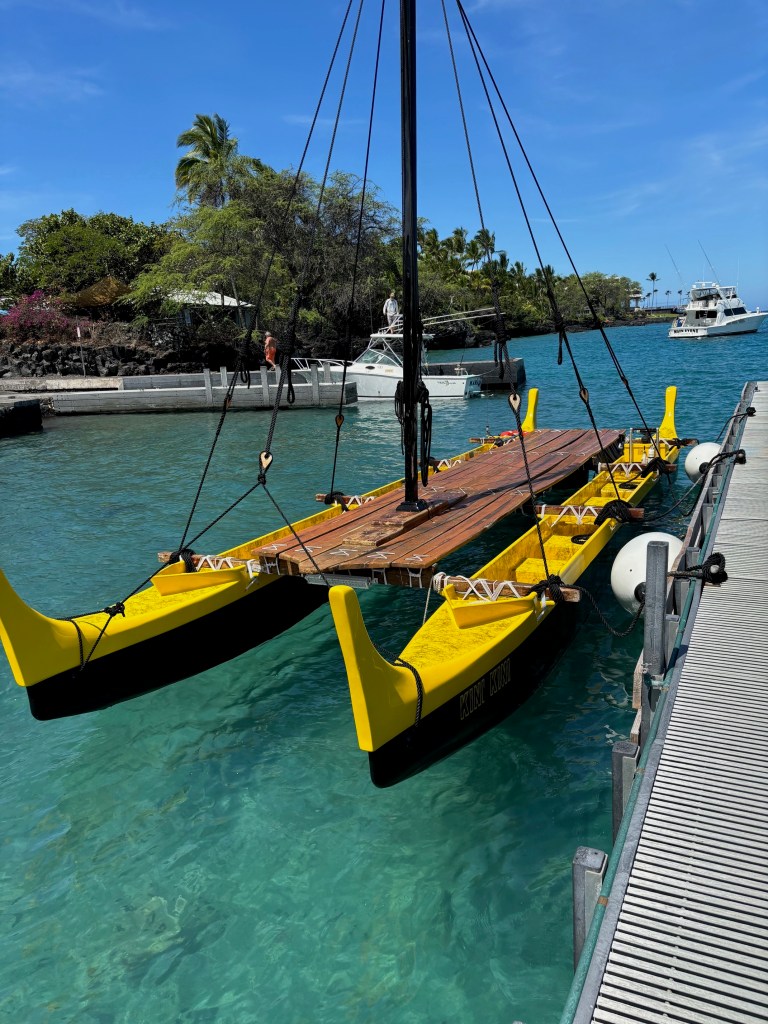
Imagine jumping off this (Eka Canoe) at night, into the black ocean, for a chance to watch 6,500-lb. manta rays up close!
It’s an amazing rush!

Cleveland CBX 4 Zipcore Wedges deliver spin and confidence

I just finished playing 18 with a nice young man – 30 years old, struck his woods fairly well. But he gave away at least 12 shots around the greens – full wedges off the toe or high on the face, chunks, duffs, lack of spin. Sometimes technique was to blame. Others, though, I would attribute to the cut-rate wedges in his bag.

Most amateurs miss their wedges in one of three ways: 1) on the toe, 2) high on the face, 3) chunk. So that young man’s misses were textbook.

Wedges that tour pros play are not very good for amateurs with these misses. The top of the face is too thin, so there’s no mass if the ball rolls up the face. MOI is limited, so anything off-center tends to twist the face and kill distance. And if you hit it on the toe, there’s no grooves to provide spin and control.
Cleveland’s new CBX 4 Zipcore Wedges ($170) address every one of these design faults in one fell swoop.

The CBX 4 design is reminiscent of cavity-back irons, with perimeter weighting increasing heel-toe MOI by 7% and high-low MOI by 5.8%. Believe it or not, most of the spin on wedge shots comes from clubhead mass distribution, rather than the grooves. So putting some weight at the top of the clubhead not only increases stability, but also spin.

Not that grooves aren’t important. Cleveland’s Zipcore technology combines deeper, closer-together grooves with HydraZip technology. This one-of-a-kind face blast and laser line pattern boost friction off the face for improved spin consistency from any lie. There is also texturing all the way to the edge of the toe, so even contact totally out on the toe will still get some spin.
Finally, to fight the chunky shots, the CBX 4 wedges all come in three different Dynamic Sole Grind selections, each optimized by loft. All three sole grinds (V-Shaped, S-Shaped, C-Shaped) feature a leading edge design that promotes smoother turf interaction and helps prevent chunking. My old wedges were real gamers, but the leading edges were very sharp. So if I contacted the ground just a fraction before the ball – especially playing on courses with sticky Bermuda turf – they would dig in…chunk! Since putting a couple of CBX 4 wedges in my bag months ago, I can count on one hand the number of chunky chips I’ve hit. Literally, maybe just two, now that I think about it. To maximize your performance, however, I’d recommend researching those three sole grinds and even getting fit for your swing (picker? digger? gouger? – you know who you are).

Cleveland CBX 4 Wedges: The verdict

Bottom line on the Cleveland CBX 4 Wedges is that they will improve your bottom line, i.e., your score. Stop wasting shots around the green, and you’ll be amazed how much lower you shoot. These aren’t “one-hit wonders,” either. They’re designed to help reduce poor shots, but they let you get creative, too. In short, the CBX 4 Zipcore Wedges feature the masterful engineering we’ve come to expect from Cleveland, targeting a wide range of recreational golfers at a very reasonable price point.

Don’t run, GALLOP to Sultan’s Run in Jasper, Indiana

Indiana is perhaps the most under-the-radar great golf state in the nation. Avid golfers can find top-notch courses not only at the state’s best universities and luxury resorts, but also scattered across the rolling countryside. North to south, east to west, you can tee it up at these hidden gems for a fraction of the cost of more well-known facilities.

Take, for example, the course that was recently chosen by the Golf Channel’s GolfPass membership as the 4th Best Public Course in America: Sultan’s Run. Located in quaint Jasper, Indiana, the 6,859-yard Sultan’s Run is a thrilling rollercoaster-ride of a course that culminates with a closing hole that is billed as “The Most Dramatic Signature Hole in Indiana.” (More on that later…)

Sultan’s Run, Hole 18 tee box…but this isn’t the most dramatic part…

In 1992, a local consortium opened Sultan’s Run on the sprawling acreage that used to be a horse farm (hence the course’s name and logo). In 1996, one of Pete Dye’s accomplished protégés, Tim Liddy, undertook a renovation that included rebuilding some greens and bunkers and slight tweaks to the routing. Today, the zoysia fairways and bentgrass greens deliver outstanding playing conditions in the often extreme southern Indiana climate.

Conditions, layout, and challenge are of such high quality, in fact, that Sultan’s Run was chosen to host the 2023 Senior LPGA Championship, adding to a long list of high-profile tournaments held here. The day we visited, the vexingly contoured greens were running about 12 on the Stimp meter. The day after we were there, an Indiana high school sectional was played, and the scores ranged from 68 (-4) to 142 (+70) from the gold tees (6,429 yards).

The course itself isn’t the only notable feature of Sultan’s Run, however. Co-owner Chris Tretter reports that he and his partner have poured $6-$7 million into the facilities over the past five years. “And we’re just getting started,” says Tretter. “Our goal is to not just have a great golf course, but to be a premier entertainment and hospitality provider in southern Indiana.” Soon there will even be a closed-circuit live-stream of the 18th fairway and green in the clubhouse so people can watch groups coming in and maybe lay down a bet or two on their performance.

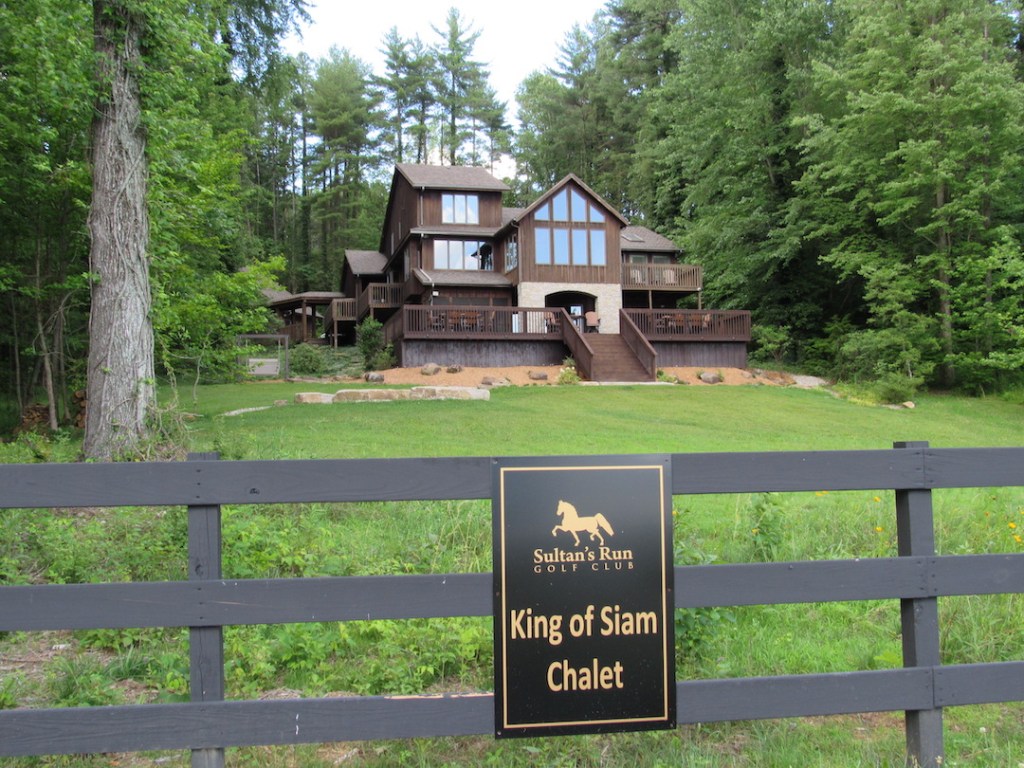
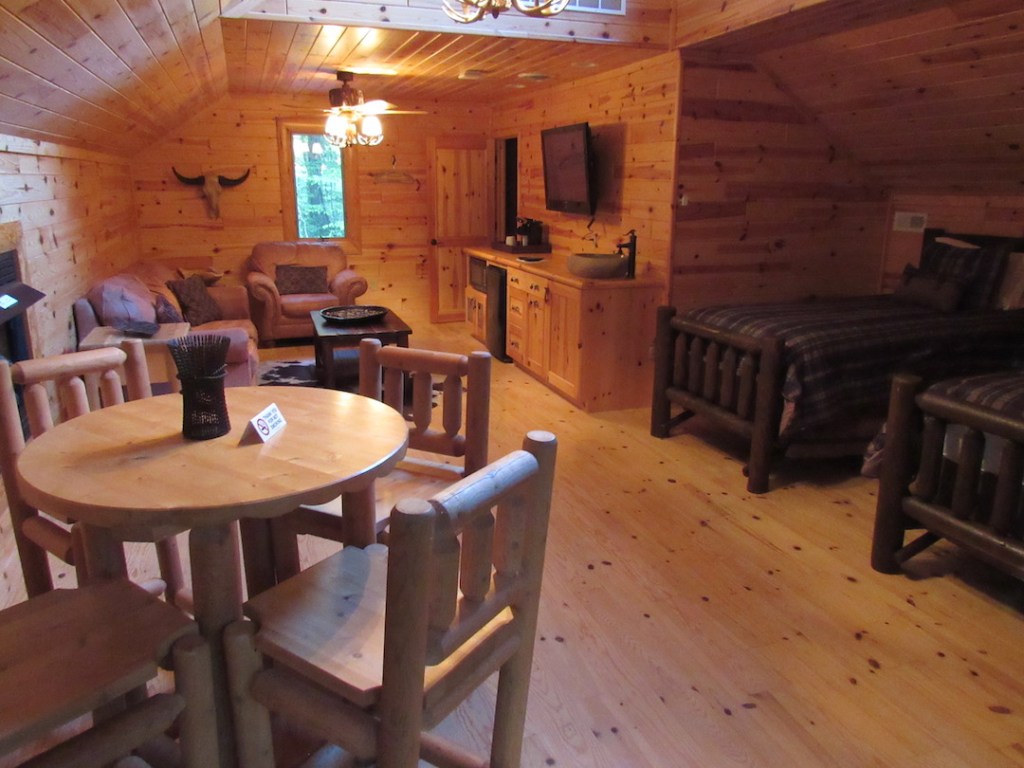
The clubhouse itself was just doubled in size, and on-site lodging has been added. Bordering the final few holes, up to 20 guests can stay in the King of Siam Chalet (12) and the adjoining cottage (8) with gorgeous views of the course. We stayed in the cottage during our visit and were highly impressed with the attention to detail and quality of every single aspect. “I could live here!” my son kept exclaiming.

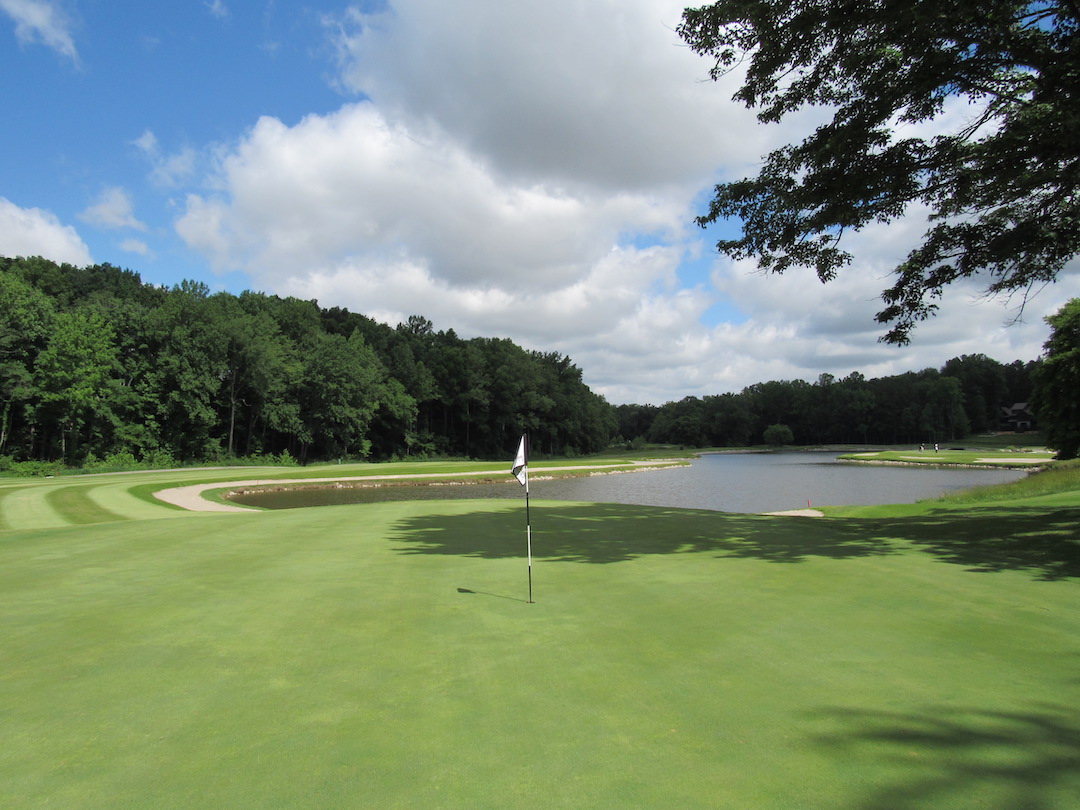
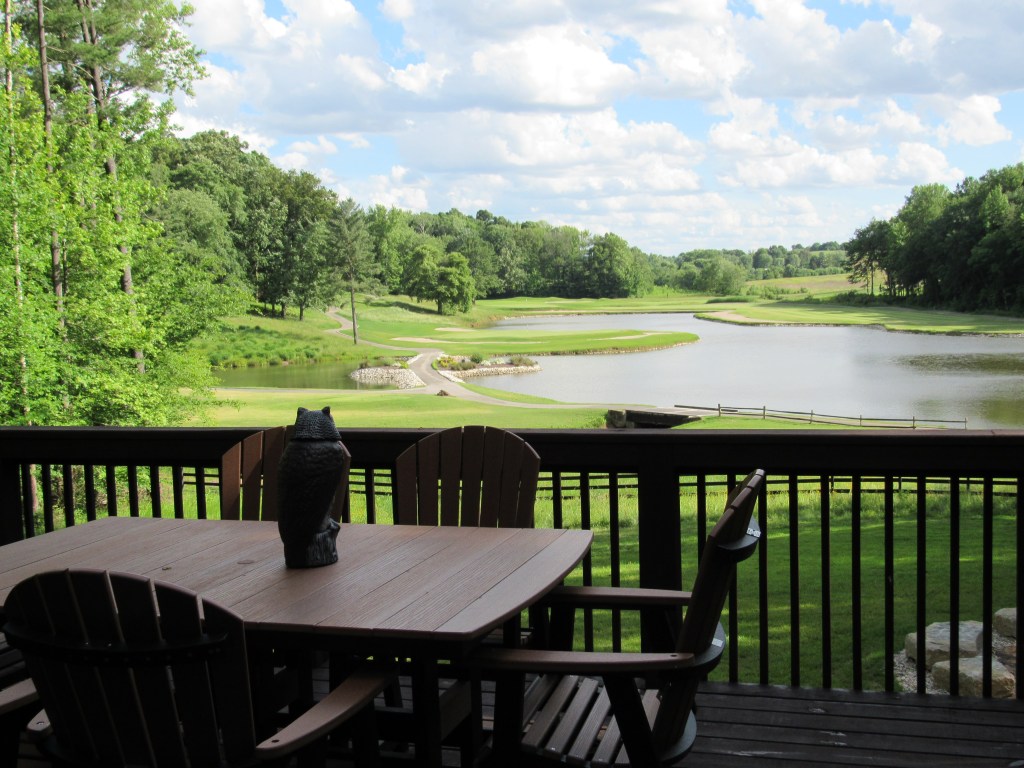
View from the King of Siam Chalet of the 16th green at Sultan’s Run
The King of Siam Chalet Sleeps up to 14. The Cabin, behind it, sleeps up to 6.
Sultan’s Run’s Cottage has two bedrooms, three baths, a loft, and full kitchen — and it’s brand new!
Cottage loft

Greens fees at Sultan’s Run max out during peak season weekends at $105, and they often can be considerably lower. (They would easily be double that in the Indianapolis area.) As for pricing of stay-and-play packages, Tretter says, “We do custom pricing for everyone. Just call, and we’ll work something out.” A true example of Hoosier hospitality!

Playing Sultan’s Run

There is simply no space here to describe all the memorable holes at Sultan’s Run. Before the round, I asked for advice from one of the exceedingly friendly workers in the well-stocked proshop. Aside from keeping the ball out of the woods and beneath the hole, he said, “There aren’t a lot of blind shots. It’s all out in front of you.”

This description, however, turned out to be total fiction. We counted easily a dozen holes with some sort of blind or semi-blind shot – tee shot, approach, lay-up – especially if we happened to be coming in from a less-than-ideal angle. Fortunately, the golf carts come with precision GPS, which helped a little. (If you’re a masochist and want to walk up and down the substantial hills, buy a yardage book!)

Sultan’s Run, Hole 1 approach — where you can’t see the putting surface…
Sultan’s Run, Hole 4, where the putting surface is also partially occluded…
Sultan’s Run, Hole 9 tee — an intimidating forced carry and a blind landing area over the top of the rise.

One of the features of the layout that is most difficult for first-timers is the change in elevations you experience from hole to hole. For example, the 194-yard, par-3 2nd could play up to 3 clubs less due to the steep drop (over water) to the green. Unless there’s wind, in which case you need at least a masters degree in engineering to pull the right stick. In fact, the entire collection of exquisite par 3s requires some expert surveyor skill.

Sultan’s Run, Hole 2 — the first of an exquisite quadruplet of par 3s
The par-3 12th Hole is maybe the hardest hole on the entire course to choose a club for.

There’s a brilliant mix of short and long par 4s, and I don’t think my notes for any course have included more uses of the words “wild” and “crazy.” The 347-yard 7th is, according to said notes, the wildest short par-4 I’ve ever seen. The fairway heaves and then falls off, and the green itself drops off on the left and back 90 degrees, so even the perfect drive over the blind hill then requires a deft touch for your second shot to hold the putting surface.

But it’s not just the short holes that are crazy-fun. The 409-yard 14th presents another blind tee shot to a fairway that tumbles dangerously downhill (seriously – we lost count of the number of signs warning against cart rollovers). A good drive is equally likely to stick high on the slope for a long, tricky second as it is to roll all the way to the bottom of the valley for a flip-wedge in.

Sultan’s Run, Hole 14 — get over the hill just in front of this position, and you’ll have a flip-wedge in.

And then there’s the 429-yard, par-4 18th. The GPS lets you know it’s “The Most Dramatic Signature Hole in Indiana.” When you stand on the tee to address the forced, downhill carry over a ravine, you think, “OK, but the carry on the 9th was longer.” (And it was—that was an intimidating tee shot!) But then, if you’re lucky, you get to your ball in the middle of the left-to-right dogleg, and you look uphill toward the green, and you see a 20-foot waterfall ringing the backside of the putting surface. The GPS wasn’t lying!

Sultan’s Run, Hole 18 — a definite “Wow!” moment from the fairway

Sultan’s Run: The Verdict

I’ve played a lot of golf in Indiana, including nationally-ranked bucket-listers like The Dye Course at French Lick. But I am being completely honest when I say that none of them have been more fun – nor more challenging first time out – than Sultan’s Run. In fact, the final five holes here rank as one of the best extended stretches of closing holes I have seen on any course.

Sultan’s Run, Hole 15 behind the green — this fairway looks like a narrow ribbon from the tee, running between woods and lake.
Sultan’s Run, Hole 17, where all kinds of trouble left and right off the tee is invisible to the player. (We watched a half-dozen groups come through one evening, and every one of them found trouble!)

My recommendation is to give Chris Tretter a call, book the chalet or cottage for a night or two, and play Sultan’s Run at least a couple times. After your first round, you will DEFINITELY want to take another crack at it. The greens were inscrutable to us, and intimidating in their speed, but smooth and true. The zoysia fairway grass sort of teed up the ball for you on every shot. Just about every shot looked and felt longer than the GPS said, which took real mental discipline to get used to. And the staff were without exception as friendly as we have ever found anywhere. This Hoosier hospitality extends to the rest of Jasper, too – take the time to treat yourself to the famed tenderloin sandwich or an alligator tail platter at the historic Snaps restaurant in town. (Snaps is on Indiana’s “Tenderloin Trail.”)

So saddle up and gallop down to Jasper for a golf experience you won’t soon forget!

Sultan’s Run, Hole 16 — part of the best closing stretch of 5 holes you will find anywhere

2024 Father’s Day Golf Gift Guide

It’s Father’s Day again! Seems like the last one was just a year ago. Time flies like a McIlroy drive, as they (should) say.

Let’s get right to the point: The best gift you can give to old Dad – or any father-figure or mentor in your life who happens to love golf – is to play a round with them. But if time or opportunity don’t allow, here are a few of the best Father’s Day gifts I’ve run across this year.

Upper Deck Golf Trading Cards

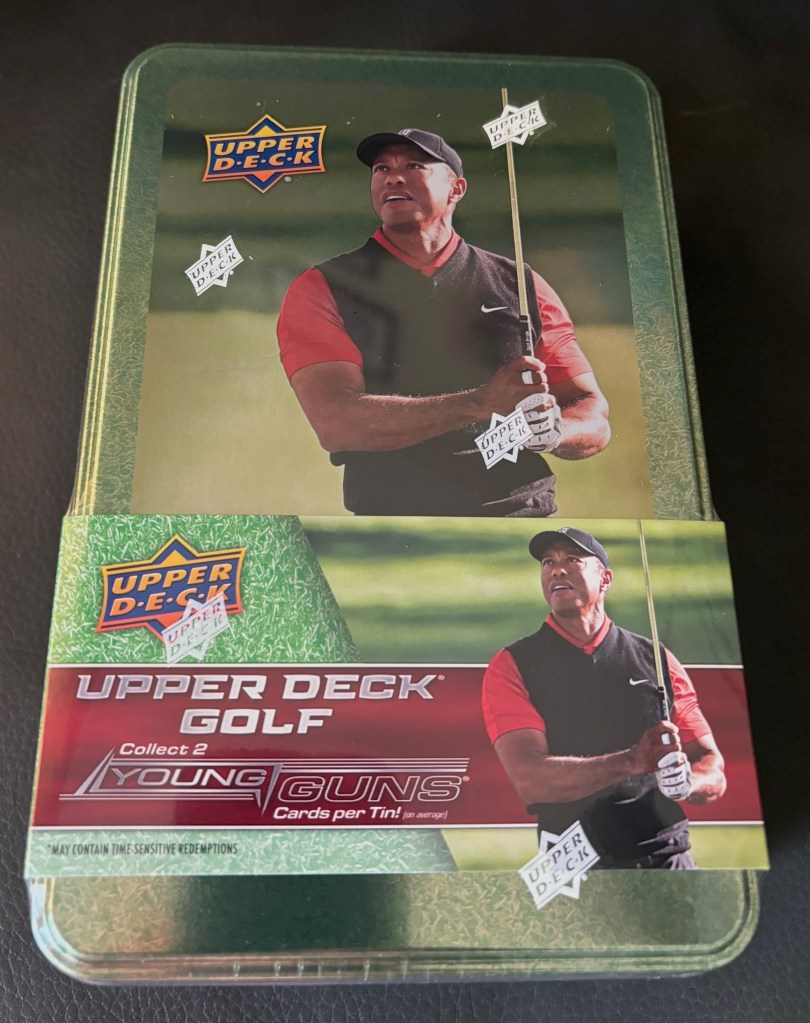
I’ve been collecting sports trading cards since I was 10 years old. I’ve just recently gotten back into the hobby, and based on the prices of cards on eBay and the thousands of “card twitter” accounts, it appears I’m not alone. I’m a much bigger golf fan than I am baseball fan these days, so I was thrilled to find sleek tins of Upper Deck Golf Cards ($35) on the shelves of my local card hot-spot. They’re printed on high-quality stock and the photography is excellent; however I was somewhat disappointed with the inserts and parallels. For example, the tin touts “Young Gun” inserts, one of which in my tin was…Billy Horschel. Huh? Guy’s been on tour for 15 years. And the “Dazzlers” inserts are shiny and sparkly, but Joel Dahmen and Ashleigh Buhai are “Dazzlers” (despite Buhai’s 2022 Women’s Open victory)? Nevertheless, it’s cool to have a few Tiger Woods and Annika Sorenstam cards, and I appreciate the inclusion of plenty of LPGA players. If your dad finds himself reliving the childhood thrill of opening packs of trading cards, this is a fun gift.

Arcade Belts

At a certain age, belts become a “must” for men. Weight redistributes, backsides turn into bellies. I don’t know why. It’s just a thing. But belts can be a pain: wrong size, metal buckles that set off airport metal detectors, expensive leather that stains and warps. Arcade Belts ($35-$40) are revolutionary, futuristic belts that solve these problems. These fabric belts are woven from 85% post-consumer polyester. They stretch and are adjustable precisely to any size. The buckle is plastic, so you can leave it on for TSA. They’re so light, you don’t even know they’re on. The only caveat is that the plastic hardware is slightly bulky, and if your beltloops are narrow, it’s tough to thread the Arcade through while your shorts are on. It works better to put the belt through before you put the shorts on. And once the belt is threaded through the loops, you can leave it in your pants when you do laundry, as it’s machine-washable!

GolfLogix Green Books

GolfLogix has custom green books for over 15,000 courses worldwide. Books ($50) contain hole overviews and heatmaps of greens with directional arrow for the breaks. Dad will feel like a Tour Pro pulling out one of these…until he misses the 5-footer for par anyway. Seriously, every time I show these to people at my home course, they all want one. Your Dad will, too!

adidas Sport SP0070 Sunglasses

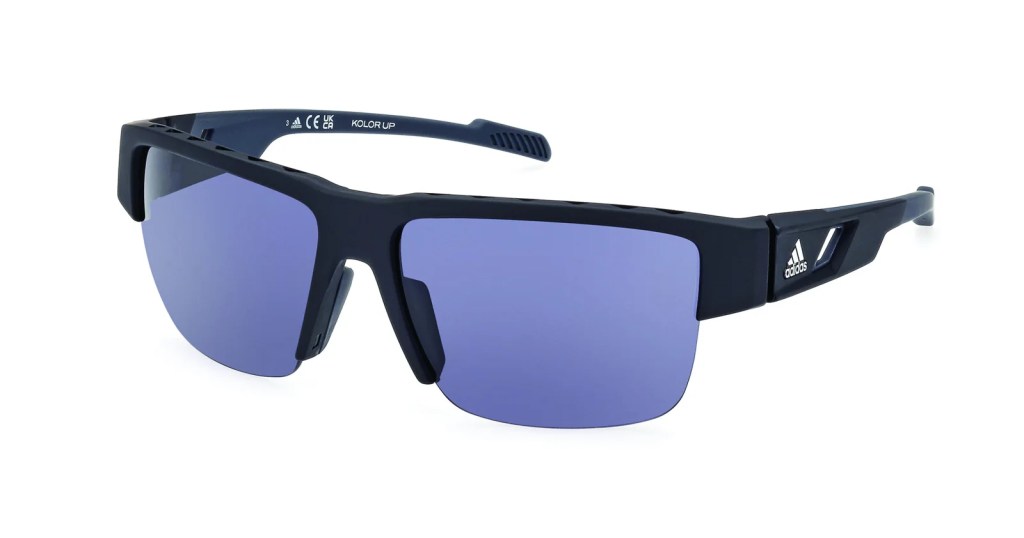
Is Dad looking to elevate his game on the greens? Adidas Sport eyewear has sunglasses tailored specifically for golf enthusiasts. The adidas Sport SP0070 sunglasses ($78) boast advanced lens technology that enhances clarity, color, contrast, and surrounding light, allowing you to read the greens with unparalleled precision. The impact resistant, ultra-lightweight frames ensure maximum comfort throughout your round, while the ergonomic design guarantees a secure fit, even during your most powerful swings. I don’t wear a lot of sunglasses, but these light and aerodynamic frames with aeration slots contoured to my head, and the flexible temples with a rubberized inside stayed snug without sacrificing comfort. And adjustable nose pads with sweat draining lines stayed put on my (usually sweaty) nose, too.

Balls, glorious balls!

If there’s anything you can get Dad that he will (a) use, and (b) lose, and (c) need plenty of replacements for (aside from sunglasses), it’s golf balls. Just last week, I was playing with a guy who sliced a brand-new pearl into the pond on the first hole and said, “There goes $5.50 in one swing.” And he was a 3-handicap.

The trick is finding balls that work for ol’ Pops. What does he like? What fits his game? There are more and more choices every year!

Srixon Q-Star Tour Divide

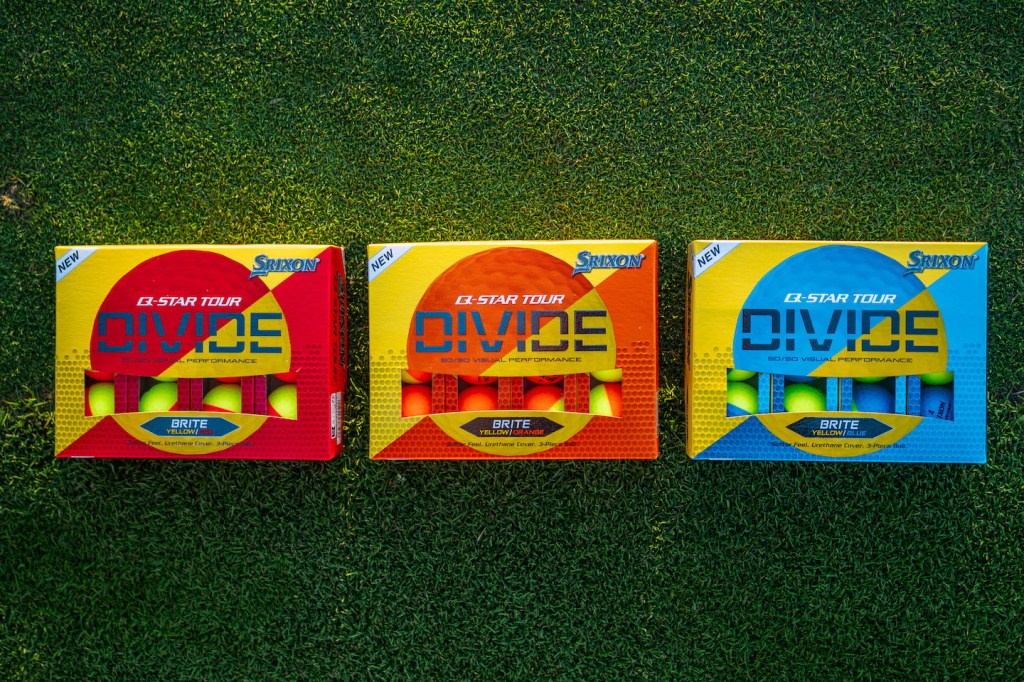
The Srixon Q-Star Tour Divide ($40/doz) are the half-and-half colored balls you have likely seen around and thought, “Why?” Well, I’ll give you three good reasons: One, they are EASY to see in the air, even with old-man eyes on overcast days. Two, they have a built-in alignment line for putting. If Dad is one of those players who draws a line on his ball to line it up with the hole when he putts – just skip the Sharpie. Three, even if Dad doesn’t want to play them, they are AMAZING for practice: the split-color design provides immediate feedback in putting and chipping – line, rotation, spin. (And then he can play with the white version, also $40).

Honma TW-S and TW-X

Honma, the biggest golf equipment company in Japan, has introduced a pair of Tour-quality golf balls to the US market in 2024: The TW-X and TW-S ($36/doz). Both sport a premium cast urethane cover that provides amazing spin performance on short irons, increased durability, and an extremely scratch-resistant surface. The TW-X and TW-S deliver exceptional feel shot after shot. Honma’s 326 Dimple construction was developed over a rigorous three-year design process. The 326 dimples are intentionally aligned with a certain size to withstand strong winds with mid/high trajectory. I’ve tested both of these extensively this year and love them. The S is softer and spinnier around the greens, with a higher ball-flight. The X has lower spin off the driver, and a more piercing ball-flight. Both are very responsive around the greens, but if I had to pick one for my game, it would be the X.

Bridgestone – so many options!

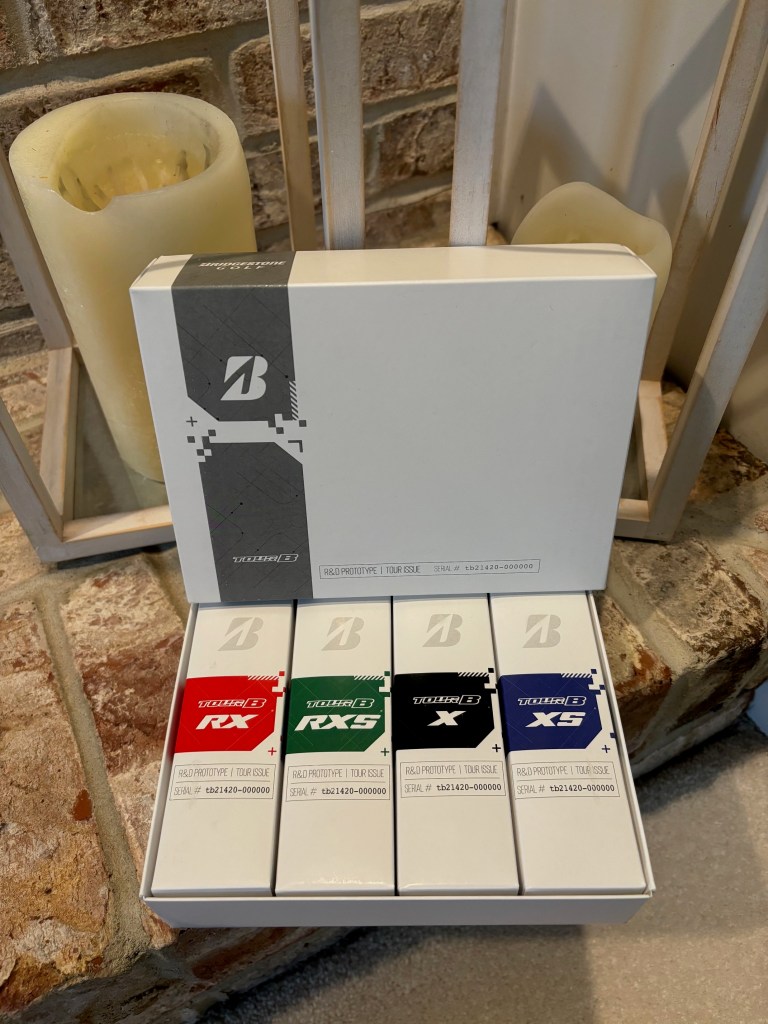
There is one golf ball company that is sort of the current heavyweight champion of the world. We all know its name, and we all know why. Its balls are outstanding. But there are plenty of challengers, including Srixon (above) and upstarts like Honma. If this were boxing, though, there would be one ball maker that would be ready to enter the ring for a title shot: Bridgestone. Bridgestone has multiple offerings at all price points for golfers looking for all sorts of features: Tour-grade performance, softness, distance, fun, budget, ladies – you name it, there’s a Bridgestone. I was able to test out all the 2024 Tour B ($50/doz) prototypes this year and was impressed by every one. Spin, control, distance – almost hard to tell them apart. Another big favorite of mine is the e12 Contact ($30/doz), whose dimples are designed to allow more clubface to contact the ball at impact. I can’t say for sure it’s not a gimmick, but I can say that every time I play the e12, I hit nearly every fairway. Could be coincidence, but it does build confidence!

TRUE Golf Shoes and Apparel

I’ll be honest: Golf apparel is really the best clothing and accessories I own. More thought goes into what I’m going to play golf in than into what I’m going to wear for a nice dinner out (much to my wife’s dismay). In fact, if I can wear the same clothes for golf AND for everywhere else, that’s ideal. TRUE Linkswear caters to golfers like me. From finely crafted shoes to hoodies to pants to flip-flops, TRUE carries just about everything for both men and women who want to look stylish on the links AND out and about before or after a round. I’ve got two pair of TRUE shoes (LUX OG Tour ($143-$205), LUX G ($175)), and I get more compliments on both than any other shoes I have. The detailing, down to the metal-capped aglets on one pair, is impeccable. The website has a shoe sizer for ease of reference, but they do run a tad small, so I’d recommend going up ½ a size. The Limited Edition Members Only collection includes a range of on- and off-course apparel and accessories that mix and match seamlessly no matter the occasion – perfect for that anniversary dinner! (Right, honey?)

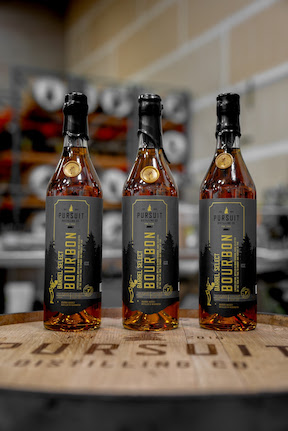
Dead Golfer Bourbon

Just this year, TRUE Linkswear has partnered with Washington state’s Pursuit Distilling Co. in creating a hand-selected, limited-edition, bottled-in-bond, 100-proof bourbon called Dead Golfer Bourbon. They’ll make just 438 bottles of this wonderful elixir, aged carefully for more than six years in American White Oak barrels. The Mash Bill is 72% yellow corn, 24% rye, and 4% specialty malt barley. You can order it directly at the link above for $105 a bottle.

The Payne Stewart Collection

Golf has its share of style icons, but few can match the late, great Payne Stewart. A new eponymous apparel line, the Payne Stewart Collection, will be debuting June 8, 2024, just in time for the U.S. Open at Pinehurst #2 (where Stewart won 25 years ago). Polos, quarter-zips, wind shirts, shorts and slacks, and, of course, the ubiquitous plus-fours and Hogan cap are part of the new collection. This line will be featured in the merch tents at the U.S. Open, but you can order yours online earlier!

 SuperStroke Putter Grips

Perhaps the best feeling in golf is feeling comfortable – and confident – on the greens. An essential part of achieving this blessed nirvana-like state is your putter grip. Your putter should feel so natural in your hands, that it’s like an extension of your body. SuperStroke Putter Grips ($30-$40) have in a very short time become ubiquitous on greens everywhere from local municipal courses to the PGA Tour, where it seems like the winner every week plays them. (By the way, SuperStroke just acquired the illustrious Lamkin Grips company, so if you play Lamkins, look for more innovation from that line, too.)

 Bushnell Wingman View

If Dad likes music on the course, there is one accessory that has become essential: The Bushnell Wingman. Bushnell’s newest version of the their revolutionary yardage-provider and speaker, the Bushnell Wingman, is the Wingman View ($200). The View incorporates visual yardages and music information on an integrated LCD screen, so if you want to play in silent mode, you can still get your yardages. And even if you don’t want music (or yardages) on the course, the Wingman serves as an excellent Bluetooth speaker anywhere (it’s not just for golf!).

Life on the Green by Ann Liguori

Iconic sports and golf broadcaster Ann Liguori works in the medium of the long-form interview like van Gogh worked in oil paints. Her award-winning cable series is called Sports Innerview precisely because of her ability to delve deep into the hearts and minds of athletes. Golf, being the mental game that it is, produces many deep thinkers, and Liguori’s interviews of golfers are some of her very best. In her new book, Life on the Green: Lessons and Wisdom from Legends of Golf (Hatherleigh Press, $18), she shares 12 interviews with some of golf’s all-time greats, from Jack Nicklaus to Annika Sorenstam. Each chapter is distilled down to a central lesson in the table of contents (e.g., Nancy Lopez: Stay positive and play happy golf), and the contents of each one make you appreciate both the interviewee and golf itself even more with every page.

You know, my kids give me a hard time because I tend to turn everything into a lesson. I love Liguori’s book because it reminds readers that, in fact, everything can be a lesson. And after individual memories and names fade, we can all hope that the lessons, at least, remain.

So happy Father’s Day, and may your lessons be passed on for many generations to come!

Cleveland Golf Launcher XL2 Driver is a Fairway-Finder

Golfers’ single-minded pursuit of distance at the expense of control reminds me of the way some people – mostly young people – drink the strongest booze possible, flavor be damned, just to “get there” faster. With age, one realizes that savoring a fine bourbon is more enjoyable than slamming shots of swill. And on the golf course, one learns that second shots from the middle of your fairway are more conducive to low scores than from rough, woods, and other fairways.

This is all to say that there is virtue in control. If your golf game is predicated on this axiom – or if your game could perhaps stand a skosh more virtue – the new Cleveland Golf Launcher XL2 Driver is worth a look.

Cleveland has long been known as a top-tier wedge- and putter-maker. In 2024, Cleveland has also debuted outstanding irons, with their ZipCore XL Irons and hybrids, with their XL Hy-Woods. Rounding out the XL line, the Launcher XL2 ($450) brings AI-assisted technology to the tee. The high-tech approach allowed Cleveland’s engineers to identify the spots on the face where amateurs tend to contact the ball (i.e., high/low, and heel/toe), and increase MOI in those regions of the face. This made for a 2% heel/toe MOI boost and a whopping 12% MOI boost on high/low contact. These numbers translate into less yardage lost on off-center hits.

Playing the Cleveland Launcher XL2 Driver

What does this AI-driven design look like on the golf course? I took the Launcher XL2 out for several rounds early this season, when my swing usually feels rusty and fairways feel like foreign lands. Much to my surprise, and delight, I found myself hitting my second shots from short grass at a far higher rate than normal for the time of the season. In fact, I would have been very pleased with the number of fairways hit in every one of these test rounds mid-season. Was it that my swing had somehow weathered the winter better than usual? I don’t think so, because several swings felt cringingly awkward. Still, off went the ball into the fairway.

Don’t get me wrong, there were still a few pulls and pushes – the Launcher XL2 isn’t a cure-all. It must also be said that when it came to “pop” resulting from my best swings and contact, the results were somewhat less than anticipated. Several drives – in admittedly cooler and wetter conditions than normal – ended up about 10 yards shorter than I would have otherwise expected. The XL2’s Rebound Frame technology produces two flex zones for concentrated power, so power wasn’t lacking, per se, but it felt like contact was just a bit soft. This said, the off-center hits ended up about where I would have expected them to. So it was overall a reasonable trade-off.

Here’s where we return to the opening reflection on distance and control: Despite often being first to hit in the foursomes of much younger players than me, I was also often the only one in the fairway, the only one to hit the green, and the one with the lowest score. Ah, the joys of sipping over taking shots.

The verdict on the Cleveland Launcher XL2 Driver

My testing of the Cleveland Launcher XL2 left me extremely impressed with the control it provides. The cool, wet, early-season conditions (and my advancing age) may have been detrimental to its distance performance in my rounds. However, even if there is any lack of “pop,” the ultimate value of a dependable fairway-finder cannot be overstated. If you happen to struggle with a slice, there is also a draw version, and if you REALLY want to go all-in for control, there is a custom control version with a shorter custom shaft.

In short, if you pair this solid big-stick with Cleveland’s excellent irons, hybrids, wedges, and putter, you’ll have a bag top-to-bottom that will allow you to savor every hole, tee to green.