
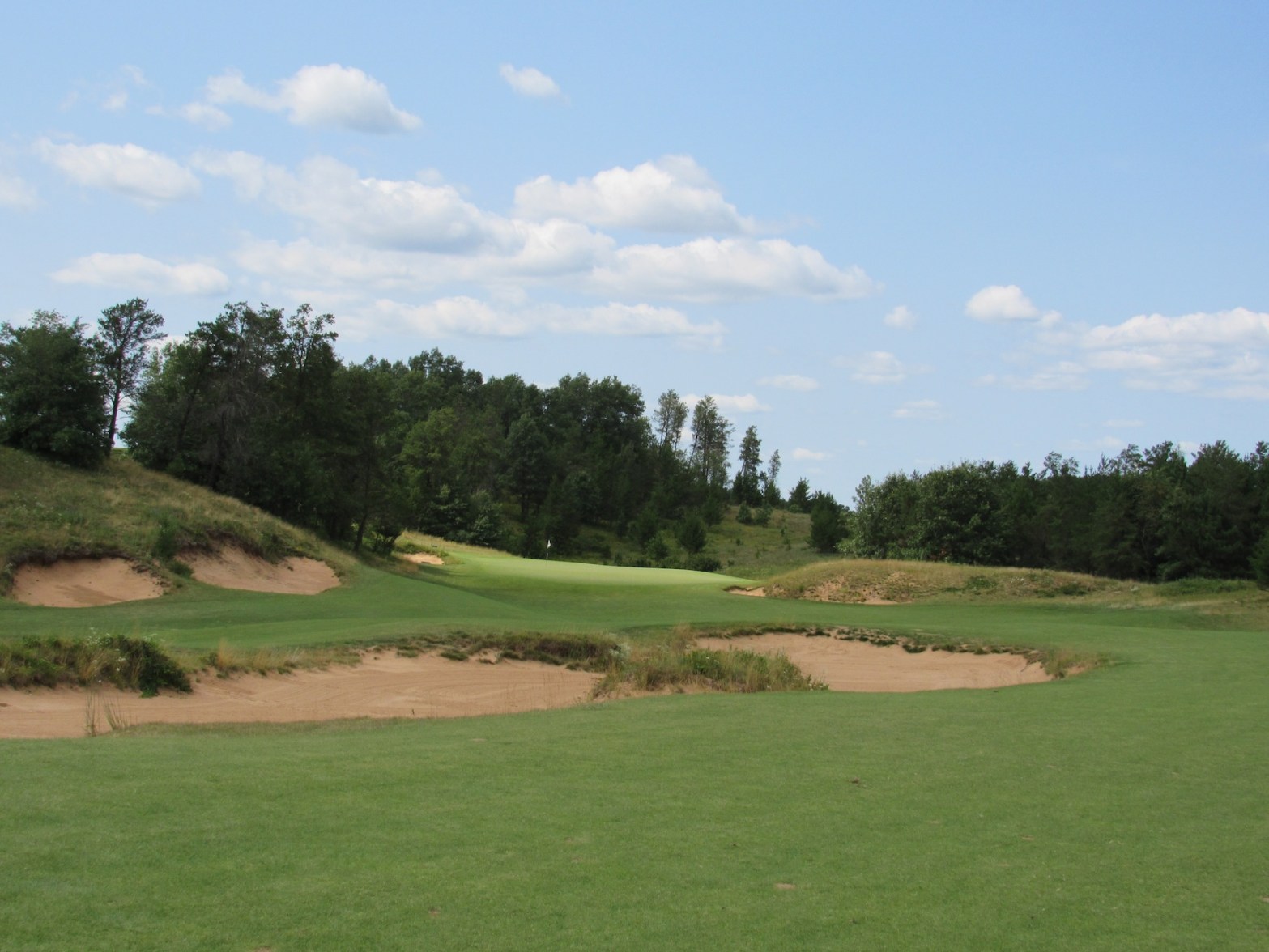
Bill Coore and Ben Crenshaw have made a handsome career for themselves designing golf courses following a “Minimalist” philosophy. Hand these two artists a topographically interesting and well-drained canvas, and they will deliver a masterpiece. Sand Hills Golf Club in Nebraska, Streamsong Red in Florida, and both Bandon Trails and The Sheep Ranch at Bandon Dunes are prime examples of canonical Coore & Crenshaw designs.
At Sand Valley Golf Resort, 90 minutes north of Madison, Wisconsin, the Keiser family – of the Bandon Dunes Keisers – handed the minimalist magicians a geological palette that perfectly suited their aesthetic: acre upon acre of seemingly endless sand and rolling dunes blanketed in fescue. Central Wisconsin was gifted these features by a massive glacial lake that formed at the end of the last Ice Age and subsequently drained, leaving behind its sandy bed.
Today Sand Valley Golf Resort encompasses some 12,000 acres of ideal inland linksland and six golf courses (so far). The first of these was Sand Valley, namesake of the resort itself, and one of Coore & Crenshaw’s best to date.
Playing Sand Valley
When I first arrived at Sand Valley, I was introduced to PGA Professional Jacob McLish, who provided me with some background on the course and some comparisons to the others on the property. “Sand Valley is the most challenging of all six courses,” he said. “There are more elevation changes and forced carries, especially from the championship tees. When we hold state or national tournaments, they’re played on Sand Valley or on a combination of The Lido [the resort’s newest, semi-private course] and Sand Valley.” Notably, Sand Valley has been chosen to host four upcoming USGA amateur championships, so the venue is certainly building its reputation.
Like all courses at the resort, Sand Valley is walking only (unless one has a medical exemption), and it, again like the other courses, is perfectly walkable, despite some impressive elevation changes. Caddies are encouraged ($100 + gratuity) but not required. Players can avail themselves of complimentary pullcarts or bring their own. For the uninitiated, however, caddies are extremely helpful in identifying lines off the tee, especially here, where fairways and greens have a lot of movement to them, and balls landing in unfortunate locations are prone to trundle off into sand or other trouble.
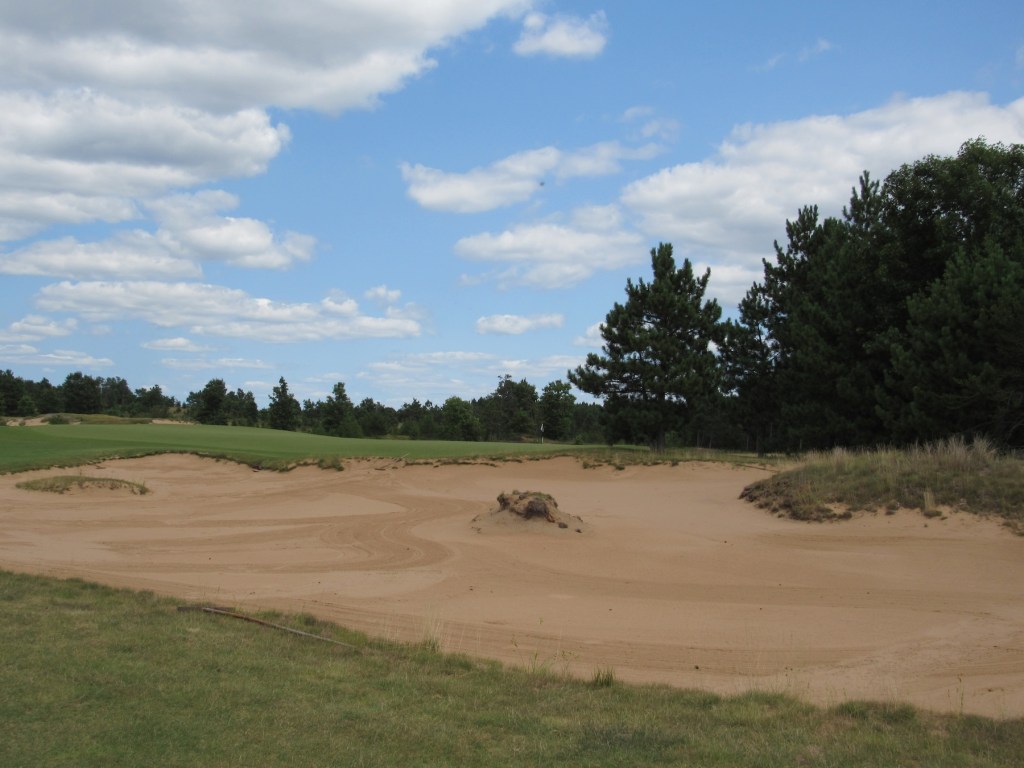
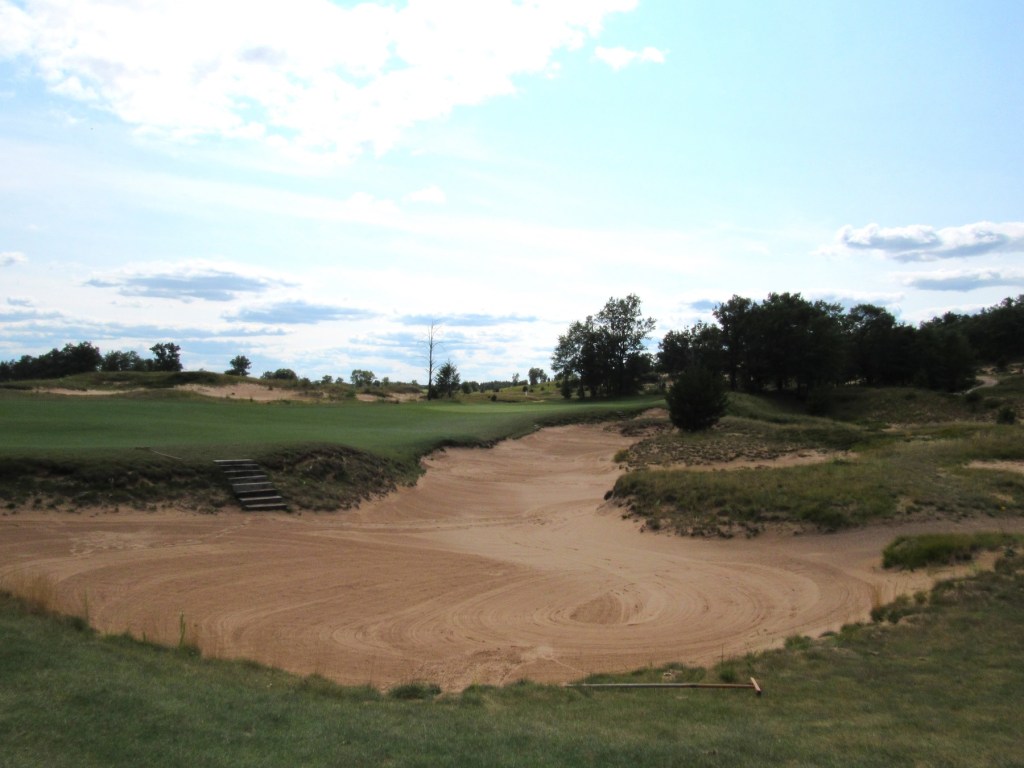
Oh, and the sand – it’s not just a marketing gimmick. I asked one of the caddie masters how many bunkers were on the course, and he just laughed at me. Once I stepped foot onto the links, I realized why: The sand is EVERYWHERE. Fortunately, all sand is played as waste area, so there’s no penalty for grounding your club. Unfortunately, the sand is really quite deep – like, over the tops of your shoes deep – and very fine. So learning how to hit out of it is a challenge. I have never left so many balls in bunkers in my life.
Sand Valley’s 1st and 10th tees are perched on a hillside below Craig’s Porch, which serves as starting area and halfway house. (The $1 tacos should not be missed.) Here, as at the resort’s two other 18-hole courses, tee times are spaced 10 minutes apart, with a 10-minute “starter time” built in once per hour. This ensures comfortable spacing between each wave of five groups. And, as the caddie master explained, all caddies carry GPS trackers so pace of play can be monitored and addressed quickly, containing most slowdowns within the five groups.
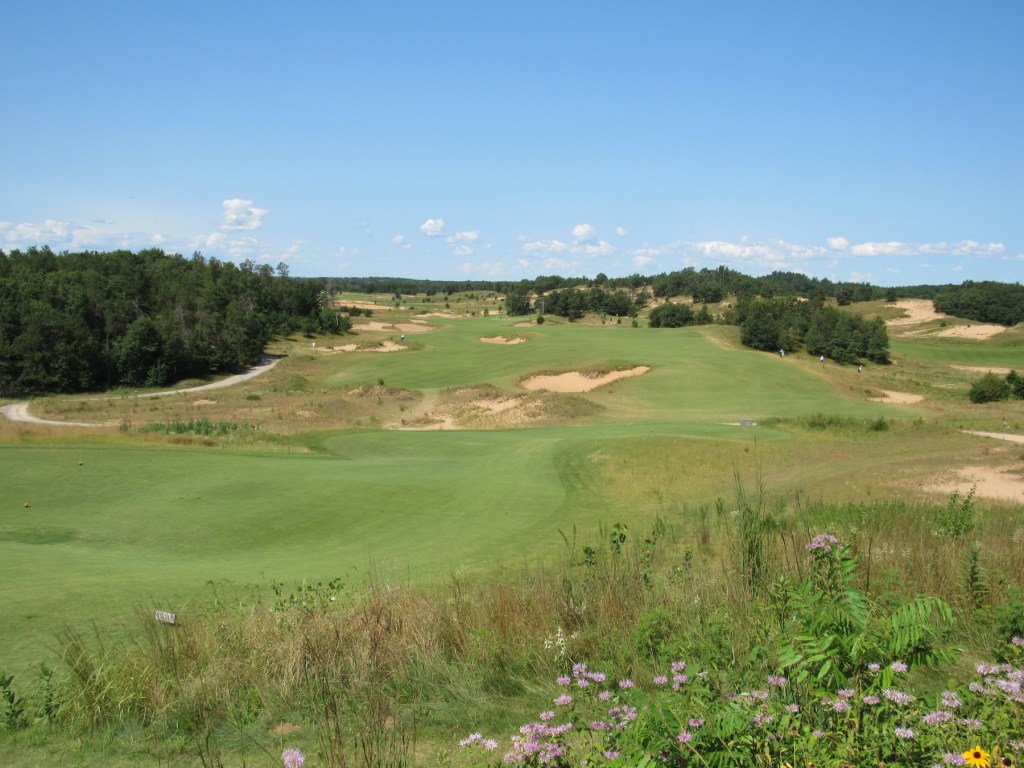
The course has six sets of tees, and four sets of combo tees, allowing golfers of all skill levels to find a comfortable yardage between 3,871 and 6,959 yards. Because of the elevation changes and the usually swirling winds, all the courses tend to play longer than the scorecard suggests. The par of 72 here is composed of a par-35 frontside and a par-37 backside, reminiscent of Streamsong Red, where the front is also significantly shorter than the back.
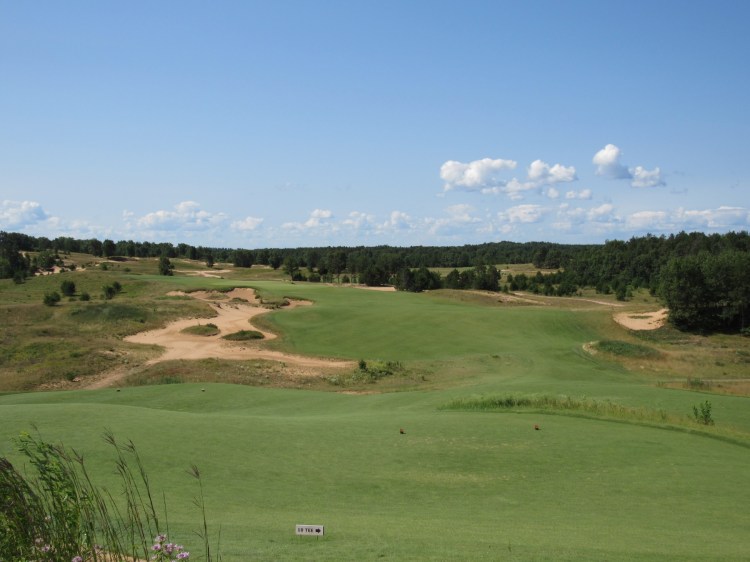
The front side starts off relatively benignly with a short par 4. The second shot here is key, as the elevated green has a severe false front that can deliver short approaches back to a player’s feet. The starter rather gleefully described an earlier group, whose long-hitter was just 30 yards short of the green off the tee but then proceeded to take three subsequent shots to get his ball to stay on the putting surface. The long par-3 3rd (216 yards from the tips) will get every player’s attention, though, with a severe right-to-left slope that requires exacting precision off the tee.
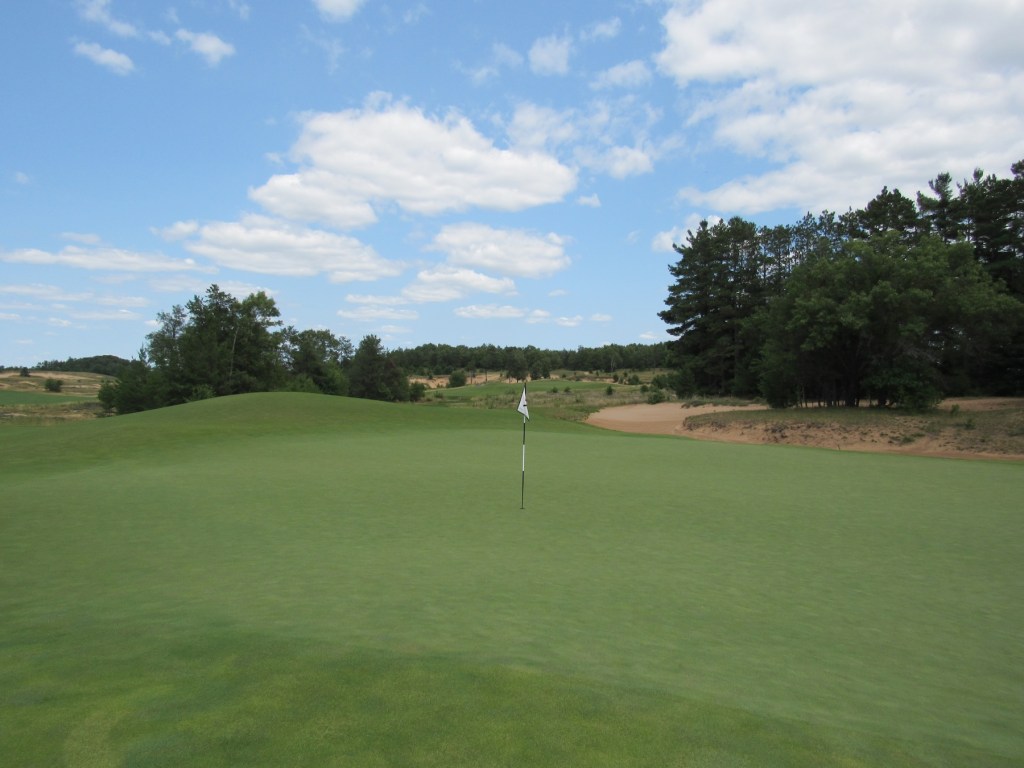
Depending on the wind direction, and the tees chosen, all 5 par 5s are reachable with good drives. The 10th and 12th holes in particular offer the best eagle opportunities, but all the long holes are birdie opportunities. The par 3s are very memorable, including the 171-yard 5th, that plays downhill some 40 feet. The 197-yard 14th, however, might be the prettiest short hole here.
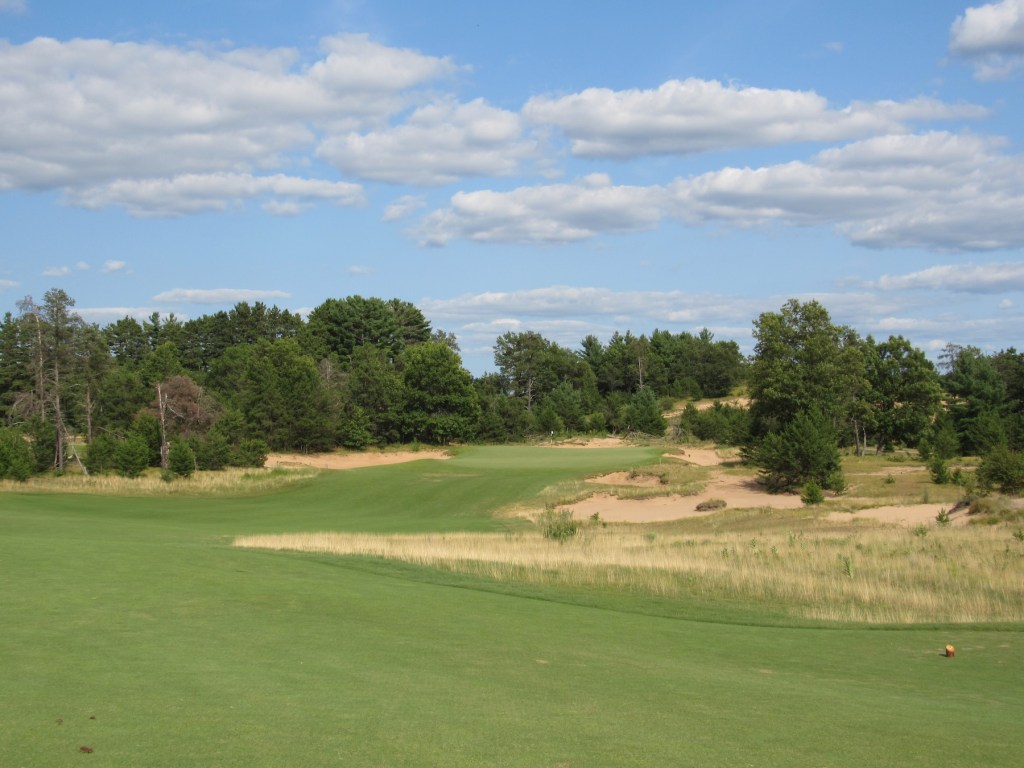
The fescue greens are immaculate, firm, and relatively speedy. Because of the fescue turf, the grain figures prominently in estimating both pace and break. This said, none of the greens felt particularly difficult to read – here or on any of the other courses I played. Moreso than many places where caddies are recommended, I found my reads and theirs to be identical nearly every time. The fescue fairways are simultaneously somewhat hairy yet also present players with very tight lies.
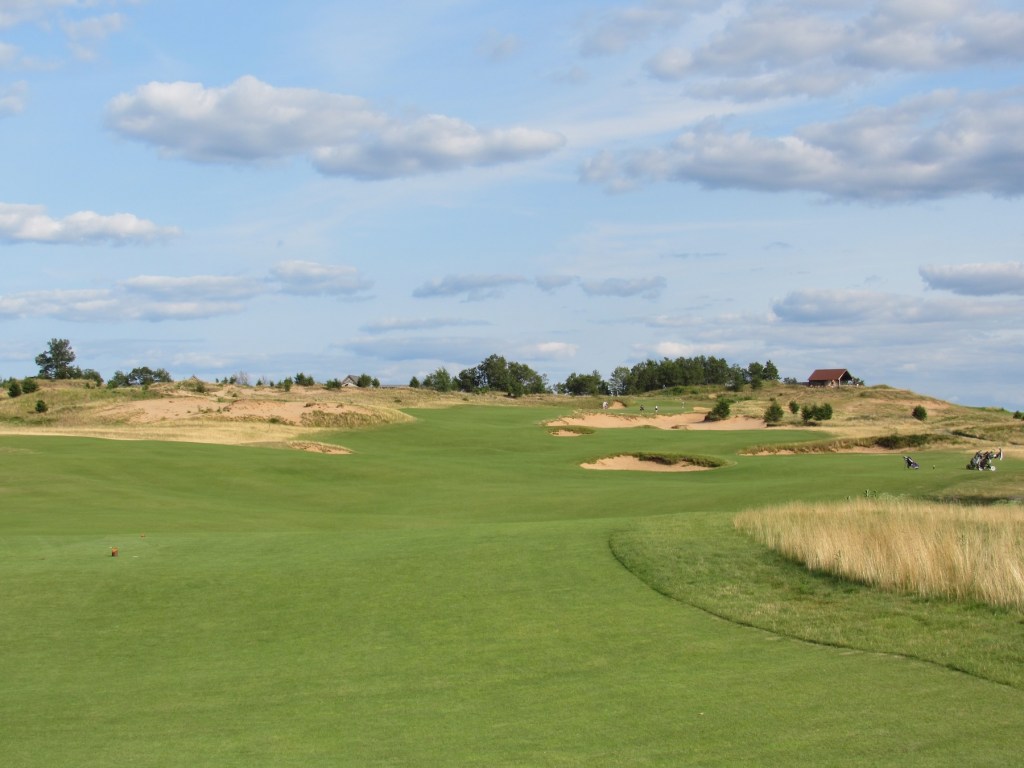
Sand Valley: The verdict
Coore & Crenshaw definitely have a “signature” minimalist style, and at Sand Valley, it is displayed prominently. The hallmark sand is everywhere; bunkers are wide, deep, and penal. There are also plenty of pot bunkers, along with bunkers with densely scrubby little pock-marked hummocks in them. Woe to the golfer whose ball ends up on one of these instead of in the sand! (Woe to me, in particular.) These sandy pits of despair cost me easily 8 strokes when I played. So the best advice is to avoid them.
Sand Valley presents a stern challenge compared to Mammoth Dunes, which is more of a resort course (with player-friendly banking and fairways wider than a football field). But it is certainly not unfair; most of the trouble is in full view out in front of you. Like any links course, however – seaside or inland – balls roll out and find unexpected trouble. Similarly, the fairways and greens resonate with that satisfying hollow sound when you thump them with your club – a sound that only many feet of sand underfoot can create. All Coore & Crenshaw had to do was scrape off the topsoil a bit to reveal the natural golf course beneath.
 Midwestern Golf
3 thoughts on “Sand Valley anchors the growing Sand Valley Golf Resort”