The term “resort course” is often used to describe certain golf courses. But I’m willing to wager that most casual golfers don’t know what the label denotes, aside from “a golf course at a resort.” There’s only part of it.
Resort courses – good resort courses – share certain features: wide fairways, visible hazards, minimal forced carries, contouring that tends to keep balls in play or at least findable, greens that are not overly difficult to read. The common thread across all these characteristics is that a good resort course should be able to be played and ENJOYED by golfers of all levels the first time out. Resort guests usually don’t have extensive local knowledge – they’re just visiting.

Sand Valley Golf Resort’s Mammoth Dunes, which opened in 2018 to universal acclaim, is a prototypical example of a “resort course.” Golf course architect David McLay Kidd went all-in on the motto “working for the golfer” in designing the layout, which follows a natural V-shaped ridgeline running through the 400+ acre course footprint.
McLay Kidd, who designed the inaugural Pacific Dunes course at the Keiser family’s Bandon Dunes, had a bit of an epiphany in the late 2000s He realized that the courses he was building were becoming too difficult for recreational golfers. On a 2009 visit to Bandon, he heard from caddies that the average score on Pacific Dunes was 100, which is not particularly enjoyable for guests who have spent thousands of dollars on a golf vacation.
So, when Mike Keiser, Jr. asked McLay Kidd to design Sand Valley’s second course, he vowed to ensure that players would enjoy their round. Golf is supposed to be fun, after all.
Playing Mammoth Dunes
The first thing I asked Sand Valley golf professional David McLish about Mammoth Dunes was whether they had actually uncovered any mammoth fossils while constructing the course. “We didn’t,” he admitted, “but we discussed, briefly, putting a few fossils around the clubhouse to build the myth.” Rather, the course moniker comes from the sheer size of the layout: the fairways, greens, and acreage of the course are all, well, mammoth in scale.
Let’s put this in perspective. One caddie recounted how a guest teed off on the first hole of Mammoth Dunes and missed the fairway by quite a lot. “A 100-yard wide fairway, and I can’t hit it,” the player lamented. The caddie responded, “To be honest, it’s 130 yards.”
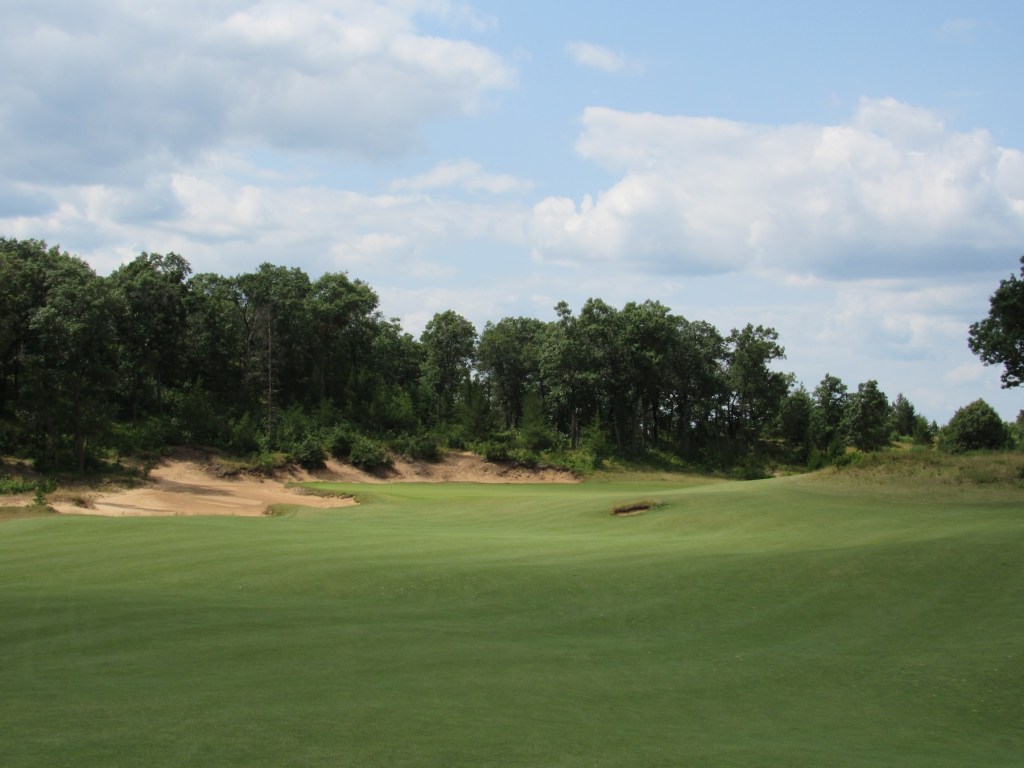
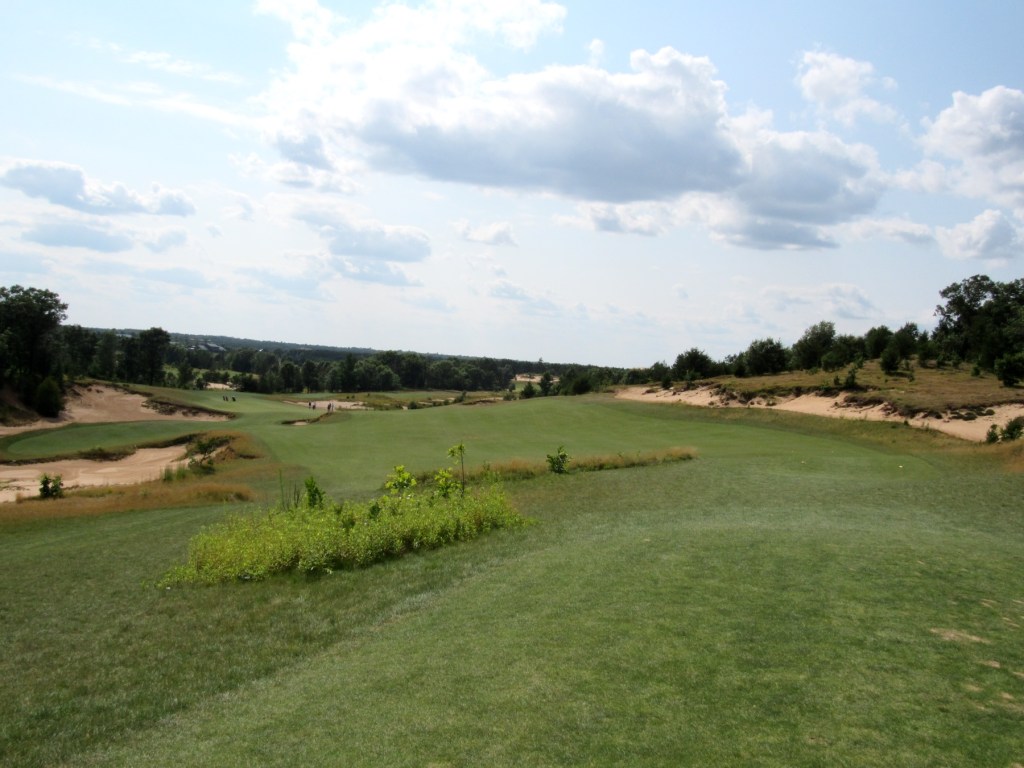
First-time visitors will be awed immediately by the enormity of the fairways. That 130-yard wide, 419-yard long 1st Hole is not an outlier. In fact, the majority of fairways on Mammoth Dunes are around 100 yards wide. Greens, likewise, are massive, but not crazily contoured. As a result, approach shots landing away from the pins can leave 80-foot putts that are, paradoxically, not overly hard to read, if not putt. Take the short par-4 6th as an example. The green here is shaped like a concave boomerang, where approaches on the proper line funnel toward the pin. Approaches unlucky enough to find the wrong end of the boomerang, however, might not leave any line at all to the hole.
Measuring 7,063 yards from the tips, Mammoth Dunes, like the original Sand Valley course, has six sets of tees (forward tees: 4,064 yards), and four sets of combo tees. The Orange-Sand combo (6,346 yards) is a solid choice for low double-digit or high single-digit handicappers. Although staff will tell you Mammoth Dunes has “no forced carries,” there are a few, especially off the 2nd tee, where even from the Sand tees, the preferred angle on the right side demands a 180-yard carry to the fairway over – you guessed it! – a vast expanse of sand.
Par is an atypical 73, thanks to three par 5s on the back nine. The 558-yard 18th is one of those that will either ice the cake of a great round or leave a bitter taste in your mouth. The huge green, perched on a hillside below the clubhouse, is fronted by a wide bunker that is also some 15 feet deep. I had two chances on two different days to stick my third shot close and finish with a birdie, but instead thinned both approaches into the bunker and had to scramble to get up and down for bogeys.

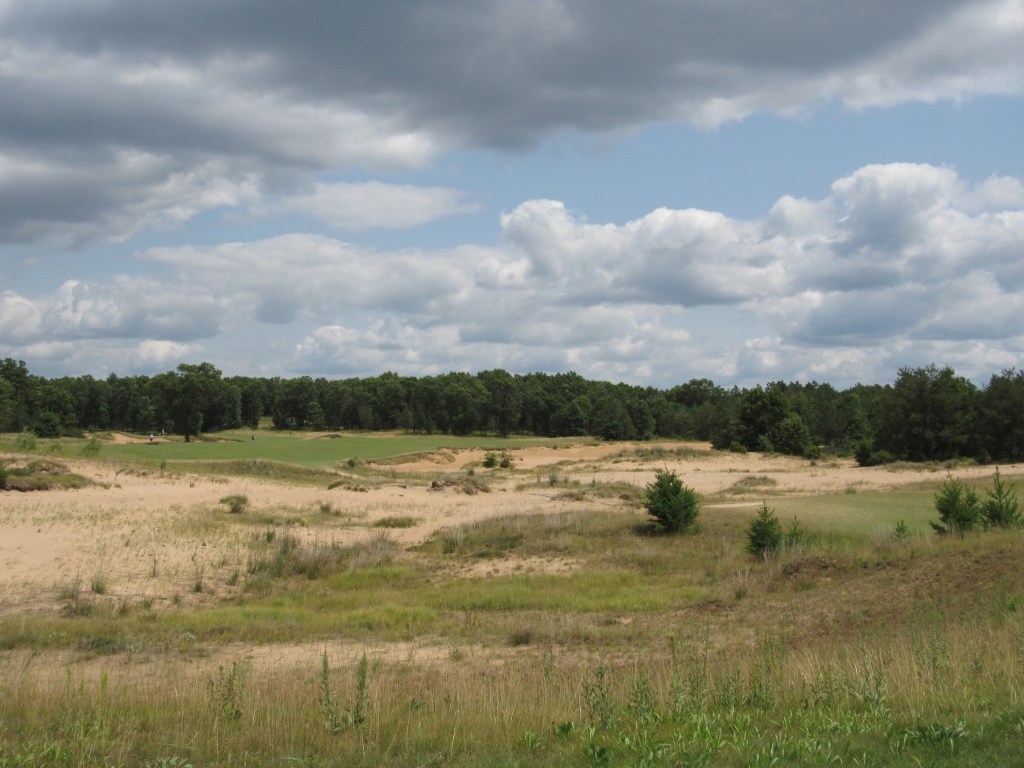
But I am getting ahead of myself. All the par 5s – indeed, all the holes here – are memorable. It is extremely rare for a course’s par 5s to be ranked as the hardest holes. Here, the #1, #2, #3, #4, and #6 handicap holes are the five par 5s. (The 457-yard, uphill par-4 5th Hole is ranked fifth hardest, for very good reason.) What makes the par 5s so difficult when the fairways are so generous? The word that keeps appearing in my notebook is “snaking” – all of them slither their way through, between, and around swaths of sand bunkering and waste areas. (FYI, all sand at Sand Valley plays as waste area – so no worries about grounding your club or removing obstacles.)
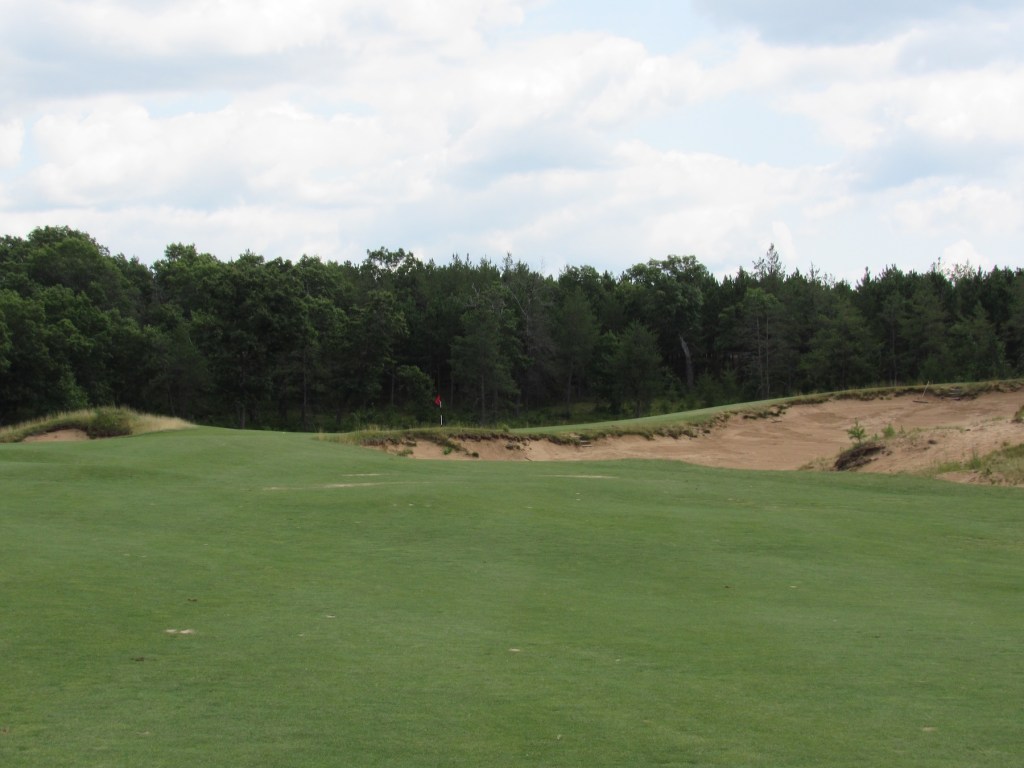
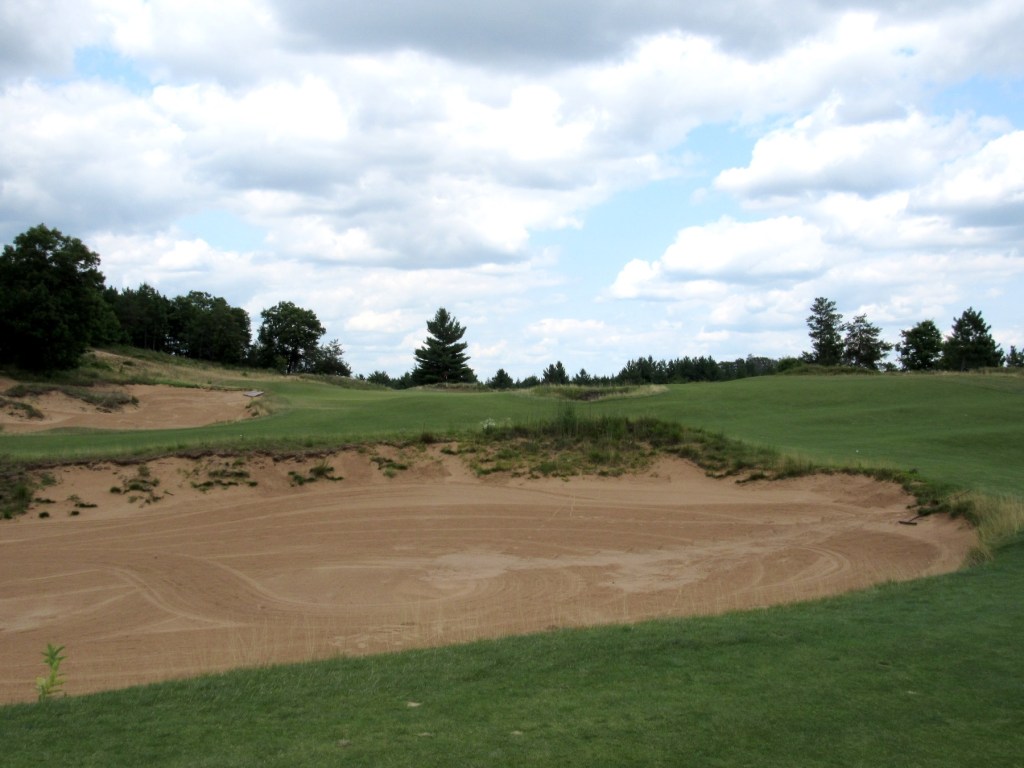
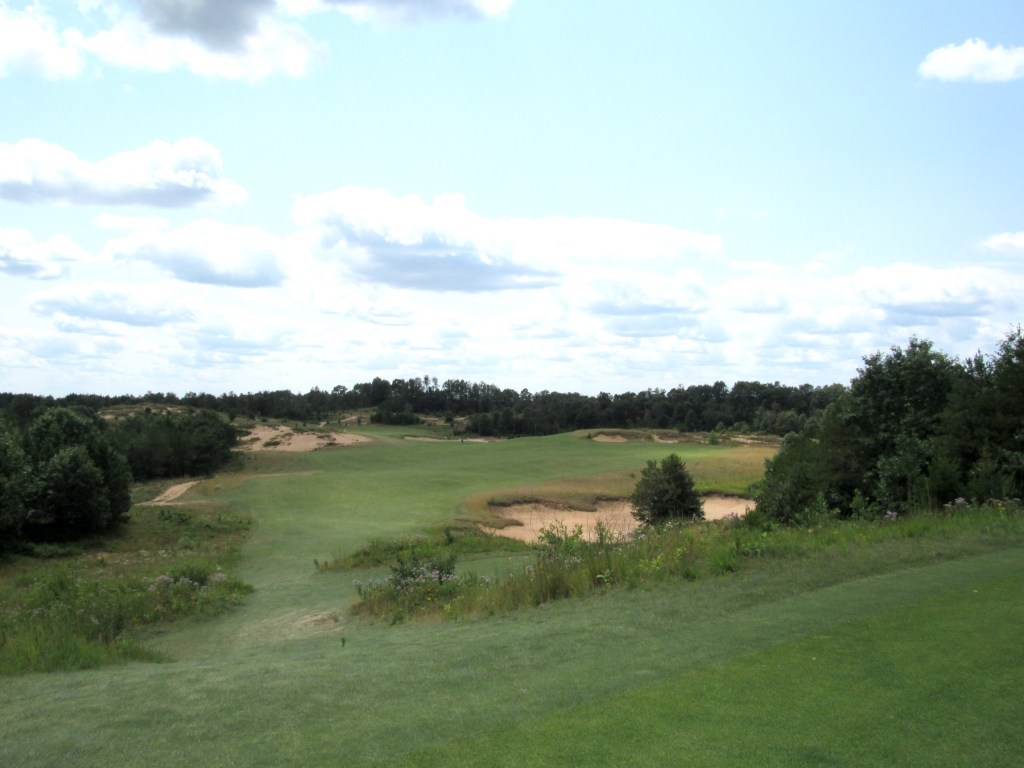
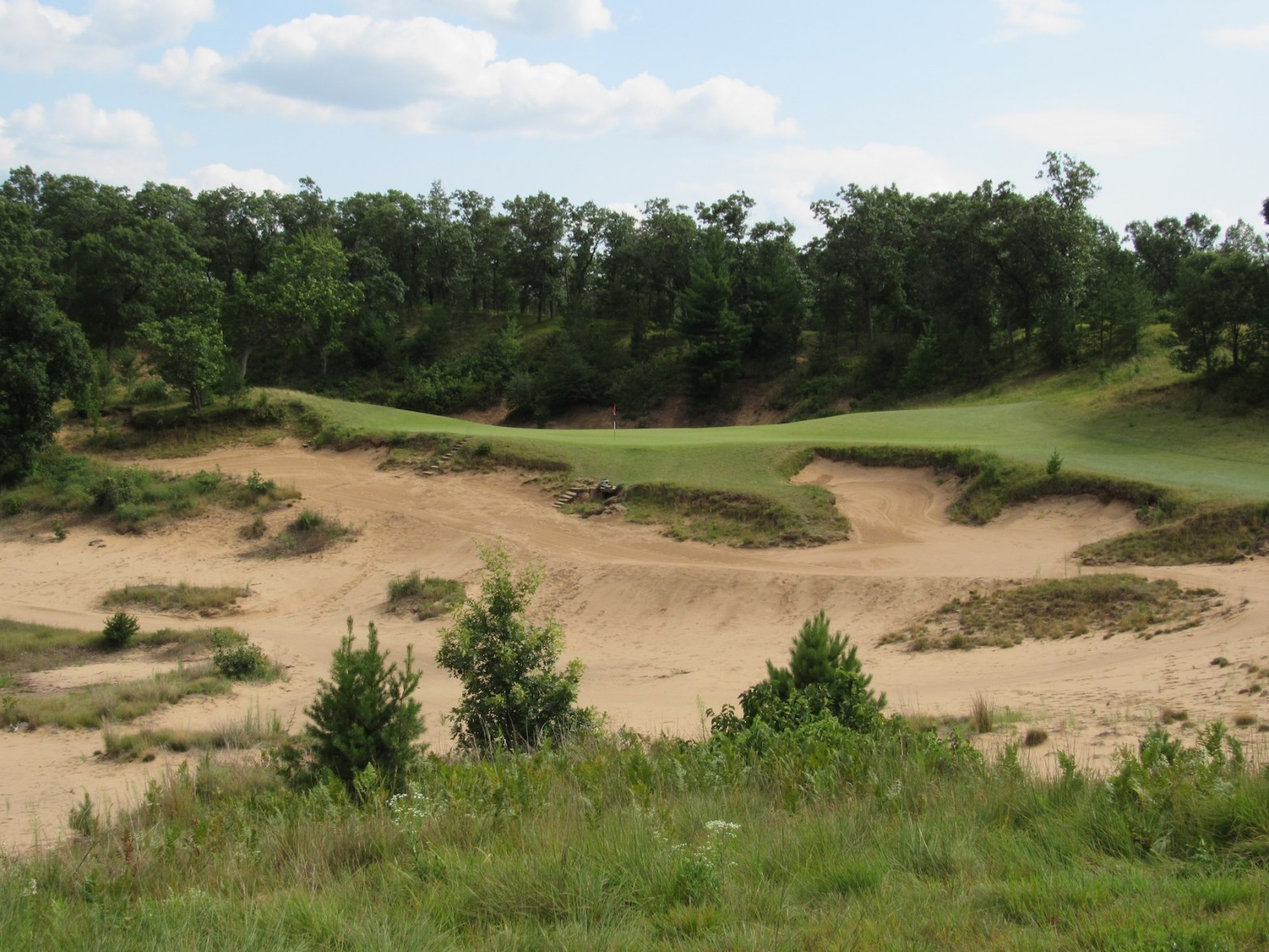
The par 3s, on the other hand, rank as the #15, #16, #17, and #18 handicap holes. Now, these are all absolutely lovely holes, beautifully framed by sand and hillsides. The fact that they are all birdie opportunities is a huge “resort course” bonus. I will say, however, that 146-yard 13th Hole, with its tee shot that must carry a deep ravine and sandy pit of despair, does not in any way feel like an easy hole, despite its diminutive length. (Until you make a 60-foot birdie putt, ahem.)

Perhaps it is at the par-4 14th hole where McLay Kidd’s focus on enjoyability really shines. This 323-yard hole brings the winning design of Golf Digest’s Armchair Architect contest to life. Brian Silvernail was the winning amateur architect, and the hole he created is pure fun. The green sits well below the tees and only the middle to back portions are visible. The ideal drive will crest the hill on the right side of the fairway with a slight draw and run down to the putting surface, invisible for much of its journey, until – if you’re lucky – you see it trundle across the putting surface. Too far right is a hazard, too far left are bunkers. Take the right line, and you can focus on draining the eagle putt.
Mammoth Dunes: The verdict
Our caddie for four days, Remington (who, I must say, was a real pistol – bah-dum-tssshhhh!), told us during our first round on Mammoth Dunes that it is the favorite of just about every guest at Sand Valley. We were very glad we had two rounds booked on it, because it was our unanimous favorite, too. All four of us carded improved scores the second time playing it, including my own personal low round of the season so far. This result is simply unheard of on most unfamiliar courses, even if they are “resort” courses. But when the fairways are so wide that you don’t lose any balls, and the greens are perfectly conditioned, not overly fast, and straightforward to read, it is possible – if you just avoid the omnipresent sand.
Since its opening, Mammoth Dunes has been consistently ranked in the top 30 public courses in the U.S. Is it the longest? No. Is it the hardest? No. Is it the most fun? Maybe! McLay Kidd succeeded in delivering a visually exciting, architecturally inspiring, immensely memorable course that serves as the centerpiece for what might just be the Midwest’s premier golf resort.